







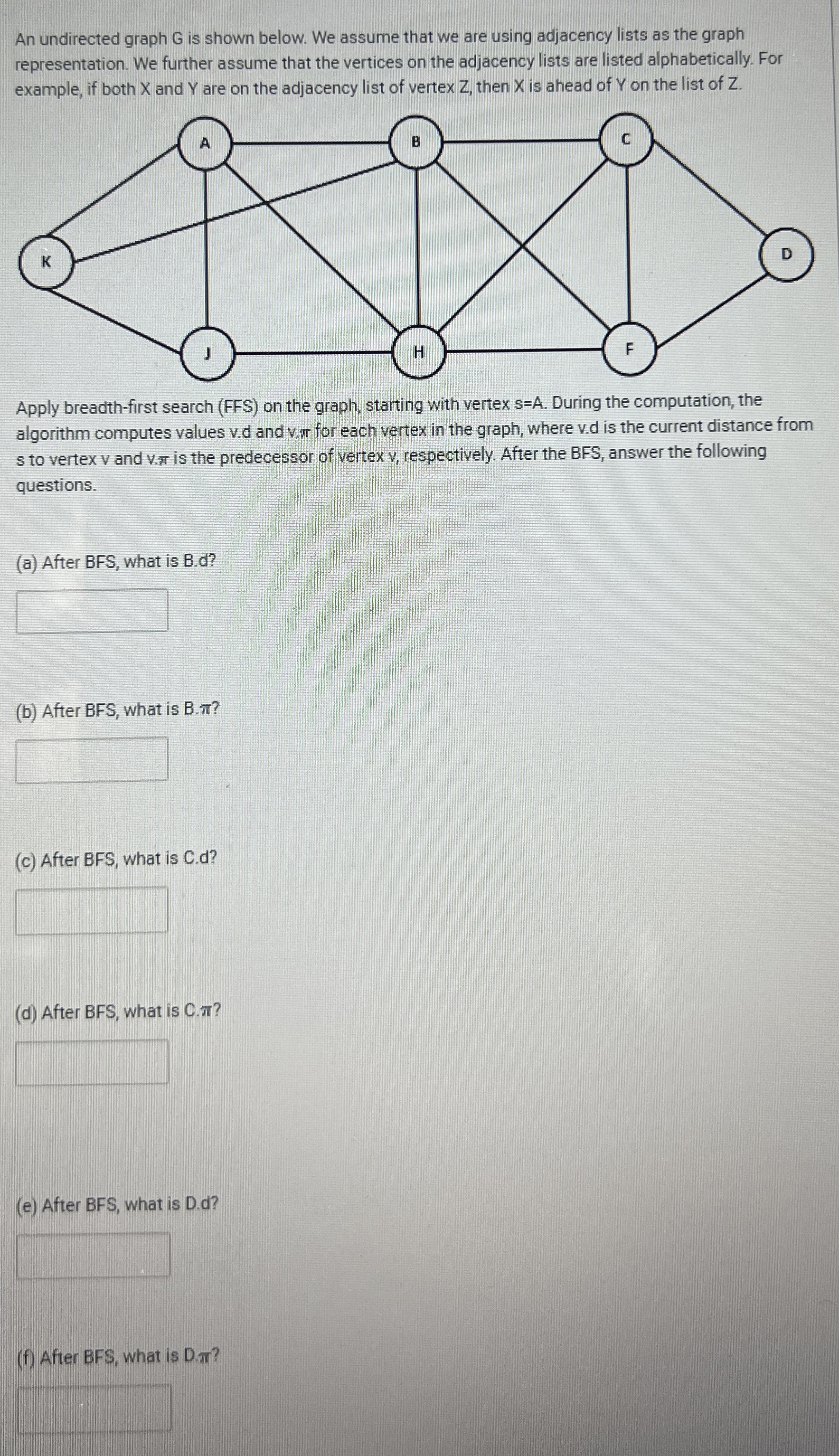
Question: An undirected graph G is shown below. We assume that we are using adjacency lists as the graph representation. We further assume that the vertices
An undirected graph is shown below. We assume that we are using adjacency lists as the graph representation. We further assume that the vertices on the adjacency lists are listed alphabetically. For example, if both and are on the adjacency list of vertex then is ahead of on the list of
Apply breadthfirst search FFS on the graph, starting with vertex During the computation, the algorithm computes values vd and : for each vertex in the graph, where vd is the current distance from to vertex and is the predecessor of vertex respectively. After the answer the following questions.
a After BFS what is Bd
c After BFS what is Cd
d After BFS what is
e After BFS what is Dd
f After BFS what is
Step by Step Solution
There are 3 Steps involved in it
1 Expert Approved Answer
Step: 1 Unlock

Question Has Been Solved by an Expert!
Get step-by-step solutions from verified subject matter experts
Step: 2 Unlock
Step: 3 Unlock
 Study Help