Question: Analyzing the case study focusing on how the organization changed its structure to achieve its goals. Make sure that your analysis covers, but not limited
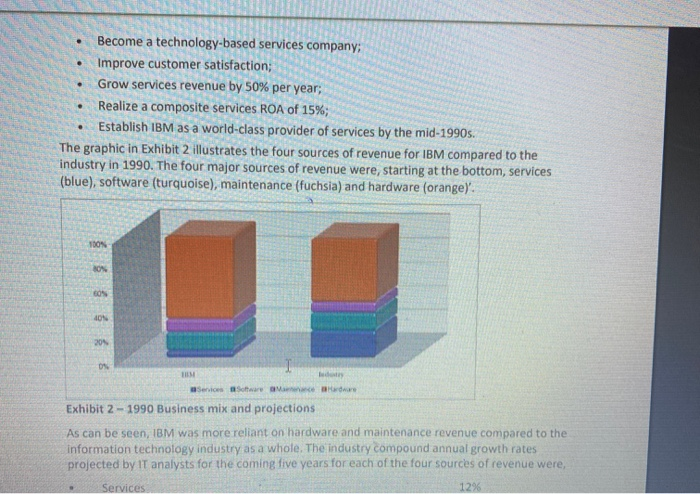
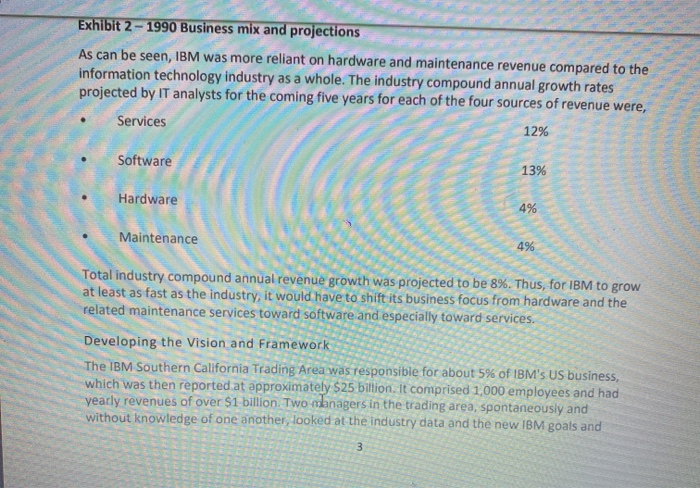
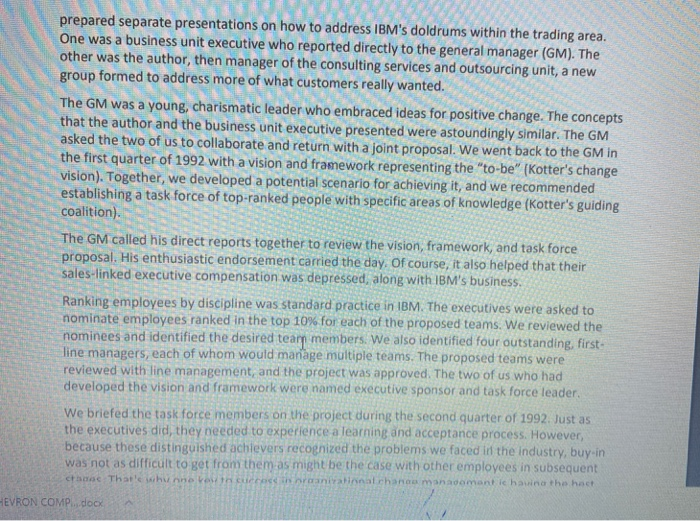
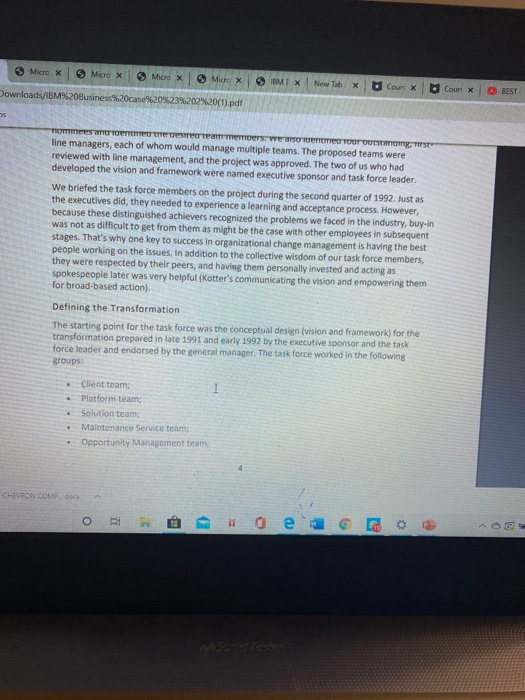
Analyzing the case study focusing on how the organization changed its structure to achieve its goals. Make sure that your analysis covers, but not limited to, the following questions: 1. What are the change challenges for IBM? Use concepts learned in Lesson 8. 2. What is your assessment of the change approach that IBM used? Use concepts learned in Lesson 8. 3. Identify needed changes in organizational structure that were required to support changes in IBM strategy. Use concepts learned in Lesson 8. 4. Based on what you learned in this course, what are your reflections on IBM's approach to change? a. illustrate how IBM new organization structure contributes to strategy. b. Apply the concept of organization life cycle to IBM. Use concepts learned in Lesson 7 agement Model in slide 33 in lesson 8 CONFERENCE PAPER Change Management Bivins, Susan S. How to cite this article: Bivins, S. S. (2014). A transformational change at IBM. Paper presented at PMI Global Congress 2014--North America, Phoenix, AZ. Newtown Square, PA: Project Management Institute. Introduction Back in the early 1990s, IBM was in trouble. Its sales force was selling hardware when customers wanted solutions; it was posting losses instead of profits; and, for the first time, lifetime employment was replaced by downsizing initiatives. Some executives realized IBM needed to transition from selling hardware to providing services, but that transition had not yet begun. This paper addresses an organizational change management project implemented in one geographic area in the early 1990s to transform part of IBM from selling hardware to delivering solutions, Although it happened a while ago, the project still exemplifies the elements of successful transformational change. Despite the passage of time, the people aspects of change remain the same. The project redefined the strategy in one geographic area, turned the strategy into tactics, and incorporated a new opportuity management process that looked a lot like an early form of portfolio management. This paper discusses the organizational approach, processes, and management systems developed to transform the business from selling hardware to delivering customer solutions. It contains no confidential IBM information. The author is now retired from IBM; everything written represents her own views rather than IBM's. This is the true story of a major change initiative in a large company and identifies some common elements needed for successful organizational change. Recognizing the Need to Change Recognizing the Need to Change Let's go back to a time when IBM was struggling. At the time, the IBM field force was organized into geographic trading areas with industry-oriented branch offices. Its customers were supported by local branch office teams that were focused on selling hardware infrastructure to customer IT directors. The customer senior executives, though, were looking for business solutions. IBM found itself in an increasingly commoditized business, with little investment in the high-growth sectors of the technology industry. The mood in 1BM was somber, both in headquarters and in the field. Thousands of employees were given packages to leave. The chairman was stepping down, and the new CEO had not yet arrived. As hard as change is, most people knew we needed to change. We didn't have the benefit of all the research about transformational change, but we knew that IBM needed to move in a new direction. Recognizing this, IBM's sales and marketing goals as stated at the time were: . . Become a technology-based services company; Improve customer satisfaction; Grow services revenue by 50% per year; Realize a composite services ROA of 15%; Establish IBM as a world-class provider of services by the mid-1990s. The graphic in Exhibit 2 illustrates the four sources of revenue for IBM compared to the industry in 1990. The four major sources of revenue were, starting at the bottom, services (blue), software (turquoise), maintenance (fuchsia) and hardware (orange)'. NOON SON GON HON 20N ON I Services are creare Exhibit 2 - 1990 Business mix and projections As can be seen, IBM was more reliant on hardware and maintenance revenue compared to the information technology industry as a whole. The industry compound annual growth rates projected by IT analysts for the coming five years for each of the four sources of revenue were, Services 1296 Exhibit 2 - 1990 Business mix and projections As can be seen, IBM was more reliant on hardware and maintenance revenue compared to the information technology industry as a whole. The industry compound annual growth rates projected by IT analysts for the coming five years for each of the four sources of revenue were, Services 12% Software 13% Hardware 4% Maintenance 4% Total industry compound annual revenue growth was projected to be 8%. Thus, for IBM to grow at least as fast as the industry, it would have to shift its business focus from hardware and the related maintenance services toward software and especially toward services. Developing the Vision and Framework The IBM Southern California Trading Area was responsible for about 5% of IBM's US business, which was then reported at approximately $25 billion. It comprised 1,000 employees and had yearly revenues of over $1 billion. Two managers in the trading area, spontaneously and without knowledge of one another, looked at the industry data and the new IBM goals and 3 prepared separate presentations on how to address IBM's doldrums within the trading area. One was a business unit executive who reported directly to the general manager (GM). The other was the author, then manager of the consulting services and outsourcing unit, a new group formed to address more of what customers really wanted. The GM was a young, charismatic leader who embraced ideas for positive change. The concepts that the author and the business unit executive presented were astoundingly similar. The GM asked the two of us to collaborate and return with a joint proposal. We went back to the GM in the first quarter of 1992 with a vision and framework representing the "to be" (Kotter's change vision). Together, we developed a potential scenario for achieving it, and we recommended establishing a task force of top-ranked people with specific areas of knowledge (Kotter's guiding coalition) The GM called his direct reports together to review the vision, framework, and task force proposal. His enthusiastic endorsement carried the day. Of course, it also helped that their sales-linked executive compensation was depressed, along with IBM's business. Ranking employees by discipline was standard practice in IBM. The executives were asked to nominate employees ranked in the top 10% for each of the proposed teams. We reviewed the nominees and identified the desired team members. We also identified four outstanding, first- line managers, each of whom would mariage multiple teams. The proposed teams were reviewed with line management, and the project was approved. The two of us who had developed the vision and framework were named executive sponsor and task force leader. We briefed the task force members on the project during the second quarter of 1992. Just as the executives did, they needed to experience a learning and acceptance process. However, because these distinguished achievers recognized the problems we faced in the industry, buy.in was not as difficult to get from them as might be the case with other employees in subsequent cthose that when the coccineroan yanatrhana manadamantic having the hact HEVRON COMP.docx Micro X 5 Micro X Micro X Micro X SOME X Newt X Cours X Downloads/IBM%20Business 20case%20%239.202%20(1).pdf Cour x BEST Tumsan Sam members. We TO TOUT OUDSTOTIS line managers, each of whom would manage multiple teams. The proposed teams were reviewed with line management, and the project was approved. The two of us who had developed the vision and framework were named executive sponsor and task force leader. We briefed the task force members on the project during the second quarter of 1992. Just as the executives did, they needed to experience a learning and acceptance process. However, because these distinguished achievers recognized the problems we faced in the industry, buy-in was not as difficult to get from them as might be the case with other employees in subsequent stages. That's why one key to success in organizational change management is having the best people working on the issues. In addition to the collective wisdom of our task force members, they were respected by their peers, and having them personally invested and acting as spokespeople later was very helpful (Kotter's communicating the vision and empowering them for broad-based action) Defining the Transformation The starting point for the task force was the conceptual design (vision and framework) for the transformation prepared in late 1991 and early 1992 by the executive sponsor and the task force leader and endorsed by the general manager. The task force worked in the following groups - Client team Platform team: Solution team Maintenance Service team Opportunity Management team CHEVRON COMP.doc o RI 51 D Analyzing the case study focusing on how the organization changed its structure to achieve its goals. Make sure that your analysis covers, but not limited to, the following questions: 1. What are the change challenges for IBM? Use concepts learned in Lesson 8. 2. What is your assessment of the change approach that IBM used? Use concepts learned in Lesson 8. 3. Identify needed changes in organizational structure that were required to support changes in IBM strategy. Use concepts learned in Lesson 8. 4. Based on what you learned in this course, what are your reflections on IBM's approach to change? a. illustrate how IBM new organization structure contributes to strategy. b. Apply the concept of organization life cycle to IBM. Use concepts learned in Lesson 7 agement Model in slide 33 in lesson 8 CONFERENCE PAPER Change Management Bivins, Susan S. How to cite this article: Bivins, S. S. (2014). A transformational change at IBM. Paper presented at PMI Global Congress 2014--North America, Phoenix, AZ. Newtown Square, PA: Project Management Institute. Introduction Back in the early 1990s, IBM was in trouble. Its sales force was selling hardware when customers wanted solutions; it was posting losses instead of profits; and, for the first time, lifetime employment was replaced by downsizing initiatives. Some executives realized IBM needed to transition from selling hardware to providing services, but that transition had not yet begun. This paper addresses an organizational change management project implemented in one geographic area in the early 1990s to transform part of IBM from selling hardware to delivering solutions, Although it happened a while ago, the project still exemplifies the elements of successful transformational change. Despite the passage of time, the people aspects of change remain the same. The project redefined the strategy in one geographic area, turned the strategy into tactics, and incorporated a new opportuity management process that looked a lot like an early form of portfolio management. This paper discusses the organizational approach, processes, and management systems developed to transform the business from selling hardware to delivering customer solutions. It contains no confidential IBM information. The author is now retired from IBM; everything written represents her own views rather than IBM's. This is the true story of a major change initiative in a large company and identifies some common elements needed for successful organizational change. Recognizing the Need to Change Recognizing the Need to Change Let's go back to a time when IBM was struggling. At the time, the IBM field force was organized into geographic trading areas with industry-oriented branch offices. Its customers were supported by local branch office teams that were focused on selling hardware infrastructure to customer IT directors. The customer senior executives, though, were looking for business solutions. IBM found itself in an increasingly commoditized business, with little investment in the high-growth sectors of the technology industry. The mood in 1BM was somber, both in headquarters and in the field. Thousands of employees were given packages to leave. The chairman was stepping down, and the new CEO had not yet arrived. As hard as change is, most people knew we needed to change. We didn't have the benefit of all the research about transformational change, but we knew that IBM needed to move in a new direction. Recognizing this, IBM's sales and marketing goals as stated at the time were: . . Become a technology-based services company; Improve customer satisfaction; Grow services revenue by 50% per year; Realize a composite services ROA of 15%; Establish IBM as a world-class provider of services by the mid-1990s. The graphic in Exhibit 2 illustrates the four sources of revenue for IBM compared to the industry in 1990. The four major sources of revenue were, starting at the bottom, services (blue), software (turquoise), maintenance (fuchsia) and hardware (orange)'. NOON SON GON HON 20N ON I Services are creare Exhibit 2 - 1990 Business mix and projections As can be seen, IBM was more reliant on hardware and maintenance revenue compared to the information technology industry as a whole. The industry compound annual growth rates projected by IT analysts for the coming five years for each of the four sources of revenue were, Services 1296 Exhibit 2 - 1990 Business mix and projections As can be seen, IBM was more reliant on hardware and maintenance revenue compared to the information technology industry as a whole. The industry compound annual growth rates projected by IT analysts for the coming five years for each of the four sources of revenue were, Services 12% Software 13% Hardware 4% Maintenance 4% Total industry compound annual revenue growth was projected to be 8%. Thus, for IBM to grow at least as fast as the industry, it would have to shift its business focus from hardware and the related maintenance services toward software and especially toward services. Developing the Vision and Framework The IBM Southern California Trading Area was responsible for about 5% of IBM's US business, which was then reported at approximately $25 billion. It comprised 1,000 employees and had yearly revenues of over $1 billion. Two managers in the trading area, spontaneously and without knowledge of one another, looked at the industry data and the new IBM goals and 3 prepared separate presentations on how to address IBM's doldrums within the trading area. One was a business unit executive who reported directly to the general manager (GM). The other was the author, then manager of the consulting services and outsourcing unit, a new group formed to address more of what customers really wanted. The GM was a young, charismatic leader who embraced ideas for positive change. The concepts that the author and the business unit executive presented were astoundingly similar. The GM asked the two of us to collaborate and return with a joint proposal. We went back to the GM in the first quarter of 1992 with a vision and framework representing the "to be" (Kotter's change vision). Together, we developed a potential scenario for achieving it, and we recommended establishing a task force of top-ranked people with specific areas of knowledge (Kotter's guiding coalition) The GM called his direct reports together to review the vision, framework, and task force proposal. His enthusiastic endorsement carried the day. Of course, it also helped that their sales-linked executive compensation was depressed, along with IBM's business. Ranking employees by discipline was standard practice in IBM. The executives were asked to nominate employees ranked in the top 10% for each of the proposed teams. We reviewed the nominees and identified the desired team members. We also identified four outstanding, first- line managers, each of whom would mariage multiple teams. The proposed teams were reviewed with line management, and the project was approved. The two of us who had developed the vision and framework were named executive sponsor and task force leader. We briefed the task force members on the project during the second quarter of 1992. Just as the executives did, they needed to experience a learning and acceptance process. However, because these distinguished achievers recognized the problems we faced in the industry, buy.in was not as difficult to get from them as might be the case with other employees in subsequent cthose that when the coccineroan yanatrhana manadamantic having the hact HEVRON COMP.docx Micro X 5 Micro X Micro X Micro X SOME X Newt X Cours X Downloads/IBM%20Business 20case%20%239.202%20(1).pdf Cour x BEST Tumsan Sam members. We TO TOUT OUDSTOTIS line managers, each of whom would manage multiple teams. The proposed teams were reviewed with line management, and the project was approved. The two of us who had developed the vision and framework were named executive sponsor and task force leader. We briefed the task force members on the project during the second quarter of 1992. Just as the executives did, they needed to experience a learning and acceptance process. However, because these distinguished achievers recognized the problems we faced in the industry, buy-in was not as difficult to get from them as might be the case with other employees in subsequent stages. That's why one key to success in organizational change management is having the best people working on the issues. In addition to the collective wisdom of our task force members, they were respected by their peers, and having them personally invested and acting as spokespeople later was very helpful (Kotter's communicating the vision and empowering them for broad-based action) Defining the Transformation The starting point for the task force was the conceptual design (vision and framework) for the transformation prepared in late 1991 and early 1992 by the executive sponsor and the task force leader and endorsed by the general manager. The task force worked in the following groups - Client team Platform team: Solution team Maintenance Service team Opportunity Management team CHEVRON COMP.doc o RI 51 D









 Study Help