Question: Annotate the article as you read > ISSUES AND INNOVATIONS Matthew D. Brown I'll Have Mine Annotated, Please: Helping Students Make Connections with Texts Matthew
Annotate the article as you read
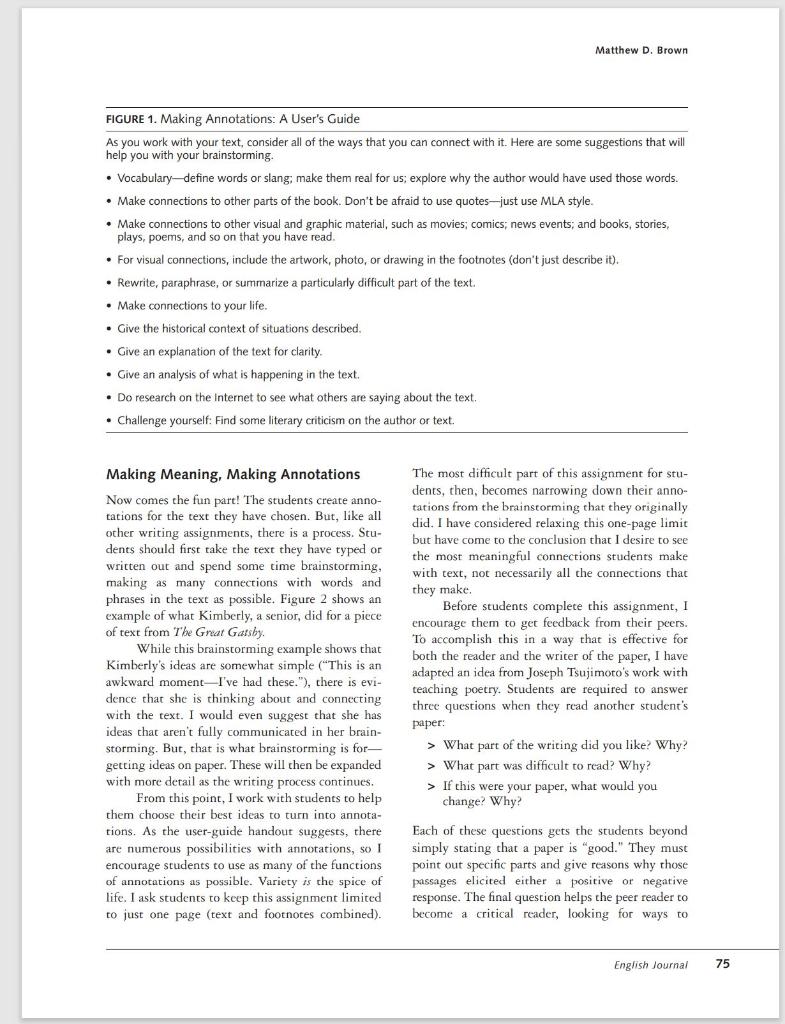
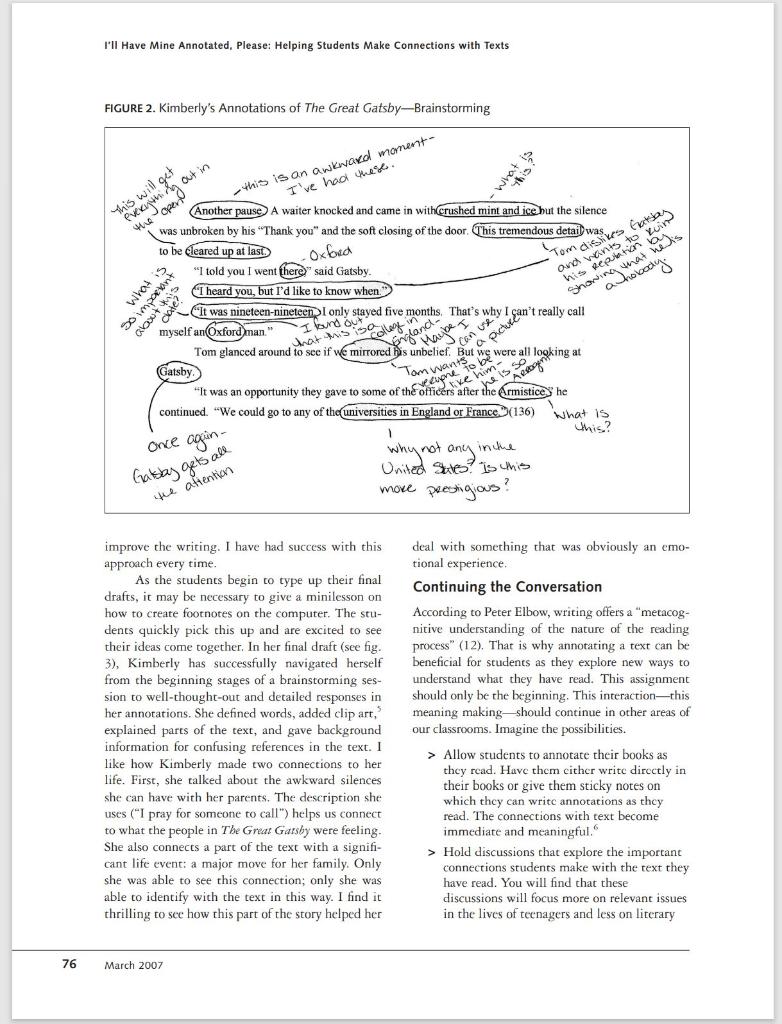
> ISSUES AND INNOVATIONS Matthew D. Brown I'll Have Mine Annotated, Please: Helping Students Make Connections with Texts Matthew D. Brown asks students to enter into conversation with the texts they read, connecting personally to make meaning. The process of annotation-analyzing the purposes for annotation, brainstorming connections, developing ideas through peer feedback, and writing detailed responses to text-allows students to consider how active interaction between reader and text is vital to their understanding E were having with text. What were they thinking about as they read? What connections were they making? What questions did they have, and could they find answers to those questions? ach year I strive to explain to stu- dents why I love to read, to com- municate the connection I have with books. Mocking disbelief is usually the only response I receive. How can I get students to see that what they read can connect to their lives to what is important to them? How can I help students see that reading will help them understand the confusing and chaotic world in which they live? Two years ago, I sat in on a discussion with Dr. Valerie Wayne at the Folger Shakespeare Library while she was working on the new Arden edition of Gymbeline. Of all the people who have worked with this play, she must know it best. She worked for two months that summer, editing and annotating twenty lines of the play each day. Yet, her effort that summer was a small fraction of the timeten years! -she will spend with the play. For all of us who love plays, the chance to study one so well, so intimately, is a dream. My students, on the other hand, would rather cut grass with nail clippers. Even so, I was interested in the work that Wayne was doing. Specifically, I was intrigued by the annotations that she was writing to go along with the play's text. While these annotations were not necessarily personal, they reflected her interac- tion with the text. I wondered what would happen if I had students annotate a piece of text. I wasn't look- ing for detailed analysis and research, and I certainly wasn't looking for the academic rigor that goes into the annotations of professionally published works, but I wanted a way to view the interactions students Allowing Students to Begin a Conversation Reading is one thing, but getting something of value from what we have read is another. When we take up a text, we are engaging in a conversation with the author, with others, and with ourselves. Yet, so much of what takes place in the classroom isolates reading so that true, authentic, and meaningful interactions with a text are sometimes ignored. Think back to the books that you love. Why are they so significant to you? I would be willing to guess that there was a personal connection with the textsomething that moved you. Yet look at our classrooms today. How much of what we do helps make those personal connections with the text? And how much of what we do allows students to share those ideas? I desire to have students enter into a conversa- tion with the text they are reading. Whether it is a conversation with me, their peers, their parents, or themselves, I want them to think about what they have read and then strive to make meaning of that text for themselves. Without allowing students to interact with text in a meaningful way, we miss the chance of allowing them to see the value of what they are reading and to form new ideas about who they are and how they fit into the world in which they live. students March 2007 73 English Journal Vol. 96, No. 4 Copyright 2007 by the National Council of Teachers of English. All rights reserved I'll Have Mine Annotated, Please: Helping Students Make Connections with Texts a First Steps: Helping Students Make Connections If I desire that students make some sort of meaning from what they read, then writing is the means that must be used to get them there. Writing helps stu- dents think about the text they are reading and work out their ideas. More importantly, though, any writ- ing that students do needs to connect to their per- sonal experiences, and those experiences must inform their understanding of what they have read. Taking a piece of text and annotating it can accomplish that. I give students a handout with a page of pub- lished text that has been annotated. Any play by Without allowing Shakespeare works well as students to interact with model since nearly all publish- ers provide annotations for the text in a meaningful way, text of his plays. (I have found we miss the chance of that a selection of a play by allowing them to see the Shakespeare from the Red value of what they are Reader series published by reading and to form new Teacher's Discovery works ideas about who they are nicely for this exercise.) The students get into small groups and how they fit into the and look at the professional world in which they live. model. They make notes in the text's margins, describing the kinds of information being given to the reader through these annotations. Once the small groups have exhausted their ideas, we come back into a whole-class discussion. I ask students to help me create a lista rubric of sortsthat helps show what good annotations do Using an overhead, I first ask them to share what they discovered in the professional model. These are easy enough for them to list. Students often point out how annotations The process of generating this list usually moves into a discussion about where these annota- tions came fromwho wrote them and why. Here is a teachable moment. Someone had to write these ideas, to look at the text and do more than just read it, to make a connection with the text. It is vital that students begin to realize that our understanding of what we have read comes from our interaction with what is on the page. have the class consider the many ways that reading can affect ushow we can connect to something that we are reading. I usually get the ball rolling by sharing how stories that I read often remind me of movies that I have seen. I add this to the list and then ask students to think of some ideas. This list can and often does grow, getting deeper and deeper into students' understanding of what it means to connect to a text. Students often share how a piece of text > touches them emotionally, making them feel happiness as well as sadness; > reminds them of childhood experiences; > teaches them something new; > changes their perspective on an issue; > helps them see how they can better relate to their parents and others around them: and > helps them see the world through someone else's experiences. Students are now ready to create their anno- tations, so I take the brainstorming list and gener- ate a guide sheet (see fig. 1). Students must choose a passage from the text we are studying one that they believe is meaningful in some way. I ask them to type or write out one to two paragraphs of that passage. The text should not take up more than a quarter of the page once it is typed. I know that it may be tempting for teachers to select the passages for the students so that there is variety in the pieces the students annotate, but students become engaged in an assignment when they are given choices. This is especially true since the nature of these annotations is often personal and reveals how students have connected to what they have read. So, I allow students to make their own choices, encouraging them to choose a passage that they like. > give definitions to difficult and unfamiliar words; > give background information, especially explaining customs, traditions, and ways of living that may be unfamiliar to us; > help explain what is going on in the text; > make connections to other texts, > point out the use of literary techniques and how they add meaning to the text; > can use humor, and > reveal that the writer of these annotations knows his or her reader. 74 March 2007 Matthew D. Brown FIGURE 1. Making Annotations: A User's Guide As you work with your text, consider all of the ways that you can connect with it. Here are some suggestions that will help you with your brainstorming. Vocabulary define words or slang, make them real for us; explore why the author would have used those words. Make connections to other parts of the book. Don't be afraid to use quotes-just use MLA style. Make connections to other visual and graphic material, such as movies; comics; news events; and books, stories, plays, poems, and so on that you have read. For visual connections, include the artwork, photo, or drawing in the footnotes (don't just describe it). Rewrite, paraphrase, or summarize a particularly difficult part of the text. Make connections to your life. . Give the historical context of situations described. . Give an explanation of the text for clarity. Give an analysis of what is happening in the text. Do research on the internet to see what others are saying about the text. Challenge yourself: Find some literary criticism on the author or text. Making Meaning, Making Annotations Now comes the fun part! The students create anno- tations for the text they have chosen. But, like all other writing assignments, there is a process. Stu- dents should first take the text they have typed or written out and spend some time brainstorming, making as many connections with words and phrases in the text as possible. Figure 2 shows an example of what Kimberly, a senior, did for a piece of text from The Great Gatsby. While this brainstorming example shows that Kimberly's ideas are somewhat simple ("This is an awkward moment I've had these."), there is evi- dence that she is thinking about and connecting with the text. I would even suggest that she has ideas that aren't fully communicated in her brain- storming. But, that is what brainstorming is for- getting ideas on paper. These will then be expanded with more detail as the writing process continues From this point, I work with students to help them choose their best ideas to turn into annota- tions. As the user-guide handour suggests, there are numerous possibilities with annotations, encourage students to use as many of the functions of annotations as possible. Variety is the spice of life. I ask students to keep this assignment limited to just one page (text and footnotes combined). The most difficult part of this assignment for stu- dents, then, becomes narrowing down their anno- tations from the brainstorming that they originally did. I have considered relaxing this one-page limit but have come to the conclusion that I desire to see the most meaningful connections students make with text, not necessarily all the connections that they make. Before students complete this assignment, I encourage them to get feedback from their peers. To accomplish this in a way that is effective for both the reader and the writer of the paper, I have adapted an idea from Joseph Tsujimoto's work with teaching poetry. Students are required to answer three questions when they read another student's paper; : > What part of the writing did you like? Why? > What part was difficult to read? Why? > If this were your paper, what would you change? Why? Each of these questions gets the students beyond simply stating that a paper is "good." They must point out specific parts and give reasons why those passages elicited either a positive or negative response. The final question helps the peer reader to become a critical reader, looking for ways to 1 English Journal 75 I'll Have Mine Annotated, Please: Helping Students Make Connections with Texts FIGURE 2. Kimberly's Annotations of The Great Gatsby-Brainstorming gut What hg out in this is an awkward moment- I've had these the apart Another pause A waiter knocked and came in with crushed mint and ice but the silence was unbroken by his "Thank you" and the soft closing of the door. This tremendous detail was to be cleared up at last "I told you I went there," said Gatsby. Oxford I heard you, but I'd like to know when Komdiskur It was nineteen-nineteen I only stayed five months. That's myself an Oxford man." a what this is a college lor wants to rian Showing his reputation as 5 dod why Scam win yo pictureen't really call Tom glanced around to see if we mirrored his unbelief. But we were all looking at Gatsby Tom wants 2015 "It was an opportunity they gave to some of the officers after the Armistice he Veure continued. "We could go to any of the universities in England or France (136) What is this? why not United a my inithe more prestigious ? 1 once again - i Is this Gatsbay gets all the attention improve the writing. I have had success with this approach every time. As the students begin to type up their final drafts, it may be necessary to give a minilesson on how to create footnotes on the computer. The stu- dents quickly pick this up and are excited to see their ideas come together. In her final draft (see fig. 3), Kimberly has successfully navigated herself from the beginning stages of a brainstorming ses- sion to well-thought-out and detailed responses in her annotations. She defined words, added clip art, explained parts of the text, and gave background information for confusing references in the text. I like how Kimberly made two connections to her life. First, she talked about the awkward silences she can have with her parents. The description she uses ("I pray for someone to call") helps us connect to what the people in The Great Gatsby were feeling. She also connects a part of the text with a signifi- cant life event: a major move for her family. Only she was able to see this connection; only she was able to identify with the text in this way. I find it thrilling to see how this part of the story helped her deal with something that was obviously an emo- tional experience Continuing the Conversation According to Peter Elbow, writing offers a "metacog- nitive understanding of the nature of the reading process" (12). That is why annotating a text can be beneficial for students as they explore new ways to understand what they have read. This assignment should only be the beginning. This interactionthis meaning making should continue in other areas of our classrooms. Imagine the possibilities. > Allow students to annotate their books as they read. Have them cither write directly in their books or give them sticky notes on which they can write annotations as they read. The connections with text become immediate and meaningful. > Hold discussions that explore the important connections students make with the text they have read. You will find that these discussions will focus more on relevant issues in the lives of teenagers and less on literary 76 March 2007 > ISSUES AND INNOVATIONS Matthew D. Brown I'll Have Mine Annotated, Please: Helping Students Make Connections with Texts Matthew D. Brown asks students to enter into conversation with the texts they read, connecting personally to make meaning. The process of annotation-analyzing the purposes for annotation, brainstorming connections, developing ideas through peer feedback, and writing detailed responses to text-allows students to consider how active interaction between reader and text is vital to their understanding E were having with text. What were they thinking about as they read? What connections were they making? What questions did they have, and could they find answers to those questions? ach year I strive to explain to stu- dents why I love to read, to com- municate the connection I have with books. Mocking disbelief is usually the only response I receive. How can I get students to see that what they read can connect to their lives to what is important to them? How can I help students see that reading will help them understand the confusing and chaotic world in which they live? Two years ago, I sat in on a discussion with Dr. Valerie Wayne at the Folger Shakespeare Library while she was working on the new Arden edition of Gymbeline. Of all the people who have worked with this play, she must know it best. She worked for two months that summer, editing and annotating twenty lines of the play each day. Yet, her effort that summer was a small fraction of the timeten years! -she will spend with the play. For all of us who love plays, the chance to study one so well, so intimately, is a dream. My students, on the other hand, would rather cut grass with nail clippers. Even so, I was interested in the work that Wayne was doing. Specifically, I was intrigued by the annotations that she was writing to go along with the play's text. While these annotations were not necessarily personal, they reflected her interac- tion with the text. I wondered what would happen if I had students annotate a piece of text. I wasn't look- ing for detailed analysis and research, and I certainly wasn't looking for the academic rigor that goes into the annotations of professionally published works, but I wanted a way to view the interactions students Allowing Students to Begin a Conversation Reading is one thing, but getting something of value from what we have read is another. When we take up a text, we are engaging in a conversation with the author, with others, and with ourselves. Yet, so much of what takes place in the classroom isolates reading so that true, authentic, and meaningful interactions with a text are sometimes ignored. Think back to the books that you love. Why are they so significant to you? I would be willing to guess that there was a personal connection with the textsomething that moved you. Yet look at our classrooms today. How much of what we do helps make those personal connections with the text? And how much of what we do allows students to share those ideas? I desire to have students enter into a conversa- tion with the text they are reading. Whether it is a conversation with me, their peers, their parents, or themselves, I want them to think about what they have read and then strive to make meaning of that text for themselves. Without allowing students to interact with text in a meaningful way, we miss the chance of allowing them to see the value of what they are reading and to form new ideas about who they are and how they fit into the world in which they live. students March 2007 73 English Journal Vol. 96, No. 4 Copyright 2007 by the National Council of Teachers of English. All rights reserved I'll Have Mine Annotated, Please: Helping Students Make Connections with Texts a First Steps: Helping Students Make Connections If I desire that students make some sort of meaning from what they read, then writing is the means that must be used to get them there. Writing helps stu- dents think about the text they are reading and work out their ideas. More importantly, though, any writ- ing that students do needs to connect to their per- sonal experiences, and those experiences must inform their understanding of what they have read. Taking a piece of text and annotating it can accomplish that. I give students a handout with a page of pub- lished text that has been annotated. Any play by Without allowing Shakespeare works well as students to interact with model since nearly all publish- ers provide annotations for the text in a meaningful way, text of his plays. (I have found we miss the chance of that a selection of a play by allowing them to see the Shakespeare from the Red value of what they are Reader series published by reading and to form new Teacher's Discovery works ideas about who they are nicely for this exercise.) The students get into small groups and how they fit into the and look at the professional world in which they live. model. They make notes in the text's margins, describing the kinds of information being given to the reader through these annotations. Once the small groups have exhausted their ideas, we come back into a whole-class discussion. I ask students to help me create a lista rubric of sortsthat helps show what good annotations do Using an overhead, I first ask them to share what they discovered in the professional model. These are easy enough for them to list. Students often point out how annotations The process of generating this list usually moves into a discussion about where these annota- tions came fromwho wrote them and why. Here is a teachable moment. Someone had to write these ideas, to look at the text and do more than just read it, to make a connection with the text. It is vital that students begin to realize that our understanding of what we have read comes from our interaction with what is on the page. have the class consider the many ways that reading can affect ushow we can connect to something that we are reading. I usually get the ball rolling by sharing how stories that I read often remind me of movies that I have seen. I add this to the list and then ask students to think of some ideas. This list can and often does grow, getting deeper and deeper into students' understanding of what it means to connect to a text. Students often share how a piece of text > touches them emotionally, making them feel happiness as well as sadness; > reminds them of childhood experiences; > teaches them something new; > changes their perspective on an issue; > helps them see how they can better relate to their parents and others around them: and > helps them see the world through someone else's experiences. Students are now ready to create their anno- tations, so I take the brainstorming list and gener- ate a guide sheet (see fig. 1). Students must choose a passage from the text we are studying one that they believe is meaningful in some way. I ask them to type or write out one to two paragraphs of that passage. The text should not take up more than a quarter of the page once it is typed. I know that it may be tempting for teachers to select the passages for the students so that there is variety in the pieces the students annotate, but students become engaged in an assignment when they are given choices. This is especially true since the nature of these annotations is often personal and reveals how students have connected to what they have read. So, I allow students to make their own choices, encouraging them to choose a passage that they like. > give definitions to difficult and unfamiliar words; > give background information, especially explaining customs, traditions, and ways of living that may be unfamiliar to us; > help explain what is going on in the text; > make connections to other texts, > point out the use of literary techniques and how they add meaning to the text; > can use humor, and > reveal that the writer of these annotations knows his or her reader. 74 March 2007 Matthew D. Brown FIGURE 1. Making Annotations: A User's Guide As you work with your text, consider all of the ways that you can connect with it. Here are some suggestions that will help you with your brainstorming. Vocabulary define words or slang, make them real for us; explore why the author would have used those words. Make connections to other parts of the book. Don't be afraid to use quotes-just use MLA style. Make connections to other visual and graphic material, such as movies; comics; news events; and books, stories, plays, poems, and so on that you have read. For visual connections, include the artwork, photo, or drawing in the footnotes (don't just describe it). Rewrite, paraphrase, or summarize a particularly difficult part of the text. Make connections to your life. . Give the historical context of situations described. . Give an explanation of the text for clarity. Give an analysis of what is happening in the text. Do research on the internet to see what others are saying about the text. Challenge yourself: Find some literary criticism on the author or text. Making Meaning, Making Annotations Now comes the fun part! The students create anno- tations for the text they have chosen. But, like all other writing assignments, there is a process. Stu- dents should first take the text they have typed or written out and spend some time brainstorming, making as many connections with words and phrases in the text as possible. Figure 2 shows an example of what Kimberly, a senior, did for a piece of text from The Great Gatsby. While this brainstorming example shows that Kimberly's ideas are somewhat simple ("This is an awkward moment I've had these."), there is evi- dence that she is thinking about and connecting with the text. I would even suggest that she has ideas that aren't fully communicated in her brain- storming. But, that is what brainstorming is for- getting ideas on paper. These will then be expanded with more detail as the writing process continues From this point, I work with students to help them choose their best ideas to turn into annota- tions. As the user-guide handour suggests, there are numerous possibilities with annotations, encourage students to use as many of the functions of annotations as possible. Variety is the spice of life. I ask students to keep this assignment limited to just one page (text and footnotes combined). The most difficult part of this assignment for stu- dents, then, becomes narrowing down their anno- tations from the brainstorming that they originally did. I have considered relaxing this one-page limit but have come to the conclusion that I desire to see the most meaningful connections students make with text, not necessarily all the connections that they make. Before students complete this assignment, I encourage them to get feedback from their peers. To accomplish this in a way that is effective for both the reader and the writer of the paper, I have adapted an idea from Joseph Tsujimoto's work with teaching poetry. Students are required to answer three questions when they read another student's paper; : > What part of the writing did you like? Why? > What part was difficult to read? Why? > If this were your paper, what would you change? Why? Each of these questions gets the students beyond simply stating that a paper is "good." They must point out specific parts and give reasons why those passages elicited either a positive or negative response. The final question helps the peer reader to become a critical reader, looking for ways to 1 English Journal 75 I'll Have Mine Annotated, Please: Helping Students Make Connections with Texts FIGURE 2. Kimberly's Annotations of The Great Gatsby-Brainstorming gut What hg out in this is an awkward moment- I've had these the apart Another pause A waiter knocked and came in with crushed mint and ice but the silence was unbroken by his "Thank you" and the soft closing of the door. This tremendous detail was to be cleared up at last "I told you I went there," said Gatsby. Oxford I heard you, but I'd like to know when Komdiskur It was nineteen-nineteen I only stayed five months. That's myself an Oxford man." a what this is a college lor wants to rian Showing his reputation as 5 dod why Scam win yo pictureen't really call Tom glanced around to see if we mirrored his unbelief. But we were all looking at Gatsby Tom wants 2015 "It was an opportunity they gave to some of the officers after the Armistice he Veure continued. "We could go to any of the universities in England or France (136) What is this? why not United a my inithe more prestigious ? 1 once again - i Is this Gatsbay gets all the attention improve the writing. I have had success with this approach every time. As the students begin to type up their final drafts, it may be necessary to give a minilesson on how to create footnotes on the computer. The stu- dents quickly pick this up and are excited to see their ideas come together. In her final draft (see fig. 3), Kimberly has successfully navigated herself from the beginning stages of a brainstorming ses- sion to well-thought-out and detailed responses in her annotations. She defined words, added clip art, explained parts of the text, and gave background information for confusing references in the text. I like how Kimberly made two connections to her life. First, she talked about the awkward silences she can have with her parents. The description she uses ("I pray for someone to call") helps us connect to what the people in The Great Gatsby were feeling. She also connects a part of the text with a signifi- cant life event: a major move for her family. Only she was able to see this connection; only she was able to identify with the text in this way. I find it thrilling to see how this part of the story helped her deal with something that was obviously an emo- tional experience Continuing the Conversation According to Peter Elbow, writing offers a "metacog- nitive understanding of the nature of the reading process" (12). That is why annotating a text can be beneficial for students as they explore new ways to understand what they have read. This assignment should only be the beginning. This interactionthis meaning making should continue in other areas of our classrooms. Imagine the possibilities. > Allow students to annotate their books as they read. Have them cither write directly in their books or give them sticky notes on which they can write annotations as they read. The connections with text become immediate and meaningful. > Hold discussions that explore the important connections students make with the text they have read. You will find that these discussions will focus more on relevant issues in the lives of teenagers and less on literary 76 March 2007









 Study Help