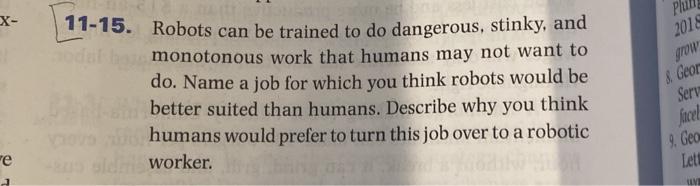
Question: answer 11-15 please 2018 & Geor 11-15. Robots can be trained to do dangerous, stinky, and monotonous work that humans may not want to do.
answer 11-15 please
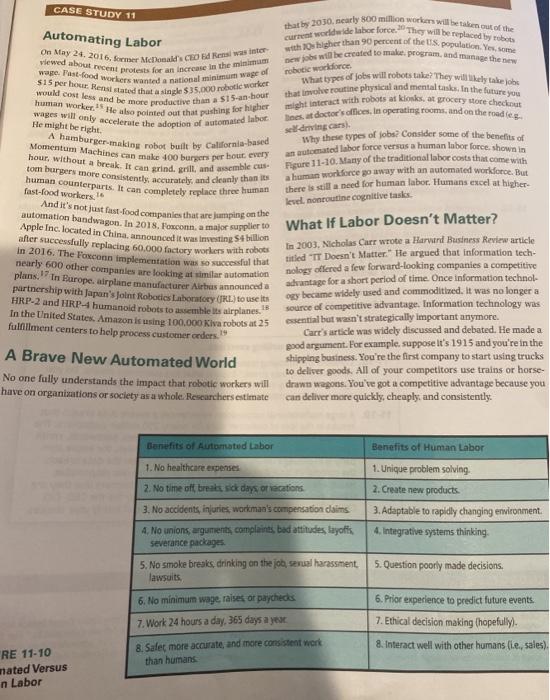
2018 & Geor 11-15. Robots can be trained to do dangerous, stinky, and monotonous work that humans may not want to do. Name a job for which you think robots would be better suited than humans. Describe why you think humans would prefer to turn this job over to a robotic worker. Serv facel 9. Geo re Lett VI that by 2030. Omillion wou will be takouto the current worldwide labor force. They will be replaced by robots with higher than 90 percent of the US. population. Yes, some On May 24.2016, former McDonald's CHF Renal water Dwiebe created to malu program and the viewed about recent process for an areas in the minimum 515 per hour Hens stated that a single $35.000 robotic worker wage Fast-food workers wanted a national minimum wage of What types of jobs will robots take? They will likely takejobs would cost less and be more productive than a 15-an-hour that involve routine physical and mental tasks. In the future you human worker. He also pointed out that pushing for higher might interact with robots at kind at grocery store che Desat dactor's offices in operating rooms and on the road A hamburger-making robot built by California-based Why these types of jobs? Consider some of the benefits of Momentum Machines can make 400 burgers per bout every automated labor force versus a human labor force shown in wages will only accelerate the adoption of automated labor hour, without a break. It can grind grill and assemble cus human counterparts. It can completely replace three human CASE STUDY 11 Automating Labor robocie wodorce He might be right serving carsi fast-food workers." And it's not just fast-food companies that are jumping on the automation bandwagon. In 2018. Foxconn. a major suppler 10 Apple Inc. located in China, announced it was investing 54 billion after successfully replacing 60.000 factory workers with robots In 2016. The Foxconn implementation was so succesful that nearly 600 other companies are looking at similar automation plans." In Rurope. airplane manufacturer Airbus announced a partnership with Japan's Joint Robotics Laboratory (CRL) to use is HRP-2 and HRP-4 humanoid robots to assemble its airplanes * In the United States, Amazon is using 100.000 Kiva robots at 25 fulfillment centers to help process customer orders A Brave New Automated World No one fully understands the impact that robotic workers will have on organizations or society as a whole. Researchers estimate Figure 11-10. Many of the traditional labor costs that come with a human workforce yo away with an automated workforce. But there is still a need for human labor Humans excel at higher level.nonroutine cognitive tasks What If Labor Doesn't Matter? In 2003. Nicholas Carr wrote a Harvard Business Review article titled "I Doesn't Matter." He argued that information tech- nology offered a few forward-looking companies a competitive advantage for a short period of time. Once information technol ogy became widely used and commoditined. It was no longer a source of competitive advantage. Information technology was Essential but wasn't strategically important anymore. Carr's article was widely discussed and debated. He made a good argument. For example, suppose It's 1915 and you're in the shipping business. You're the first company to start using trucks to deliver goods. All of your competitors use trains or horse- drawn wagons. You've got a competitive advantage because you can deliver more quickly, cheaply, and consistently Benefits of Automated Labor Benefits of Human Labor 1. No healthcare expenses 1. Unique problem solving 2. Create new products 2. No time of breaks sick days or recations 3. No accidents, injuries workman's compensation claims 4. No unions, arguments complaints, bad attitudes, layotis severance packages 5. No smoke breaks, drinking on the job, sexual harassment lawsuits 3. Adaptable to rapidly changing environment. 4. Integrative systems thinking. 5. Question poorly made decisions. 6. No minimum wage, raises or paychecks 7. Work 24 hours a day, 365 days a yea 6. Prior experience to predict future events. 7. Ethical decision making (hopefully). 8. Interact well with other humans (ie, sales), 8. Salet more accurate, and more consistent work than humans RE 11-10 nated Versus n Labor









 Study Help