







Question: Answer 1-23 please. Also for graph under question 7, use that graph for 8-23. Thank You. 1) {(-2, 6), (1, 4), (2, 6)} 1. Domain
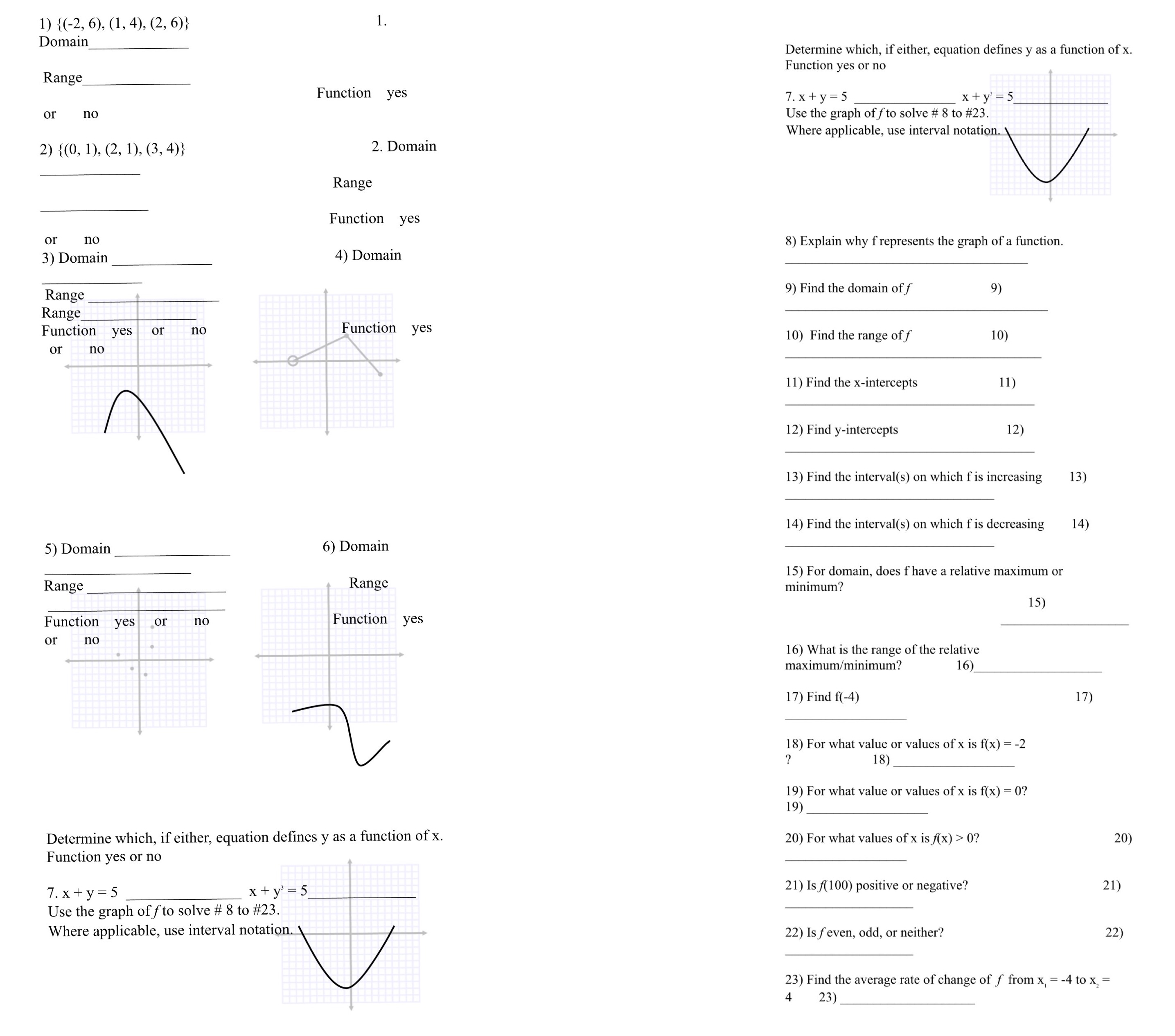
Answer 1-23 please. Also for graph under question 7, use that graph for 8-23. Thank You.
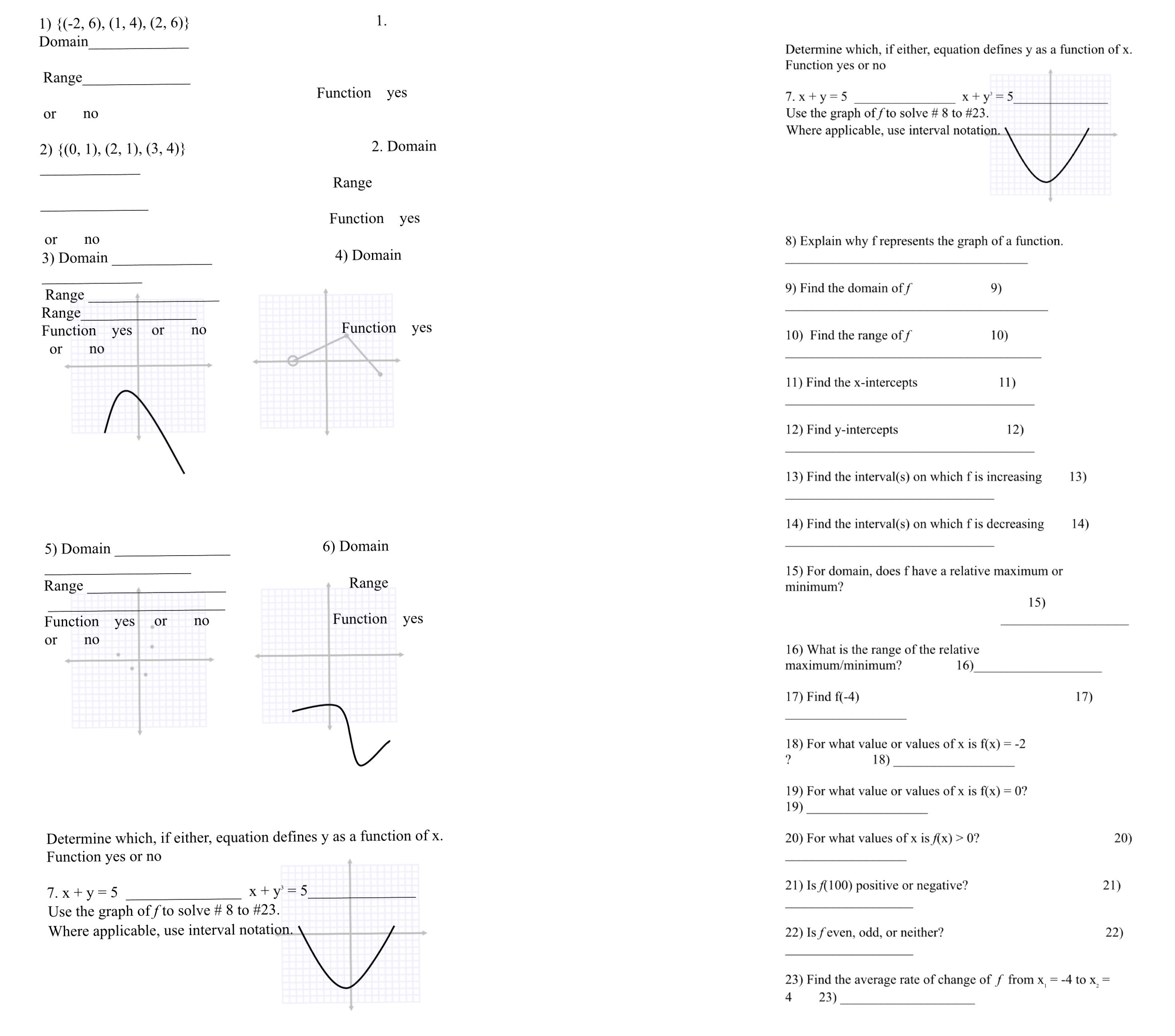
1) {(-2, 6), (1, 4), (2, 6)} 1. Domain Determine which, if either, equation defines y as a function of x. Function yes or no Range Function yes 7. xty= 5 xty' = s_ or no Use the graph of f to solve # 8 to #23. Where applicable, use interval notation. 2) {(0, 1), (2, 1), (3, 4)} 2. Domain Range Function yes or no xplain why f represents the esents the graph of a function. 3) Domain 4) Domain Rang 9) Find the domain of f 9) Range Function yes or no Function yes 10) Find the range of f 10) or no d the x-intercepts 11) 12) Find y-intercepts 12) 13) Find the interval(s) on which f is increasing 13) 14) Find the interval(s) on which f is decreasing 14 ) 5) Domain 6) Domain 15) For domain, does f have a relative maximum or Range Range minimum? 15) Function yes or no Function yes or no 16) What is the range of the relative maximum/minimum 16) 17) Find f(-4) 17) 18) For what value or values of x is f(x) = -2 18) 19) For what value or values of x is f(x) = 0? 19) Determine which, if either, equation defines y as a function of x. 20) For what values of x is f(x) > 0? 20) Function yes or no 7. xty= 5 xty' = 5_ 21) Is f(100) positive or negative? 21) Use the graph of ft Where applicable, use interval notation. 22) Is feven, odd, or neither? 22) 23) Find the average rate of change of f from x, = -4 to x, = 4 23)
Step by Step Solution
There are 3 Steps involved in it

Get step-by-step solutions from verified subject matter experts
 Study Help