







Question: answer 15,16, and 17 Hydrogen chloride gas reacts with solid silicon to produce trichlorosilane gas and hydrogen gas: Si(s)+3HCl(g)SiHCl3(g)+H2(g) What mass in grams of trichlorosilane
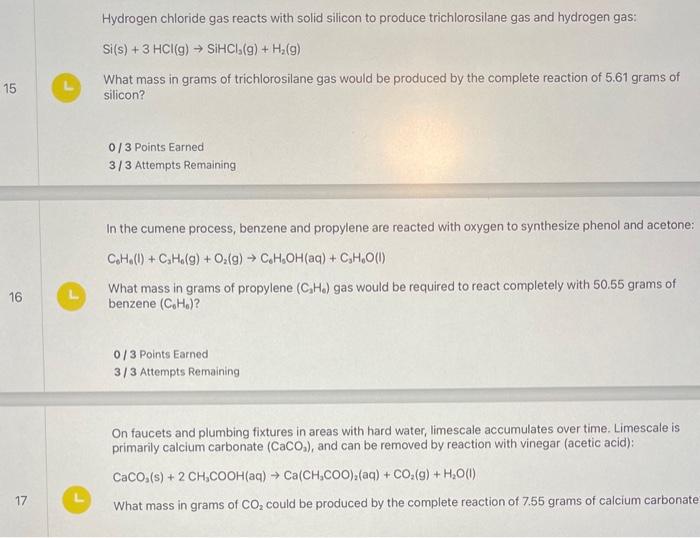
Hydrogen chloride gas reacts with solid silicon to produce trichlorosilane gas and hydrogen gas: Si(s)+3HCl(g)SiHCl3(g)+H2(g) What mass in grams of trichlorosilane gas would be produced by the complete reaction of 5.61 grams of silicon? 0/ 3 Points Earned 3/3 Attempts Remaining In the cumene process, benzene and propylene are reacted with oxygen to synthesize phenol and acetone: C6H6(l)+C3H6(g)+O2(g)C6H6OH(aq)+C3H2O(l) What mass in grams of propylene (C2H0) gas would be required to react completely with 50.55 grams of benzene (C0H0) ? 0/3 Points Earned 3/3 Attempts Remaining On faucets and plumbing fixtures in areas with hard water, limescale accumulates over time. Limescale is primarily calcium carbonate (CaCO2), and can be removed by reaction with vinegar (acetic acid): CaCO3(s)+2CH3COOH(aq)Ca(CH3COO2(aq)+CO2(g)+H2O(l) What mass in grams of CO2 could be produced by the complete reaction of 7.55 grams of calcium carbonate
Step by Step Solution
There are 3 Steps involved in it

Get step-by-step solutions from verified subject matter experts
 Study Help