







Question: Answer all it's one question 8.1.15 Many studies have been done to look at the relationship between heart disease and baldness, In one study, researchers
Answer all it's one question
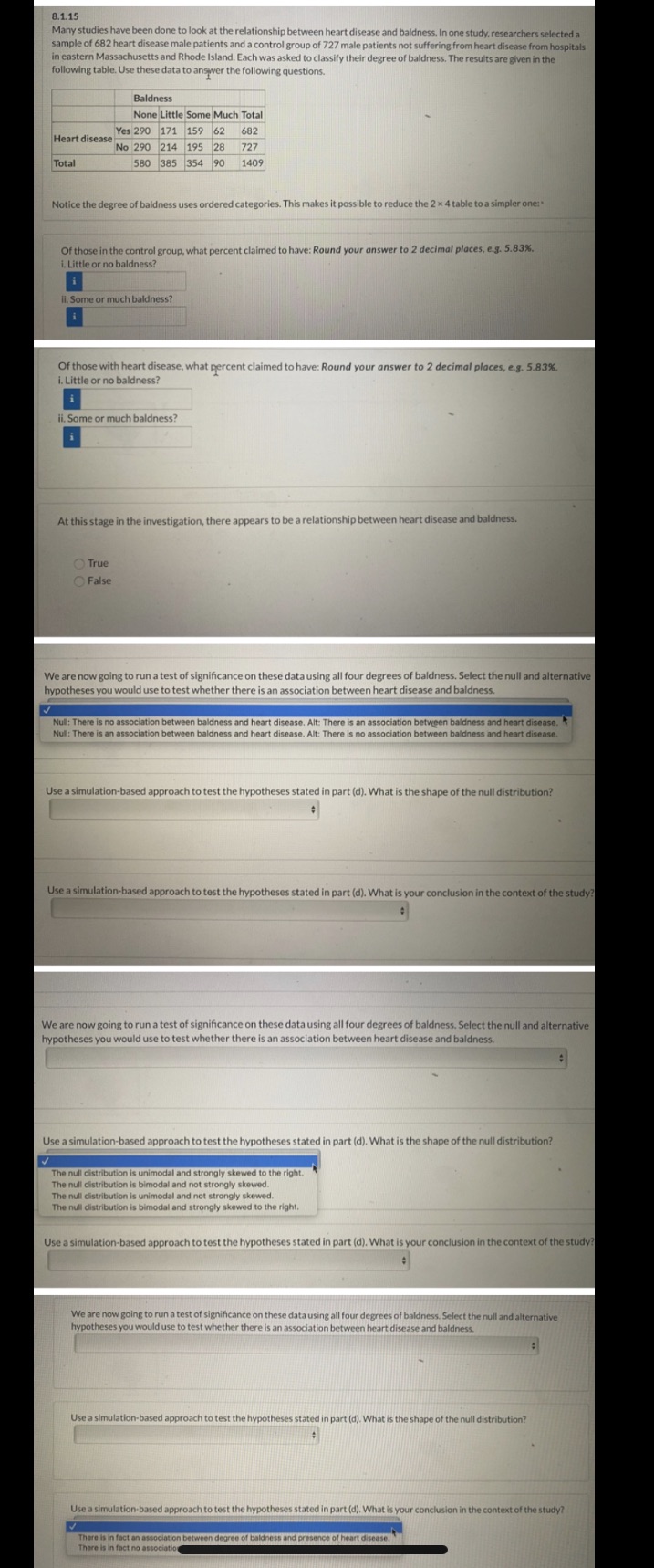
8.1.15 Many studies have been done to look at the relationship between heart disease and baldness, In one study, researchers selected a sample of 682 heart disease male patients and a control group of 727 male patients not suffering from heart disease from hospitals in eastern Massachusetts and Rhode Island. Each was asked to classify their degree of baldness. The results are given in the following table. Use these data to answer the following questions. Baldness None Little Some Much Total Heart disease Yes 290 171 159 62 682 No 290 214 195 28 727 Total 580 385 354 90 1409 Notice the degree of baldness uses ordered categories. This makes it possible to reduce the 2 x 4 table to a simpler one:" Of those in the control group, what percent claimed to have: Round your answer to 2 decimal places, e.g. 5.83%. i. Little or no baldness? i i. Some or much baldness? Of those with heart disease, what percent claimed to have: Round your answer to 2 decimal places, e.g. 5.83%. i. Little or no baldness? i ii. Some or much baldness? At this stage in the investigation, there appears to be a relationship between heart disease and baldness. True False We are now going to run a test of significance on these data using all four degrees of baldness. Select the null and alternative hypotheses you would use to test whether there is an association between heart disease and baldness. Null: There is no association between baldness and heart disease. Alt: There is an association between baldness and heart disease. Null: There is an association between baldness and heart disease. Alt: There is no association between baldness and heart disease. Use a simulation-based approach to test the hypotheses stated in part (d). What is the shape of the null distribution? Use a simulation-based approach to test the hypotheses stated in part (d). What is your conclusion in the context of the study? We are now going to run a test of significance on these data using all four degrees of baldness. Select the null and alternative hypotheses you would use to test whether there is an association between heart disease and baldness. Use a simulation-based approach to test the hypotheses stated in part (d). What is the shape of the null distribution? The null distribution is unimodal and strongly skewed to the right. The null distribution is bimodal and not strongly skewed. The null distribution is unimodal and not strongly skewed. The null distribution is bimodal and strongly skewed to the right. Use a simulation-based approach to test the hypotheses stated in part (d). What is your conclusion in the context of the study? We are now going to run a test of significance on these data using all four degrees of baldness. Select the null and alternative hypotheses you would use to test whether there is an association between heart disease and baldness. Use a simulation-based approach to test the hypotheses stated in part (d). What is the shape of the null distribution? Use a simulation-based approach to test the hypotheses stated in part (d). What is your conclusion in the context of the study? There is in fact an association between degree of baldness and presence of heart disease. There is in fact no association
Step by Step Solution
There are 3 Steps involved in it

Get step-by-step solutions from verified subject matter experts
 Study Help