







Question: answer all the question in long Pfizer: A New Kind of Structure Admit it.49 Sometimes the projects you are working on (school, work, or both)
answer all the question in long 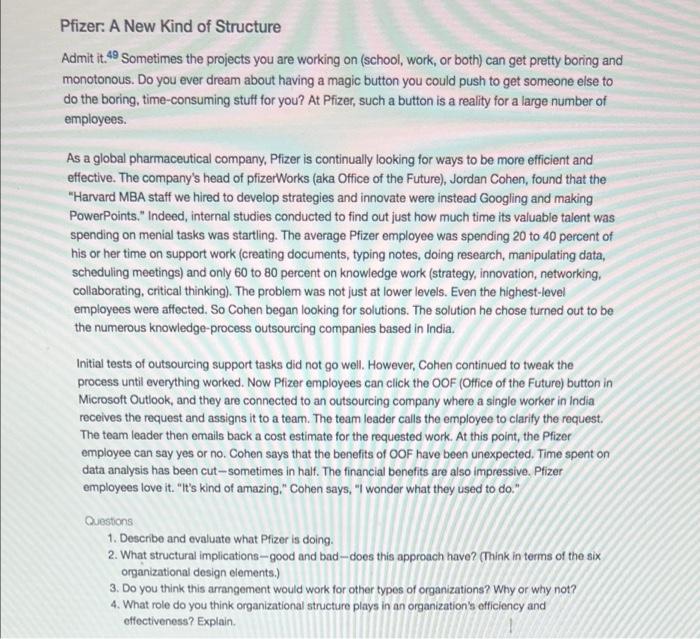
Pfizer: A New Kind of Structure Admit it.49 Sometimes the projects you are working on (school, work, or both) can get pretty boring and monotonous. Do you ever dream about having a magic button you could push to get someone else to do the boring, time-consuming stuff for you? At Pfizer, such a button is a reality for a large number of employees. As a global pharmaceutical company, Pfizer is continually looking for ways to be more efficient and effective. The company's head of pfizerWorks (aka Office of the Future), Jordan Cohen, found that the "Harvard MBA staff we hired to develop strategies and innovate were instead Googling and making PowerPoints." Indeed, internal studies conducted to find out just how much time its valuable talent was spending on menial tasks was startling. The average Pfizer employee was spending 20 to 40 percent of his or her time on support work (creating documents, typing notes, doing research, manipulating data, scheduling meetings) and only 60 to 80 percent on knowledge work (strategy, innovation, networking, collaborating, critical thinking). The problem was not just at lower levels. Even the highest level employees were affected. So Cohen began looking for solutions. The solution he chose turned out to be the numerous knowledge-process outsourcing companies based in India. Initial tests of outsourcing support tasks did not go well. However, Cohen continued to tweak the process until everything worked. Now Pfizer employees can click the OOF (Office of the Future) button in Microsoft Outlook, and they are connected to an outsourcing company where a single worker in India receives the request and assigns it to a team. The team leader calls the employee to clarify the request. The team leader then emails back a cost estimate for the requested work. At this point, the Pfizer employee can say yes or no. Cohen says that the benefits of OOF have been unexpected. Time spent on data analysis has been cut--sometimes in half. The financial benefits are also impressive. Pfizer employees love it. "it's kind of amazing." Cohen says, "I wonder what they used to do." Questions 1. Describe and evaluate what Pfizer is doing. 2. What structural implications-good and bad-does this approach have? (Think in terms of the six organizational design elements.) 3. Do you think this arrangement would work for other types of organizations? Why or why not? 4. What role do you think organizational structure plays in an organization's efficiency and effectiveness? Explain
Step by Step Solution
There are 3 Steps involved in it
1 Expert Approved Answer
Step: 1 Unlock

Question Has Been Solved by an Expert!
Get step-by-step solutions from verified subject matter experts
Step: 2 Unlock
Step: 3 Unlock
 Study Help