







Question: Answer all the questions below: Draw the short-run equilibrium position for a perfectly competitive firm that is making losses, the losses being insufficient to make
Answer all the questions below:
Draw the short-run equilibrium position for a perfectly competitive firm that is making losses, the
losses being insufficient to make it shut down in the short run.
Suppose an industry is operating in perfect competition.
Explain, with the aid of a diagram of a firm in this industry, the effects on both price and output in
both the short run and the long run of:
(i) an increase in the fixed costs of production for the products
(ii) a permanent rise in demand for the product.
A company maximises profits by setting output at a level such that the marginal cost of production
equals the price for which the company sells the product.'
Describe the conditions under which this statement is true.
Which of the following CANNOT be true for a profit-maximising monopolist?
A Profits are equal to normal profits in the long run.
B An economic profit is made in the short run.
C An economic loss is made in the short run.
D Marginal revenue is negative.
(i) Draw a diagram to show the profit-maximising position for a monopolist.
(ii) Indicate on the diagram the price and output if the monopolist decides to:
(a) break even (ie make only normal profit)
(b) produce the optimal output.
Monopolies are efficient because they make the high profits'.
Discuss this statement.
A profit-maximising monopolist will aim to maximise total revenue if the marginal cost of the
product supplied is zero at all output levels.'
Discuss this assertion, and draw a diagram to illustrate a monopoly in this position.
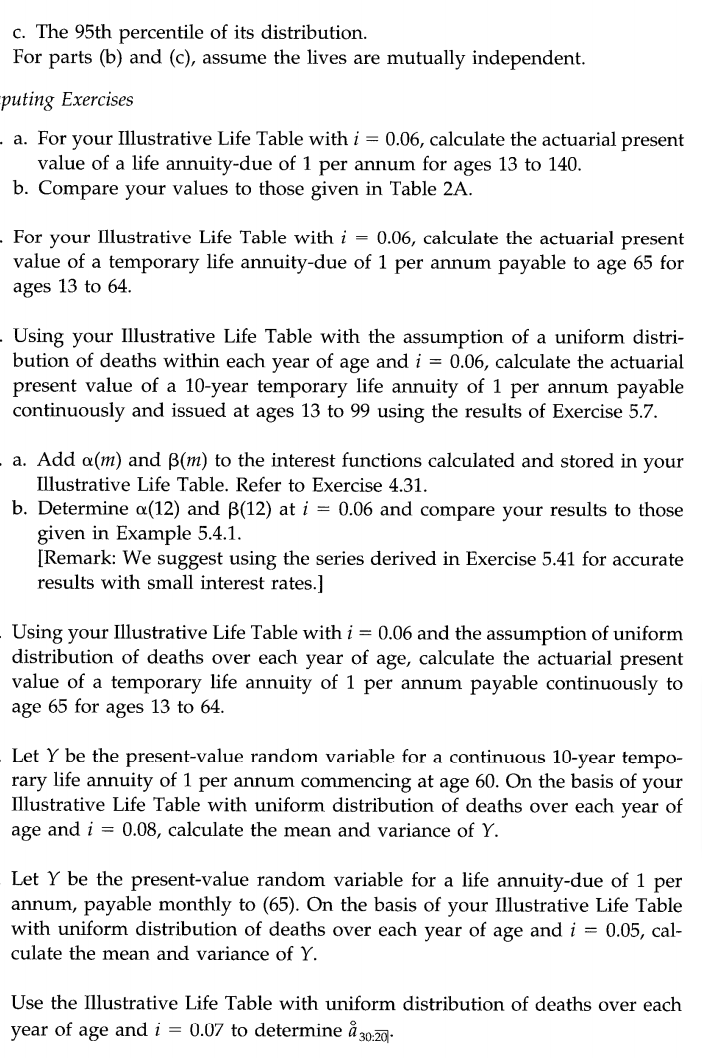
c. The 95th percentile of its distribution. For parts (b) and (c), assume the lives are mutually independent. pitting Exercises . a. For your Illustrative Life Table with i = 0.06, calculate the actuarial present value of a life annuity-due of 1 per annum for ages 13 to 140. b. Compare your values to those given in Table 2A. . For your Illustrative Life Table with i = 0.06, calculate the actuarial present value of a temporary life armuity~due of 1 per annum payable to age 65 for ages 13 to 64. . Using your Illustrative Life Table with the assumption of a uniform distri- bution of deaths within each year of age and i = 0.06, calculate the actuarial present value of a 10-year temporary life annuity of 1 per annum payable continuously and issued at ages 13 to 99 using the results of Exercise 55?. . a. Add u(m} and Mrs} to the interest functions calculated and stored in your Illustrative Life Table. Refer to Exercise 4.31. b. Determine u[12) and M12) at i = 0.06 and compare your results to those given in Example 5.4.1. [Remark We suggest using the series derived in Exercise 5.41 for accurate results with small interest rates] . Using your Illustrative Life Table with i = 0.06 and the assumption of uniform distribution of deaths over each year of age, calculate the actuarial present value of a temporary life annuity of 1 per annum payable continuously to age 65 for ages 13 to 64. . Let Y be the present-value random variable for a continuous 10-year tempo- rary life annuity of 1 per annum commencing at age 60. On the basis of your Illustrative Life Table with uniform distribution of deaths over each year of age and i = 0.08, calculate the mean and variance of I". Let 1' be the present-value random variable for a life annuity-due of 1 per annum, payable monthly to {65}. On the basis of your Illustrative Life Table with uniform distribution of deaths over each year of age and i = 0.05, cal- culate the mean and variance of 1'. Use the Illustrative Life Table with uniform distribution of deaths over each year of age and i = 0.0? to determine 5mm
Step by Step Solution
There are 3 Steps involved in it

Get step-by-step solutions from verified subject matter experts
 Study Help