



Question: Answer as many as you can please!!! 1. Suppose that we have two urns - call them um I and urn II - each containing
Answer as many as you can please!!!
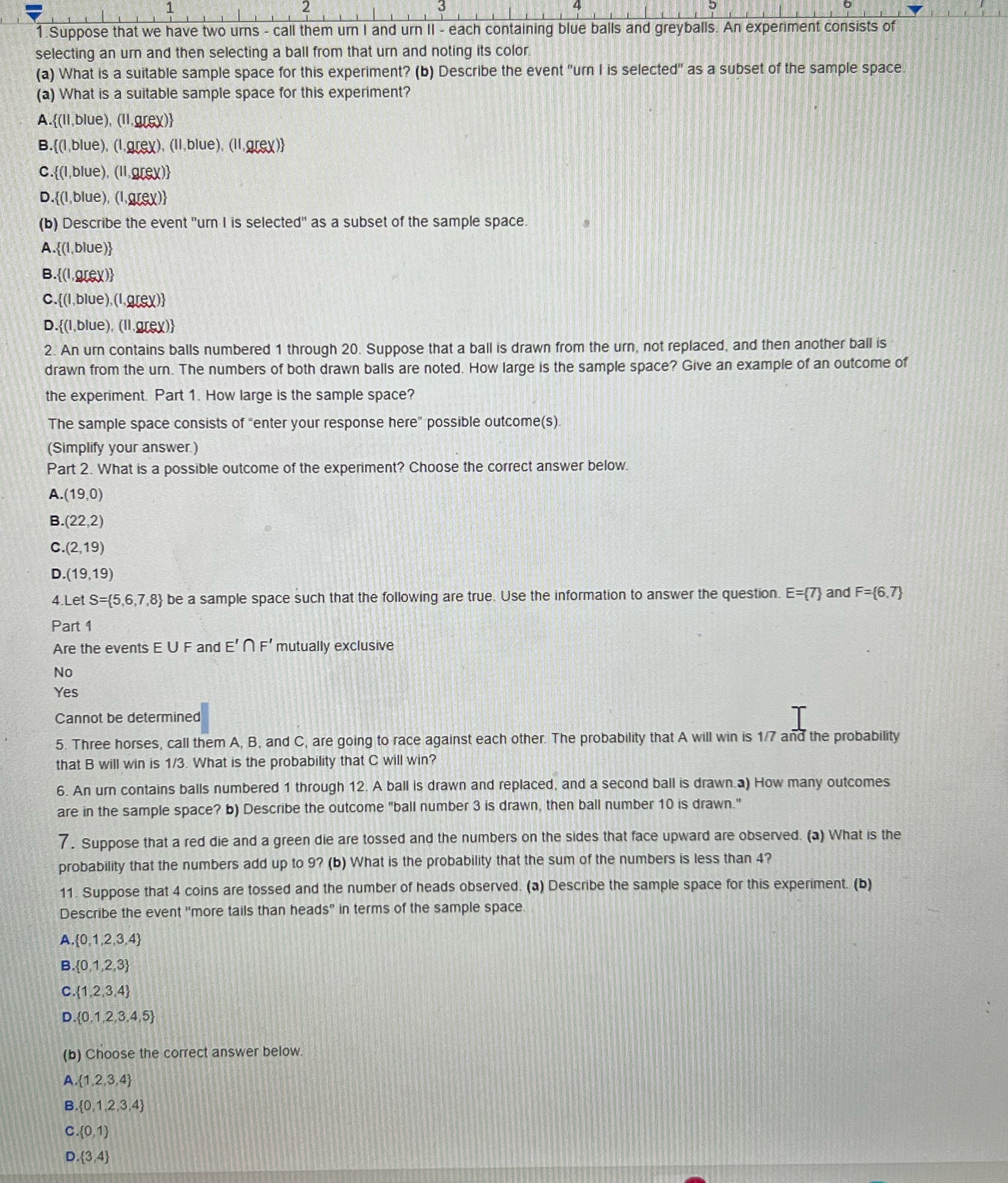
1. Suppose that we have two urns - call them um I and urn II - each containing blue balls and greyballs. An experiment consists of selecting an um and then selecting a ball from that urn and noting its color (a) What is a suitable sample space for this experiment? (b) Describe the event "urn I is selected" as a subset of the sample space (a) What is a suitable sample space for this experiment? A.{(Il,blue). (llagex)} B.{(1,blue). (1.grey). (11,blue). (ll,grex)} C.{(1,blue), (ll,grex)} D.{(1,blue), (1,grex)} (b) Describe the event "urn I is selected" as a subset of the sample space. A.{(1,blue)} B.{(1,grex)} C.{(1,blue).(1,grey)} D.{(1,blue), (ll,grex)} 2. An urn contains balls numbered 1 through 20. Suppose that a ball is drawn from the urn, not replaced, and then another ball is drawn from the urn. The numbers of both drawn balls are noted. How large is the sample space? Give an example of an outcome of the experiment. Part 1. How large is the sample space? The sample space consists of "enter your response here" possible outcome(s) (Simplify your answer.) Part 2. What is a possible outcome of the experiment? Choose the correct answer below. A.(19,0) B.(22,2) C.(2, 19) D.(19, 19) 4.Let S=(5,6,7,8) be a sample space such that the following are true. Use the information to answer the question. E=(7} and F=(6.7} Part 1 Are the events E U F and E'n F' mutually exclusive No Yes Cannot be determined T 5. Three horses, call them A, B. and C, are going to race against each other. The probability that A will win is 1/7 and the probability that B will win is 1/3. What is the probability that C will win? 6. An urn contains balls numbered 1 through 12. A ball is drawn and replaced, and a second ball is drawn.a) How many outcomes are in the sample space? b) Describe the outcome "ball number 3 is drawn, then ball number 10 is drawn." 7. Suppose that a red die and a green die are tossed and the numbers on the sides that face upward are observed. (a) What is the probability that the numbers add up to 9? (b) What is the probability that the sum of the numbers is less than 4? 11. Suppose that 4 coins are tossed and the number of heads observed. (a) Describe the sample space for this experiment. (b) Describe the event "more tails than heads" in terms of the sample space. A.{0,1,2,3,4 ) B. {0,1,2,3} C.(1,2.3,4} D. {0,1,2,3.4,5} (b) Choose the correct answer below. A.(1,2,3,4) B.(0,1.2,3,4} C.(0,1} D.(3,4)
Step by Step Solution
There are 3 Steps involved in it

Get step-by-step solutions from verified subject matter experts