







Question: answer completely and thoroughly Describe the ethical challenges regarding one of the following scientific breakthroughs: genetically modified foods, human genome or stem cell research. Do
answer completely and thoroughly
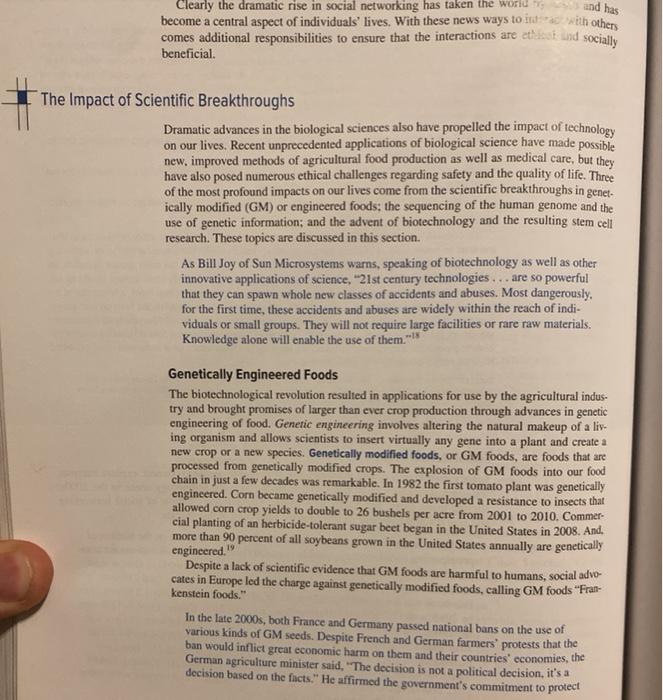
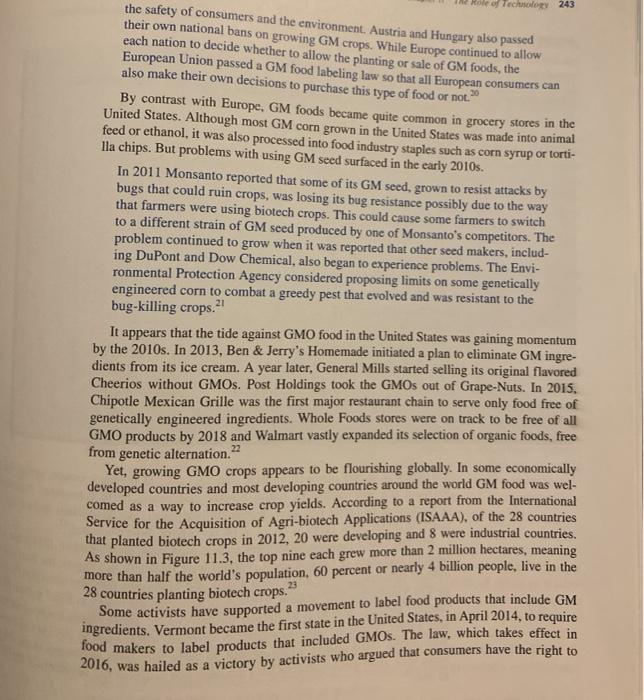
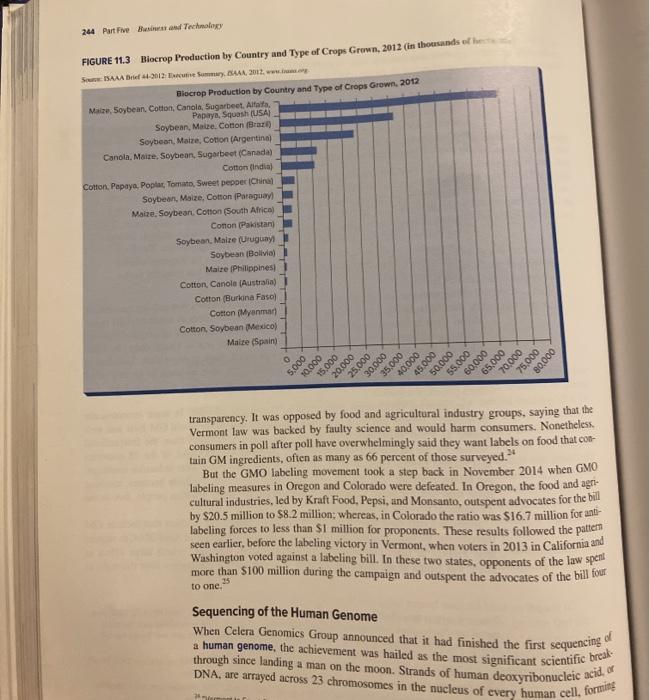
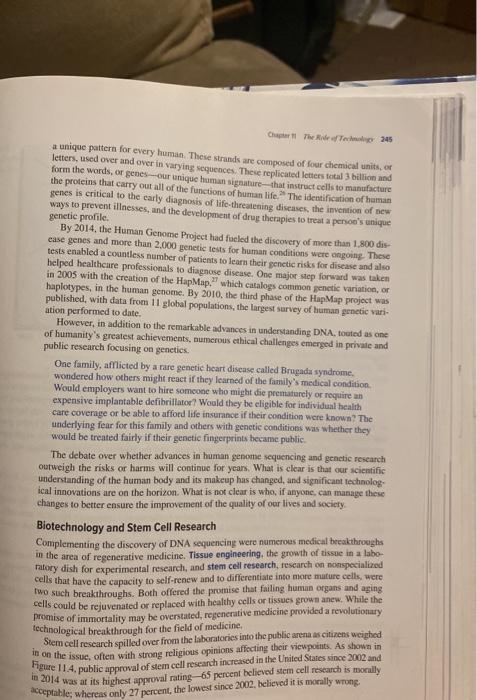
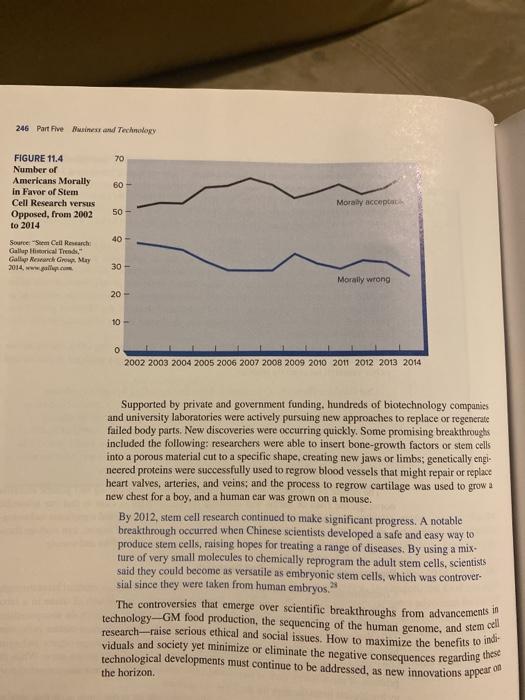
and has Clearly the dramatic rise in social networking has taken the world become a central aspect of individuals' lives. With these news ways to do with others comes additional responsibilities to ensure that the interactions are chaut und socially beneficial. The Impact of Scientific Breakthroughs Dramatic advances in the biological sciences also have propelled the impact of technology on our lives. Recent unprecedented applications of biological science have made possible new, improved methods of agricultural food production as well as medical care, but they have also posed numerous ethical challenges regarding safety and the quality of life. Three of the most profound impacts on our lives come from the scientific breakthroughs in genet- ically modified (GM) or engineered foods: the sequencing of the human genome and the use of genetic information, and the advent of biotechnology and the resulting stem cell research. These topics are discussed in this section. As Bill Joy of Sun Microsystems warns, speaking of biotechnology as well as other innovative applications of science, "21st century technologies... are so powerful that they can spawn whole new classes of accidents and abuses. Most dangerously, for the first time, these accidents and abuses are widely within the reach of indi- viduals or small groups. They will not require large facilities or rare raw materials. Knowledge alone will enable the use of them." Genetically Engineered Foods The biotechnological revolution resulted in applications for use by the agricultural indus- try and brought promises of larger than ever crop production through advances in genetic engineering of food. Genetic engineering involves altering the natural makeup of a liv ing organism and allows scientists to insert virtually any gene into a plant and create a new crop or a new species. Genetically modified foods, or GM foods, are foods that are processed from genetically modified crops. The explosion of GM foods into our food chain in just a few decades was remarkable. In 1982 the first tomato plant was genetically engineered. Corn became genetically modified and developed a resistance to insects that allowed corn crop yields to double to 26 bushels per acre from 2001 to 2010. Commer cial planting of an herbicide-tolerant sugar beet began in the United States in 2008. And. more than 90 percent of all soybeans grown in the United States annually are genetically engineered. Despite a lack of scientific evidence that GM foods are harmful to humans, social advo- cates in Europe led the charge against genetically modified foods, calling GM foods "Fran- kenstein foods." In the late 2000s, both France and Germany passed national bans on the use of various kinds of GM seeds. Despite French and German farmers' protests that the ban would inflict great economic harm on them and their countries' economies, the German agriculture minister said, "The decision is not a political decision, it's a decision based on the facts." He affirmed the government's commitment to protect e Role of Technology 243 the safety of consumers and the environment, Austria and Hungary also passed their own national bans on growing GM crops. While Europe continued to allow each nation to decide whether to allow the planting or sale of GM foods, the European Union passed a GM food labeling law so that all European consumers can also make their own decisions to purchase this type of food or not. By contrast with Europe, GM foods became quite common in grocery stores in the United States. Although most GM corn grown in the United States was made into animal feed or ethanol, it was also processed into food industry staples such as corn syrup or torti- lla chips. But problems with using GM seed surfaced in the early 2010s. In 2011 Monsanto reported that some of its GM seed, grown to resist attacks by bugs that could ruin crops, was losing its bug resistance possibly due to the way that farmers were using biotech crops. This could cause some farmers to switch to a different strain of GM seed produced by one of Monsanto's competitors. The problem continued to grow when it was reported that other seed makers, includ- ing DuPont and Dow Chemical, also began to experience problems. The Envi- ronmental Protection Agency considered proposing limits on some genetically engineered corn to combat a greedy pest that evolved and was resistant to the bug-killing crops. It appears that the tide against GMO food in the United States was gaining momentum by the 2010s. In 2013, Ben & Jerry's Homemade initiated a plan to eliminate GM ingre- dients from its ice cream. A year later, General Mills started selling its original flavored Cheerios without GMOs. Post Holdings took the GMOs out of Grape-Nuts. In 2015. Chipotle Mexican Grille was the first major restaurant chain to serve only food free of genetically engineered ingredients. Whole Foods stores were on track to be free of all GMO products by 2018 and Walmart vastly expanded its selection of organic foods, free from genetic alternation. Yet, growing GMO crops appears to be flourishing globally. In some economically developed countries and most developing countries around the world GM food was wel- comed as a way to increase crop yields. According to a report from the International 21 Service for the Acquisition of Agri-biotech Applications (ISAAA), of the 28 countries that planted biotech crops in 2012, 20 were developing and 8 were industrial countries. As shown in Figure 11.3. the top nine each grew more than 2 million hectares, meaning more than half the world's population, 60 percent or nearly 4 billion people, live in the 28 countries planting biotech crops. Some activists have supported a movement to label food products that include GM ingredients. Vermont became the first state in the United States, in April 2014, to require food makers to label products that included GMOs. The law, which takes effect in 2016, was hailed as a victory by activists who argued that consumers have the right to 244 Part Five Business and Technology FIGURE 11.3 Biocrop Production by Country and Type of Crops Grown, 2012 (in thousands of her SIISAMA Brief 44.2012 IcuteSmy.BA, 2012, ww.. Blocrop Production by country and Type of Crops Grown, 2012 Maze Soybean Cotton Canola, Sugarbeet, Alta Papaya, Squash (USA) Soybean, Mabe. Cotton (Brazil) Soybean, Malze, Cotton (Argentina) Canola, Maire, Soybean, Sugar beet (Canada) Cotton (India) Cotton Papaya. Poplar Tomato, Sweet pepper (China) Soybean, Maize, Cotton (Paraguay Maize. Soybean Cotton (South Africa) Conon Pakistani Soybean. Maize (Uruguay Soybean Bolivia) Maire Philippines Cotton, Canole (Australia) Cotton (Burkina Faso Cotton (Myanmar Cotton, Soybean (Mexico) Maire (Spain) 75,000 80,000 70,000 65,000 60,000 55.000 50.000 45.000 40,000 35,000 30.000 25,000 20.000 15,000 5,000 10,000 0 transparency. It was opposed by food and agricultural industry groups, saying that the Vermont law was backed by faulty science and would harm consumers. Nonetheless, consumers in poll after poll have overwhelmingly said they want labels on food that com tuin GM ingredients, often as many as 66 percent of those surveyed. But the GMO labeling movement took a step back in November 2014 when GMO labeling measures in Oregon and Colorado were defeated. In Oregon, the food and agri- cultural industries, led by Kraft Food, Pepsi, and Monsanto, outspent advocates for the bill by $20.5 million to $8.2 million, whereas, in Colorado the ratio was $16.7 million for anti- labeling forces to less than $1 million for proponents. These results followed the pattern seen earlier, before the labeling victory in Vermont, when voters in 2013 in California and Washington voted against a labeling bill. In these two states, opponents of the law spent more than $100 million during the campaign and outspent the advocates of the bill four to one Sequencing of the Human Genome When Celera Genomics Group announced that it had finished the first sequencing a human genome, the achievement was hailed as the most significant scientific break DNA, are arrayed across 23 chromosomes in the nucleus of every human cell, forming Chat The Tech 345 a unique pattern for every human. These strands are composed of four chemical units, or letters, used over and over in varying sequences. These replicated letters total 3 billion and form the words, or genes-our unique human signature-that instruct cells to manufacture the proteins that carry out all of the functions of human life. The identification of human genes is critical to the carly diagnosis of life-threatening diseases, the invention of new ways to prevent illnesses, and the development of drug therapies to treat a pence's unique genetic profile. By 2014, the Human Genome Project had fueled the discovery of more than 1.800 dis- ease genes and more than 2.000 genetic tests for human conditions were ongoing. There tests enabled a countless number of patients to learn their genetic risks for disease and also helped healthcare professionals to diagnose disease. One major step forward was taken in 2005 with the creation of the HapMap." which catalogs common genetic variation or haplotypes, in the human genome. By 2010, the third phase of the Hap Map project was published, with data from 11 global populations, the largest survey of human genetic vari- ation performed to date. However, in addition to the remarkable advances in understanding DNA.touted as one of humanity's greatest achievements, numerous ethical challenges emerged in private and public research focusing on genetics One family, afflicted by a rare genetic heart disease called Brugada syndrome, wondered how others might react if they learned of the family's medical condition Would employers want to hire someone who might die prematurely or require an expensive implantable defibrillator? Would they be eligible for individual health care coverage or be able to afford life insurance if their condition were known? The underlying fear for this family and others with genetic conditions was whether they would be treated fairly if their genetic fingerprints became public The debate over whether advances in human genome sequencing and genetic research outweigh the risks or harms will continue for years. What is clear is that our scientific understanding of the human body and its makeup has changed, and significant technolog- ical innovations are on the horizon. What is not clear is who, if anyone can manage these changes to better ensure the improvement of the quality of our lives and society Biotechnology and Stem Cell Research Complementing the discovery of DNA sequencing were numerous medical breakthroughs in the area of regenerative medicine. Tissue engineering, the growth of tissue in a labo ratory dish for experimental research, and stem cell research, tescarch on nonspecialized cells that have the capacity to self-renew and to differentiate into more mature cells, were Two such breakthroughs. Both offered the promise that failing human organs and aging cells could be rejuvenated or replaced with healthy cells or tissues grown anew. While the promise of immortality may be overstated, regenerative medicine provided a revolutionury technological breakthrough for the field of medicine. Stem cell research spilled over from the laboratories into the public arena as citizens weighed in on the issue often with strong religious opinions affecting their viewpoints. As shown in Figure 114, public approval of stem cell research increased in the United States since 2002 and in 2014 was at its highest approval rating 65 percent believed stem cell research is mocally acceptable, whereas only 27 percent, the lowest since 2002, believed it is morally wrong 246 Part Five Business and Technology 70 60 Moraly accepta FIGURE 11.4 Number of Americans Morally In Favor of Stem Cell Research versus Opposed, from 2002 to 2014 SourceSem Cell Research Gallupical Trendi Gallup Rearch Group May 2014, www.gal.com 50 40 30 - Morally wrong 20- 10 o 2002 2003 2004 2005 2006 2007 2008 2009 2010 2011 2012 2013 2014 Supported by private and government funding, hundreds of biotechnology companies and university laboratories were actively pursuing new approaches to replace or regenerate failed body parts. New discoveries were occurring quickly. Some promising breakthroughs included the following: researchers were able to insert bone-growth factors or stem cells into a porous material cut to a specific shape, creating new jaws or limbs; genetically engi- neered proteins were successfully used to regrow blood vessels that might repair or replace heart valves, arteries, and veins, and the process to regrow cartilage was used to grow a new chest for a boy, and a human ear was grown on a mouse. By 2012, stem cell research continued to make significant progress. A notable breakthrough occurred when Chinese scientists developed a safe and easy way to produce stem cells, raising hopes for treating a range of diseases. By using a mix- ture of very small molecules to chemically reprogram the adult stem cells, scientists said they could become as versatile as embryonic stem cells, which was controver- sial since they were taken from human embryos. The controversies that emerge over scientific breakthroughs from advancements in technology-GM food production, the sequencing of the human genome, and stem cell research-raise serious ethical and social issues. How to maximize the benefits to indir viduals and society yet minimize or eliminate the negative consequences regarding the technological developments must continue to be addressed, as new innovations appear om the horizon
Describe the ethical challenges regarding one of the following scientific breakthroughs: genetically modified foods, human genome or stem cell research. Do the potential benefits of this breakthrough outweigh the potential costs?
Step by Step Solution
There are 3 Steps involved in it
1 Expert Approved Answer
Step: 1 Unlock

Question Has Been Solved by an Expert!
Get step-by-step solutions from verified subject matter experts
Step: 2 Unlock
Step: 3 Unlock
 Study Help