







Question: answer each subquestion base on the lecture. Questions for Discussion 4-32. What are some of the sources of information LEGO used to form their strategy
answer each subquestion base on the lecture. 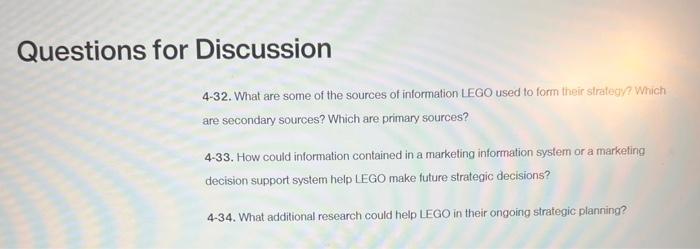
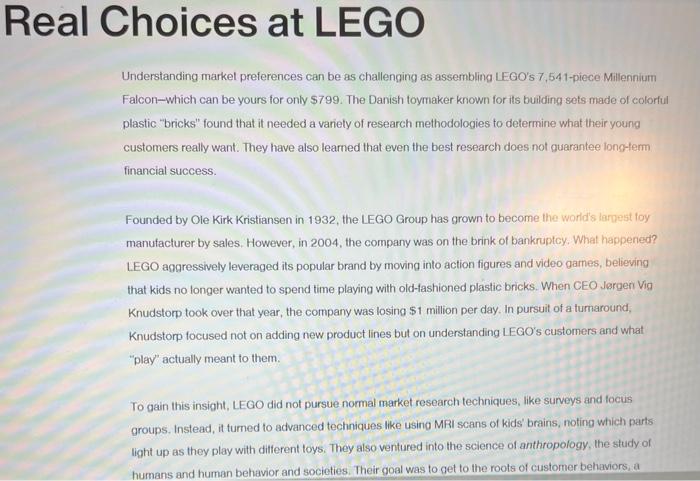
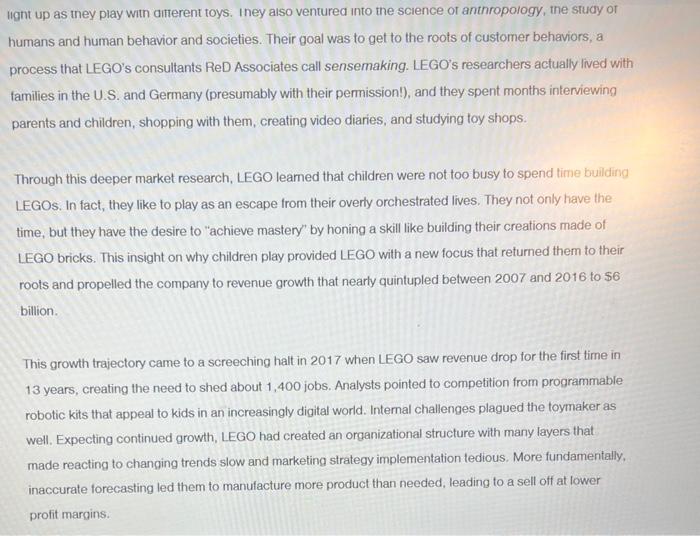
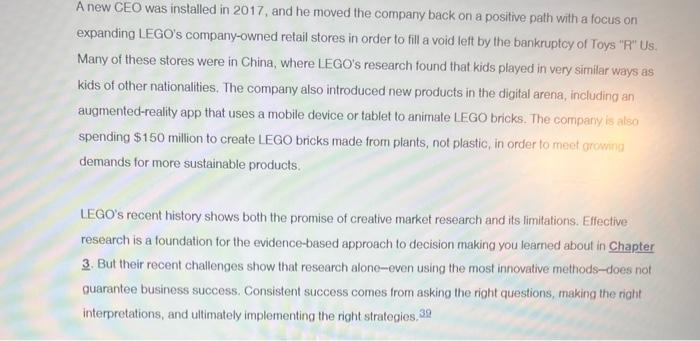
Questions for Discussion 4-32. What are some of the sources of information LEGO used to form their strategy which are secondary sources? Which are primary sources? 4-33. How could information contained in a marketing information system or a marketing decision support system help LEGO make future strategic decisions? 4-34. What additional research could help LEGO in their ongoing strategic planning? Real Choices at LEGO Understanding market preferences can be as challenging as assembling LEGO's 7,541-piece Millennium Falcon-which can be yours for only $799. The Danish toymaker known for its building sets made of colorful plastic "bricks" found that it needed a variety of research methodologies to determine what their young customers really want. They have also learned that even the best research does not guarantee long-term financial success Founded by Ole Kirk Kristiansen in 1932, the LEGO Group has grown to become the world's largest foy manufacturer by sales. However, in 2004, the company was on the brink of bankruptcy. What happened? LEGO aggressively leveraged its popular brand by moving into action figures and video games, believing that kids no longer wanted to spend time playing with old-fashioned plastic bricks. When CEO Jrgen Via Knudstorp took over that year, the company was losing $1 million per day. In pursuit of a turnaround, Knudstorp focused not on adding new product lines but on understanding LEGO's customers and what "play" actually meant to them. To gain this insight, LEGO did not pursue normal market research techniques, like surveys and focus groups. Instead, it turned to advanced techniques like using MRI scans of kids' brains, noting which parts light up as they play with different toys. They also ventured into the science of anthropology, the study of humans and human behavior and societies. Their goal was to get to the roots of customer behaviors, a light up as they play with different toys. They also ventured into the science of anthropology, the study of humans and human behavior and societies. Their goal was to get to the roots of customer behaviors, a process that LEGO's consultants ReD Associates call sensemaking. LEGO's researchers actually lived with families in the U.S. and Germany (presumably with their permission!), and they spent months interviewing parents and children, shopping with them, creating video diaries, and studying toy shops. Through this deeper market research, LEGO learned that children were not too busy to spend time building LEGOs. In fact, they like to play as an escape from their overly orchestrated lives. They not only have the time, but they have the desire to achieve mastery' by honing a skill like building their creations made of LEGO bricks. This insight on why children play provided LEGO with a new focus that returned them to their roots and propelled the company to revenue growth that nearly quintupled between 2007 and 2016 to $6 billion This growth trajectory came to a screeching halt in 2017 when LEGO saw revenue drop for the first time in 13 years, creating the need to shed about 1,400 jobs. Analysts pointed to competition from programmable robotic kits that appeal to kids in an increasingly digital world. Internal challenges plagued the toymaker as well. Expecting continued growth, LEGO had created an organizational structure with many layers that made reacting to changing trends slow and marketing strategy implementation tedious. More fundamentally, inaccurate forecasting led them to manufacture more product than needed, leading to a sell off at lower profit margins. A new CEO was installed in 2017, and he moved the company back on a positive path with a focus on expanding LEGO's company-owned retail stores in order to fill a void left by the bankruptcy of Toys"R"Us. Many of these stores were in China, where LEGO's research found that kids played in very similar ways as kids of other nationalities. The company also introduced new products in the digital arena, including an augmented reality app that uses a mobile device or tablet to animate LEGO bricks. The company is also spending $150 million to create LEGO bricks made from plants, not plastic, in order to meet growing demands for more sustainable products LEGO's recent history shows both the promise of creative market research and its limitations. Effective research is a foundation for the evidence-based approach to decision making you learned about in Chapter 3. But their recent challenges show that research alone-even using the most innovative methods-does not guarantee business success. Consistent success comes from asking the right questions, making the right interpretations, and ultimately implementing the right strategies, 32
Step by Step Solution
There are 3 Steps involved in it
1 Expert Approved Answer
Step: 1 Unlock

Question Has Been Solved by an Expert!
Get step-by-step solutions from verified subject matter experts
Step: 2 Unlock
Step: 3 Unlock
 Study Help