







Question: answer fully please! 4. Recent research indicates that in some bacteria, when an anticodon attempts to hydrogen bond to a codon, two parts of the
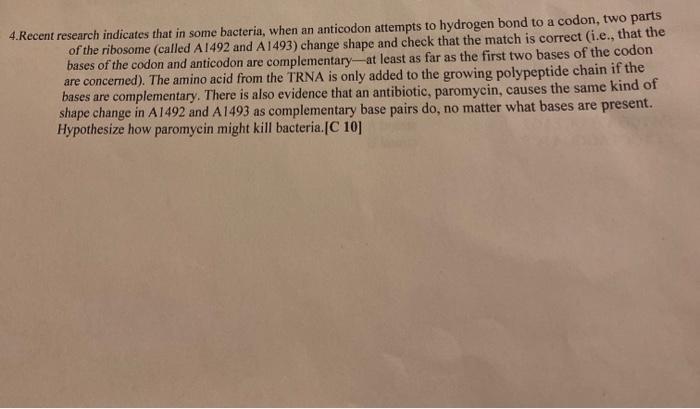
4. Recent research indicates that in some bacteria, when an anticodon attempts to hydrogen bond to a codon, two parts of the ribosome (called A1492 and A1493) change shape and check that the match is correct (i.e., that the bases of the codon and anticodon are complementary-at least as far as the first two bases of the codon are concerned). The amino acid from the TRNA is only added to the growing polypeptide chain if the bases are complementary. There is also evidence that an antibiotic, paromycin, causes the same kind of shape change in A 1492 and A1493 as complementary base pairs do, no matter what bases are present. Hypothesize how paromycin might kill bacteria.C 10] 4. Recent research indicates that in some bacteria, when an anticodon attempts to hydrogen bond to a codon, two parts of the ribosome (called A1492 and A1493) change shape and check that the match is correct (i.e., that the bases of the codon and anticodon are complementary-at least as far as the first two bases of the codon are concerned). The amino acid from the TRNA is only added to the growing polypeptide chain if the bases are complementary. There is also evidence that an antibiotic, paromycin, causes the same kind of shape change in A 1492 and A1493 as complementary base pairs do, no matter what bases are present. Hypothesize how paromycin might kill bacteria.C 10]
Step by Step Solution
There are 3 Steps involved in it

Get step-by-step solutions from verified subject matter experts
 Study Help