







Question: Answer in python: The banded, upper triangular matrix A E RnXn can be written as 0 a2 b2 c2 0 3 3 an-2 bn-2 Cn-2
Answer in python:
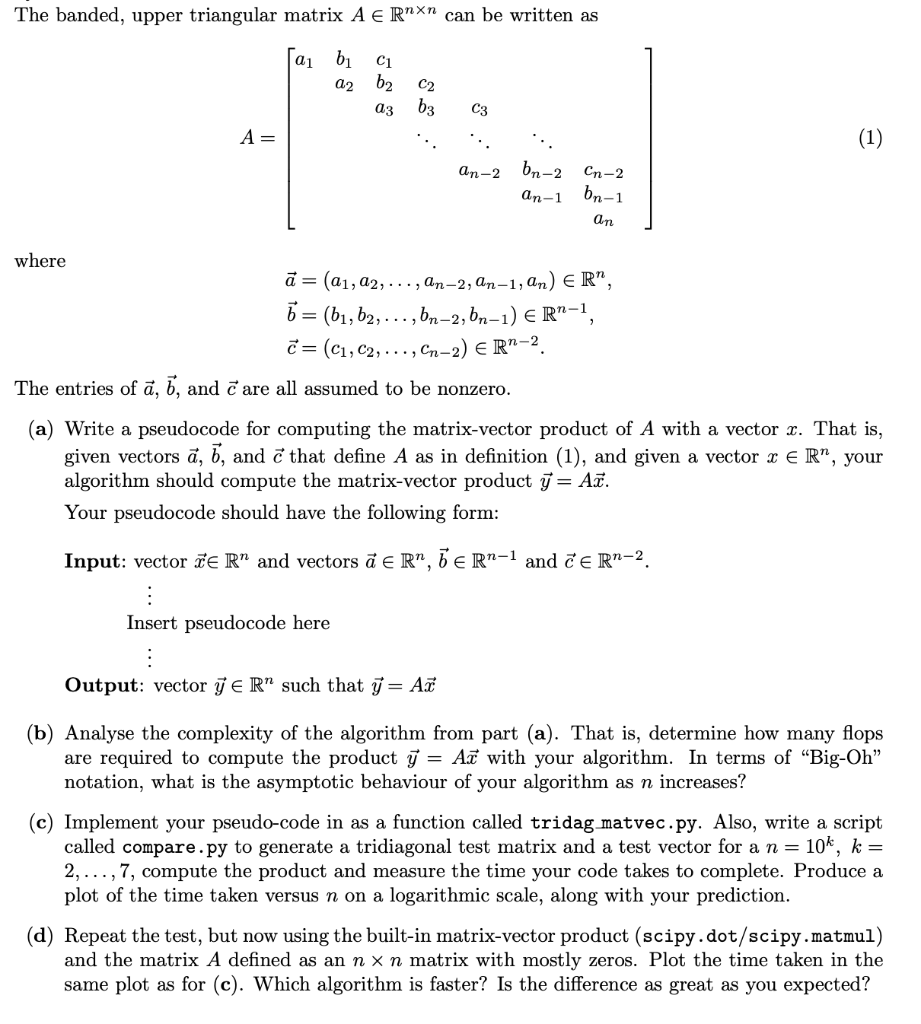
The banded, upper triangular matrix A E RnXn can be written as 0 a2 b2 c2 0 3 3 an-2 bn-2 Cn-2 where (, , an-2,an-1, an) E R", 6- (bi,b2,...,bn-2,bn,-1) R-1, n-2 The entries of , b, and are all assumed to be nonzero (a) Write a pseudocode for computing the matrix-vector product of A with a vector x. That is, given vectors a, b, and c that define A as in definition (1), and given a vector x E Rn, your algorithm should compute the matrix-vector product y- Aa Your pseudocode should have the following form Input: vector re Rn and vectors a E R", be Rn-i and Rn-2 Insert pseudocode here Output: vector fE R" such that y- At (b) Analyse the complexity of the algorithm from part (a). That is, determine how many flops are required to compute the product y - Ai with your algorithm. In terms of "Big-Oh" notation, what is the asymptotic behaviour of your algorithm as n increases? (c) Implement your pseudo-code in as a function called tridag matvec.py. Also, write a script called compare.py to generate a tridiagonal test matrix and a test vector for a n -10*, k- 2' .. , 7, compute the product and measure the time your code takes to complete. Produce a plot of the time taken versus n on a logarithmic scale, along with your prediction. (d) Repeat the test, but now using the built-in matrix-vector product (scipy.dot/scipy.matmul) and the matrix A defined as an n n matrix with mostly zeros. Plot the time taken in the same plot as for (c). Which algorithm is faster? Is the difference as great as you expectedi
Step by Step Solution
There are 3 Steps involved in it

Get step-by-step solutions from verified subject matter experts
 Study Help