







Question: answer it in typing .. Please answer all the questions.. I will give helpful immediately.. Just provide me a correct answer.. thank you Case Study





answer it in typing .. Please answer all the questions.. I will give helpful immediately.. Just provide me a correct answer.. thank you
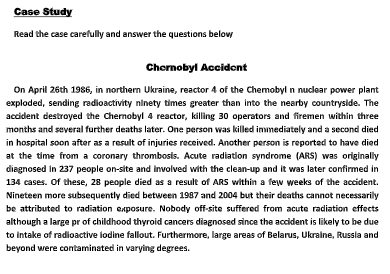
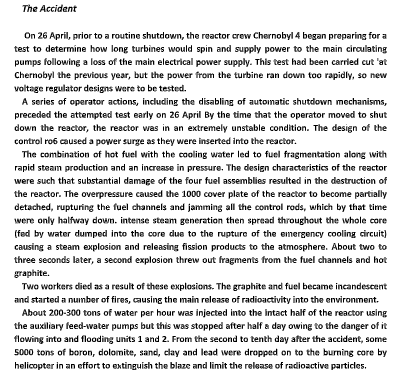
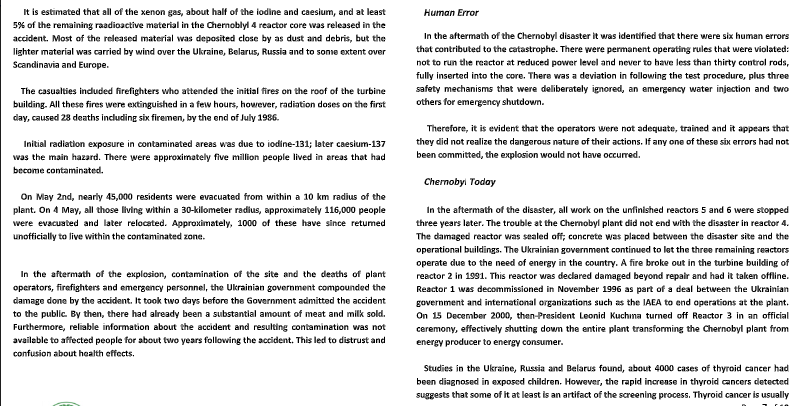
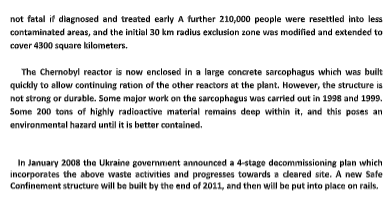
Case Study Read the case carefully and answer the questions below Chernobyl Accident On April 26th 1986, in northern Ukraine, reactor 4 of the Chemobyl n nuclear power plant exploded, sending radioactivity ninety times greater than into the nearby countryside. The accident destroyed the Chernobyl 4 reactor, killing 30 operators and firemen within three months and several further deaths later. One person was killed immediately and a second died in hospital soon after as a result of injuries received. Another person is reported to have died at the time from a coronary thrombosis. Acute radiation syndrome (ARS) was originally diagnosed in 237 people on-site and involved with the clean-up and it was later confirmed in 134 cases. Of these, 28 people died as a result of ARS within a few weeks of the accident. Nineteen more subsequently died between 1987 and 2004 but their deaths cannot necessarily be attributed to radiation exposure. Nobody off-site suffered from acute radiation effects although a large pr of childhood thyroid cancers diagnosed since the accident is likely to be due to intake of radioactive iodine fallout. Furthermore, large areas of Belarus, Ukraine, Russia and beyond were contaminated in varying degrees. The Accident On 26 April, prior to a routine shutdown, the reactor crew Chernobyl 4 began preparing for a test to determine how long turbines would spin and supply power to the main circulating pumps following a loss of the main electrical power supply. This test had been carried cut 'at Chernobyl the previous year, but the power from the turbine ran down too rapidly, so new voltage regulator designs were to be tested. A series of operator actions, including the disabling of automatic shutdown mechanisms, preceded the attempted test early on 26 April By the time that the operator moved to shut down the reactor, the reactor was in an extremely unstable condition. The design of the control ro6 caused a power surge as they were inserted into the reactor. The combination of hot fuel with the cooling water led to fuel fragmentation along with rapid steam production and an increase in pressure. The design characteristics of the reactor were such that substantial damage of the four fuel assemblies resulted in the destruction of the reactor. The overpressure caused the 1000 cover plate of the reactor to become partially detached, rupturing the fuel channels and jamming all the control rods, which by that time were only halfway down. intense steam generation then spread throughout the whole core (fed by water dumped into the core due to the rupture of the emergency cooling circuit) causing a steam explosion and releasing fission products to the atmosphere. About two to three seconds later, a second explosion threw out fragments from the fuel channels and hot graphite. Two workers died as a result of these explosions. The graphite and fuel became incandescent and started a number of fires, causing the main release of radioactivity into the environment. About 200-300 tons of water per hour was injected into the intact half of the reactor using the auxiliary feed-water pumps but this was stopped after half a day owing to the danger of it flowing into and flooding units 1 and 2. From the second to tenth day after the accident, some 5000 tons of boron, dolomite, sand, clay and lead were dropped on to the burning core by helicopter in an effort to extinguish the blaze and limit the release of radioactive particles. Human Error It is estimated that all of the xenon gas, about half of the iodine and caesium, and at least 5% of the remaining raadioactive material in the Chernobly 4 reactor core was released in the accident. Most of the released material was deposited close by as dust and debris, but the lighter material was carried by wind over the Ukraine, Belarus, Russia and to some extent over Scandinavia and Europe. In the aftermath of the Chernobyl disaster it was identified that there were six human errors that contributed to the catastrophe. There were permanent operating rules that were violated: not to run the reactor at reduced power level and never to have less than thirty control rods, fully inserted into the core. There was a deviation in following the test procedure, plus three safety mechanisms that were deliberately ignored, an emergency water injection and two others for emergency shutdown. The casualties included firefighters who attended the initial fires on the roof of the turbine building. All these fires were extinguished in a few hours, however, radiation doses on the first day, caused 28 deaths including six firemen, by the end of July 1986. Therefore, it is evident that the operators were not adequate, trained and it appears that they did not realize the dangerous nature of their actions. If any one of these six errors had not Initial radiation exposure in contaminated areas was due to iodine-131; later caesium-137 was the main hazard. There were approximately five million people lived in areas that had been committed the explosion would not have occurred. become contaminated. Chernobyl Today On May 2nd, nearly 45,000 residents were evacuated from within a 10 km radius of the plant. On 4 May, all those living within a 30-kilometer radius, approximately 116,000 people were evacuated and later relocated. Approximately, 1000 of these have since retumed unofficially to live within the contaminated zone. In the aftermath of the explosion, contamination of the site and the deaths of plant operators, firefighters and emergency personnel, the Ukrainian government compounded the damage done by the accident. It took two days before the Government admitted the accident to the public. By then, there had already been a substantial amount of meat and milk sold. Furthermore, reliable information about the accident and resulting contamination was not available to affected people for about two years following the accident. This led to distrust and In the aftermath of the disaster, all work on the unfinished reactors 5 and 6 were stopped three years later. The trouble at the Chernobyl plant did not end with the disaster in reactor 4. The damaged reactor was sealed off, concrete was placed between the disaster site and the operational buildings. The Ukrainian government continued to let the three remaining reactors operate due to the need of energy in the country. A fire broke out in the turbine building of reactor 2 in 1991. This reactor was declared damaged beyond repair and had it taken offline. Reactor 1 was decommissioned in November 1996 as part of a deal between the Ukrainian government and international organizations such as the IAEA to end aperations at the plant. On 15 December 2000, then-President Leonid Kuchma turned off Reactor 3 in an official ceremony, effectively shutting down the entire plant transforming the Chernobyl plant from energy producer to energy consumer. confusion about health effects. Studies in the Ukraine, Russia and Belarus found, about 4000 cases of thyroid cancer had been diagnosed in exposed children. However, the rapid incrense in thyroid cancers detected suggests that some of it at least is an artifact of the screening process. Thyroid cancer is usually not fatal if diagnosed and treated early A further 210,000 people were resettled into less contaminated areas, and the initial 30 km radius exclusion zone was modified and extended to cover 4300 square kilometers. The Chernobyl reactor is now enclosed in a large concrete sarcophagus which was built quickly to allow continuing ration of the other reactors at the plant. However, the structure is not strong or durable. Some major work on the sarcophagus was carried out in 1998 and 1999. Some 200 tons of highly radioactive material remains deep within it, and this poses an environmental hazard until it is better contained. In January 2008 the Ukraine government announced a 4-stage decommissioning plan which incorporates the above waste activities and progresses towards a cleared site. A new Sale Confinement structure will be built by the end of 2011, and then will be put into place on rails. Case Questions: 1. What are the short-term effects of the Chernobyl nuclear power plant explosion? Discuss. 2. What are the long-term effects of the Chernobyl nuclear power plant explosion? Discuss 3. What pair/s of principles in moral reasoning had not been used in the Chernobyl nuclear power plant case to have prevented the explosion? Explain 4. If you are asked to help the Chernobyl nuclear power plant to prevent explosion in the future, what will you suggest? Detail your suggestions. REFLECTION WHAT DID I LEARNStep by Step Solution
There are 3 Steps involved in it
1 Expert Approved Answer
Step: 1 Unlock

Question Has Been Solved by an Expert!
Get step-by-step solutions from verified subject matter experts
Step: 2 Unlock
Step: 3 Unlock
 Study Help