







Question: answer only #3. second to last paragraph where it says stanford 1988-1989 is the info you need to answer the question NIH Ind X G
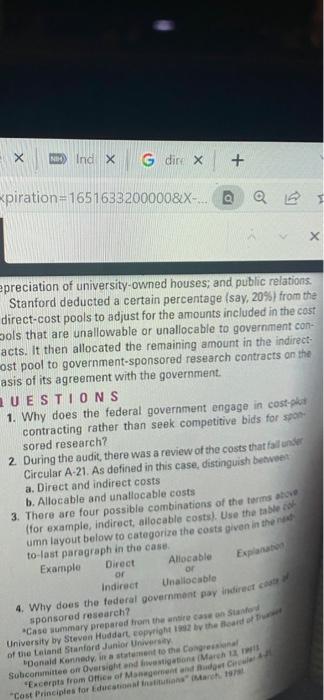
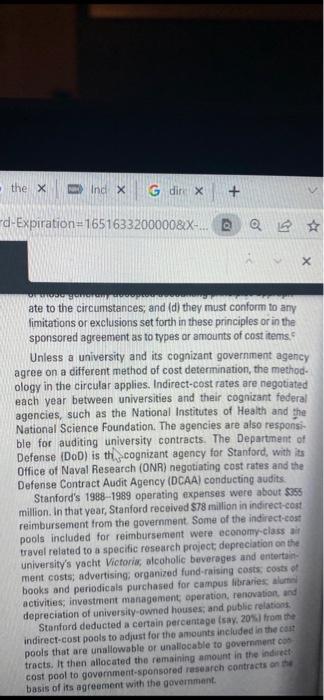
NIH Ind X G dire x + piration=16516332000008X- QQ epreciation of university-owned houses; and public relations. Stanford deducted a certain percentage (say, 20%) from the direct-cost pools to adjust for the amounts included in the cost ols that are unallowable or unallocable to government con- acts. It then allocated the remaining amount in the indirect ost pool to government-sponsored research contracts on the asis of its agreement with the government. UESTIONS 1. Why does the federal government engage in costo contracting rather than seek competitive bids for spor sored research? 2. During the audit, there was a review of the costs that failunder Circular A-21. As defined in this case, distinguish between a. Direct and indirect costs b. Allocable and unallocable costs 3. There are four possible combinations of the terms (for example, indirect, allocable costs. Use the table.com umn layout below to categorize the costs given in the to-last paragraph in the case, Example Direct Allocable Indirect Unallocable 4. Why does the federal government pay indirect sponsored research? Case summary prepared from the wire case and University by Steven Huddart copyright by the Board of of the teland Stanford Junior University "Donald Kennedy, in a statement to the Congres Subcommittee on Oversigton (March Excerpt from Office of Mong and "Cost Principles for Educational Mar Explana Of or the x M] Ind X G dir x + d-Expiration=1651633200000&X-Q ate to the circumstances, and (d) they must conform to any limitations or exclusions set forth in these principles or in the sponsored agreement as to types or amounts of cost items Unless a university and its cognizant government agency agree on a different method of cost determination, the method. ology in the circular applies. Indirect-cost rates are negotiated each year between universities and their cognizant federal agencies, such as the National Institutes of Health and the National Science Foundation. The agencies are also responsi ble for auditing university contracts. The Department of Defense (DoD) is the cognizant agency for Stanford, with its Office of Naval Research (ONR) negotiating cost rates and the Defense Contract Audit Agency (DCAA) conducting audits Stanford's 1988-1989 operating expenses were about $355 million. In that year, Stanford received $78 million in indirect-cost reimbursement from the government Some of the indirect-cost pools included for reimbursement were economy-class travel related to a specific research project depreciation on the university's yacht Victoria, alcoholic beverages and entertain ment costs, advertising, organized fundraising costs: costs of books and periodicals purchased for campus libraries are activities, investment management operation, renovation and depreciation of university-owned houses and public relations Stanford deducted a certain percentage (say, 20% from the indirect-cost pools to adjust for the amounts included in the cost pools that are unallowable or unallocable to government tracts. It then allocated the remaining amount in the indirect cost pool to government-sponsored research contracts on basis of its agreement with the government NIH Ind X G dire x + piration=16516332000008X- QQ epreciation of university-owned houses; and public relations. Stanford deducted a certain percentage (say, 20%) from the direct-cost pools to adjust for the amounts included in the cost ols that are unallowable or unallocable to government con- acts. It then allocated the remaining amount in the indirect ost pool to government-sponsored research contracts on the asis of its agreement with the government. UESTIONS 1. Why does the federal government engage in costo contracting rather than seek competitive bids for spor sored research? 2. During the audit, there was a review of the costs that failunder Circular A-21. As defined in this case, distinguish between a. Direct and indirect costs b. Allocable and unallocable costs 3. There are four possible combinations of the terms (for example, indirect, allocable costs. Use the table.com umn layout below to categorize the costs given in the to-last paragraph in the case, Example Direct Allocable Indirect Unallocable 4. Why does the federal government pay indirect sponsored research? Case summary prepared from the wire case and University by Steven Huddart copyright by the Board of of the teland Stanford Junior University "Donald Kennedy, in a statement to the Congres Subcommittee on Oversigton (March Excerpt from Office of Mong and "Cost Principles for Educational Mar Explana Of or the x M] Ind X G dir x + d-Expiration=1651633200000&X-Q ate to the circumstances, and (d) they must conform to any limitations or exclusions set forth in these principles or in the sponsored agreement as to types or amounts of cost items Unless a university and its cognizant government agency agree on a different method of cost determination, the method. ology in the circular applies. Indirect-cost rates are negotiated each year between universities and their cognizant federal agencies, such as the National Institutes of Health and the National Science Foundation. The agencies are also responsi ble for auditing university contracts. The Department of Defense (DoD) is the cognizant agency for Stanford, with its Office of Naval Research (ONR) negotiating cost rates and the Defense Contract Audit Agency (DCAA) conducting audits Stanford's 1988-1989 operating expenses were about $355 million. In that year, Stanford received $78 million in indirect-cost reimbursement from the government Some of the indirect-cost pools included for reimbursement were economy-class travel related to a specific research project depreciation on the university's yacht Victoria, alcoholic beverages and entertain ment costs, advertising, organized fundraising costs: costs of books and periodicals purchased for campus libraries are activities, investment management operation, renovation and depreciation of university-owned houses and public relations Stanford deducted a certain percentage (say, 20% from the indirect-cost pools to adjust for the amounts included in the cost pools that are unallowable or unallocable to government tracts. It then allocated the remaining amount in the indirect cost pool to government-sponsored research contracts on basis of its agreement with the government
Step by Step Solution
There are 3 Steps involved in it

Get step-by-step solutions from verified subject matter experts
 Study Help