



Question: Answer the case study questions St- on, ed age. Dr. Butler's friend retorted, But doc, my right knee is also 100 years old, and it
Answer the case study questions 
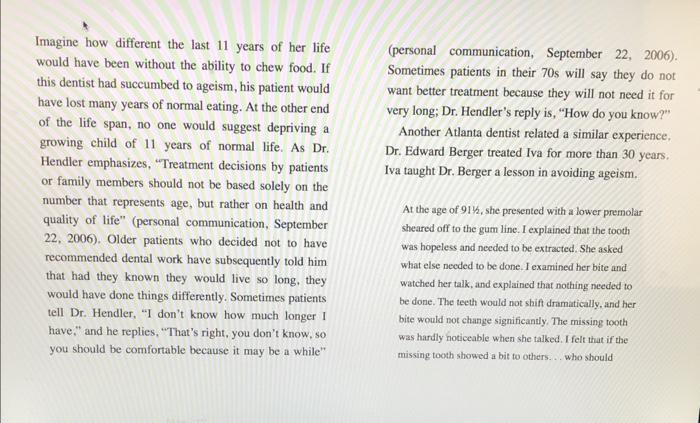
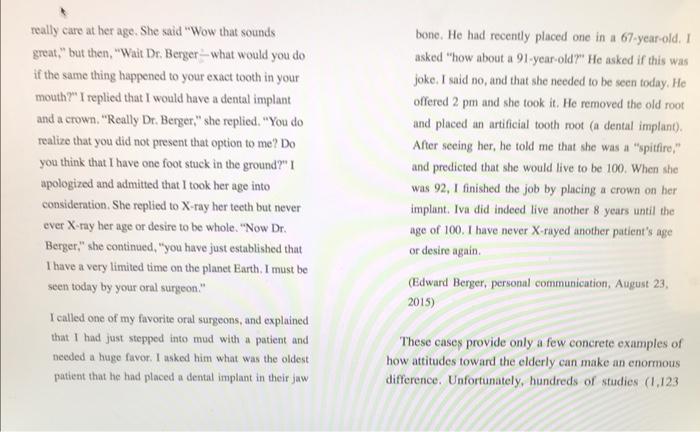
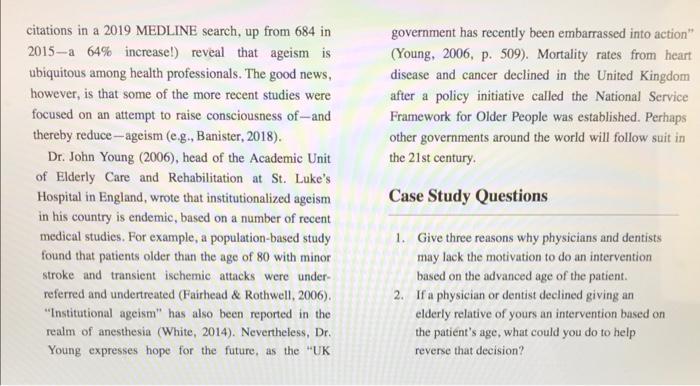
St- on, ed age." Dr. Butler's friend retorted, "But doc, my right knee is also 100 years old, and it doesn't hurt!" In this case, the physician's lack of knowledge (or at least inadequate diagnosis) resulted in a fairly benign outcome, although the patient's left knee did not receive treatment. However, it is difficult to imagine a 25-year-old being told that an ailment was the result of his or her age. Dr. Kevin Hendler specializes in geriatric dentistry at Emory Healthcare in Atlanta, Georgia. He related the following incident (Hendler, 2005). A 97-year-old woman presented with the need for some dental work. The patient and her family were not very enthusiastic about dental work, assuming that the older lady did not have much longer to live anyway, given her age. Dr. Hendler convinced her to go ahead with the dental work, and the lady went on to live to the age of 108. Case Study: Ageism Dr. Robert Butler, a physician who founded the National Institute on Aging in the United States, related the following incident involving a centenarian friend. His 100-year-old friend had a pain in his left knee, so he went to see his internist about it. After examining the patient, the doctor concluded that it was just "old (personal communication, September 22, 2006). Sometimes patients in their 70s will say they do not want better treatment because they will not need it for very long; Dr. Hendler's reply is, "How do you know?" Another Atlanta dentist related a similar experience, Dr. Edward Berger treated Iva for more than 30 years. Iva taught Dr. Berger a lesson in avoiding ageism. Imagine how different the last 11 years of her life would have been without the ability to chew food. If this dentist had succumbed to ageism, his patient would have lost many years of normal eating. At the other end of the life span, no one would suggest depriving a growing child of 11 years of normal life. As Dr. Hendler emphasizes, "Treatment decisions by patients or family members should not be based solely on the number that represents age, but rather on health and quality of life" (personal communication, September 22, 2006). Older patients who decided not to have recommended dental work have subsequently told him that had they known they would live so long, they would have done things differently. Sometimes patients tell Dr. Hendler, "I don't know how much longer ! have" and he replies, "That's right, you don't know, so you should be comfortable because it may be a while" At the age of 91%, she presented with a lower premolar sheared off to the gum line. I explained that the tooth was hopeless and needed to be extracted. She asked what else needed to be done. I examined her bite and watched her talk, and explained that nothing needed to be done. The teeth would not shift dramatically, and her bite would not change significantly. The missing tooth was hardly noticeable when she talked. I felt that if the missing tooth showed a bit to others who should really care at her age. She said "Wow that sounds great, but then, "Wait Dr. Berger-what would you do if the same thing happened to your exact tooth in your mouth?" I replied that I would have a dental implant and a crown. "Really Dr. Berger," she replied, "You do realize that you did not present that option to me? Do you think that I have one foot stuck in the ground?" I apologized and admitted that I took her age into consideration. She replied to X-ray her teeth but never ever X-ray her age or desire to be whole. "Now Dr. Berger," she continued, "you have just established that I have a very limited time on the planet Earth, I must be seen today by your oral surgeon." I called one of my favorite oral surgeons, and explained that I had just stepped into mud with a patient and needed a huge favor. I asked him what was the oldest patient that he had placed a dental implant in their juw bone. He had recently placed one in a 67-year-old. I asked "how about a 91-year-old?" He asked if this was joke. I said do, and that she needed to be seen today. He offered 2 pm and she took it. He removed the old root and placed an artificial tooth root (a dental implant). After seeing her, he told me that she was a "spitfire." and predicted that she would live to be 100. When she was 92, I finished the job by placing a crown on her implant. Iva did indeed live another 8 years until the age of 100. I have never X-rayed another patient's age or desire again (Edward Berger, personal communication, August 23 2015) These cases provide only a few concrete examples of how attitudes toward the elderly can make an enormous difference. Unfortunately, hundreds of studies (1,123 government has recently been embarrassed into action" (Young, 2006, p. 509). Mortality rates from heart disease and cancer declined in the United Kingdom after a policy initiative called the National Service Framework for Older People was established. Perhaps other governments around the world will follow suit in the 21st century citations in a 2019 MEDLINE search, up from 684 in 2015-a 64% increase!) reveal that ageism is ubiquitous among health professionals. The good news, however, is that some of the more recent studies were focused on an attempt to raise consciousness of- and thereby reduce-ageism (e.g., Banister, 2018). Dr. John Young (2006), head of the Academic Unit of Elderly Care and Rehabilitation at St. Luke's Hospital in England, wrote that institutionalized ageism in his country is endemic, based on a number of recent medical studies. For example, a population-based study found that patients older than the age of 80 with minor stroke and transient ischemic attacks were under referred and undertreated (Fairhead & Rothwell, 2006). "Institutional ageism" has also been reported in the realm of anesthesia (White, 2014). Nevertheless, Dr. Young expresses hope for the future, as the "UK Case Study Questions 1. Give three reasons why physicians and dentists may lack the motivation to do an intervention based on the advanced age of the patient. 2. If a physician or dentist declined giving an elderly relative of yours an intervention based on the patient's age, what could you do to help reverse that decision
Step by Step Solution
There are 3 Steps involved in it
1 Expert Approved Answer
Step: 1 Unlock

Question Has Been Solved by an Expert!
Get step-by-step solutions from verified subject matter experts
Step: 2 Unlock
Step: 3 Unlock