







Question: answer the first pic please? Introduction Identify the key problems and issues in the case study. Formulate and include a thesis statement, summarizing the outcome
answer the first pic please? 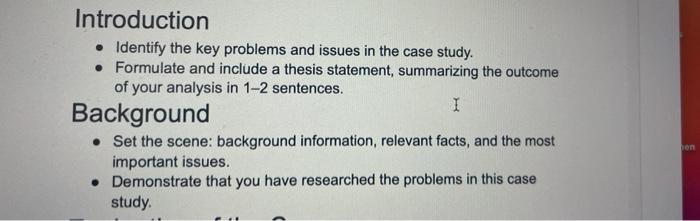
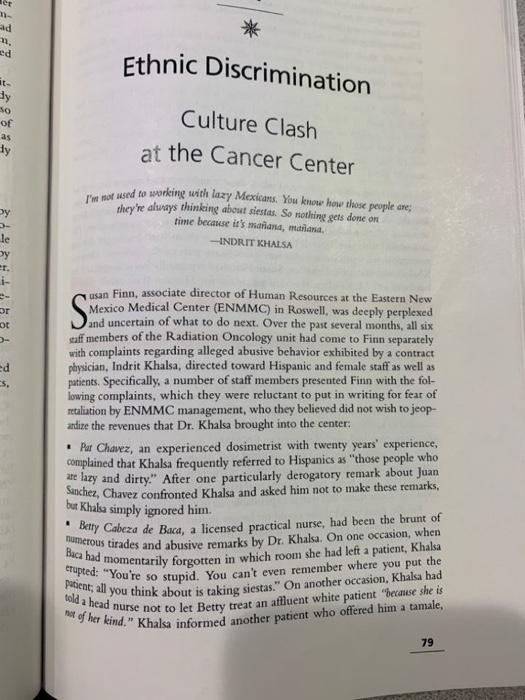
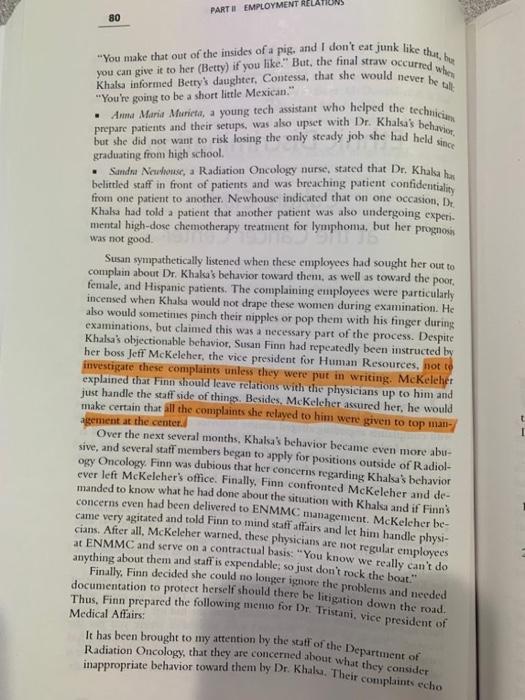
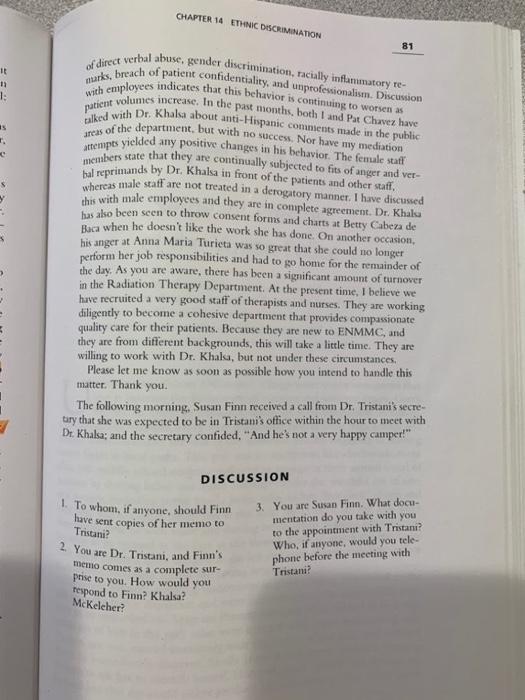
Introduction Identify the key problems and issues in the case study. Formulate and include a thesis statement, summarizing the outcome of your analysis in 1-2 sentences. I Background Set the scene: background information, relevant facts, and the most important issues. Demonstrate that you have researched the problems in this case study con CE ad ed Ethnic Discrimination it. Aly so of as dy Culture Clash at the Cancer Center 'w morised to surking with lazy Mexicans. You know how those people are; they're always thinking about siestas. So nothing gets done on time because it's mariana, mariana, - INDRIT KHALSA le i- or or S. ed -5, usan Finn, associate director of Human Resources at the Eastern New Mexico Medical Center (ENMMC) in Roswell, was deeply perplexed and uncertain of what to do next. Over the past several months, all six staff members of the Radiation Oncology unit had come to Finn separately with complaints regarding alleged abusive behavior exhibited by a contract physician, Indrit Khalsa, directed toward Hispanic and female staff as well as patients. Specifically, a number of staff members presented Finn with the fol- lowing complaints, which they were reluctant to put in writing for fear of retaliation by ENMMC management, who they believed did not wish to jeop- andize the revenues that Dr. Khalsa brought into the center: . Par Chavez, an experienced dosimetrist with twenty years' experience, complained that Khalsa frequently referred to Hispanics as "those people who aze lazy and dirty." After one particularly derogatory remark about Juan Suchez, Chavez confronted Khalsa and asked him not to make these remarks, but Khaka simply ignored him. Betty Cabeza de Baca, a licensed practical nurse, had been the brunt of numerous tirades and abusive remarks by Dr. Khalsa. On one occasion, when Baca had momentarily forgotten in which room she had left a patient, Khalsa erupted: "You're so stupid. You can't even remember where you put the patient; all you think about is taking siestas." On another occasion, Khalsa had told a head nurse not to let Betty treat an affluent white patient because she is net of her kind." Khalsa informed another patient who offered him a tamale, 79 PART EMPLOYMENT 80 "You make that out of the insides of a pig, and I don't eat junk like that, Khalsa informed Betty's daughter, Contessa, that she would never be tall: you can give it to her (Betty) if you like." But, the final straw occurred when "You're going to be a short little Mexican" . Amma Maria Murica, a young tech assistant who helped the technician prepure patients and their setups, was also upset with Dr. Khalsa's behavior but she did not want to risk losing the only steady job she had held since graduating from high school . Sandne Newhouse, a Radiation Oncology nurse stated that Dr. Khaka ha belittled staff in front of patients and was breaching patient confidentiality from one patient to another. Newhouse indicated that on one occasion, De Khalsa had told a patient that another patient was also undergoing experi- mental high-dose chemotherapy treatment for lymphoma, but her prognosis was not good Susan sympathetically listened when these employees had sought her out to complain about Dr. Khalsa's behavior toward them, as well as toward the poor, female, and Hispanic patients. The complaining employees were particularly incensed when Khalsa would not drape these women during examination. He also would sometimes pinch their nipples or pop them with his finger during examinations, but claimed this was a necessary part of the process. Despite Khalsa's objectionable behavior, Susan Finn had repeatedly been instructed by her boss Jeff McKeleher, the vice president for Human Resources, not to investigate these complaints unless they were put in writing. McKelehet explained that Finn should leave relations with the physicians up to him and just handle the staff side of things. Besides, McKelcher assured her, he would agement at the center make certain that all the complaints she relayed to him were given to top man Over the next several months, Khalsa's behavior became even more abu- sive, and several staff members began to apply for positions outside of Radiol- ogy Oncology. Finn was dubious that her concerns regarding Khalsa's behavior ever left McKelcher's office. Finally, Finn confronted McKeleher and de- manded to know what he had done about the situation with Khala and if Finn's concerns even had been delivered to ENMMC management. McKelcher be- cians. After all, McKeleher warned, these physicians are not regular employees came very agitated and told Finn to mind staff affairs and let him handle physi- at ENMMC and serve on a contractual basis: "You know we really can't do anything about them and staff is expendable, so just don't rock the boat." Finally, Finn decided she could no longer ignore the problems and needed documentation to protect herself should there be litigation down the road. Thus, Finn prepared the following memo for Dr. Tristani. vice president of Medical Affairs It has been brought to my attention by the staff of the Department of Radiation Oncology, that they are concerned about what they consider inappropriate behavior toward them by Dr. Khals. Their complaints echo CHAPTER 14 ETHNIC DISCRIMINATION It 11 1: 35 . 81 marks, breach of patient confidentiality, and unprofessionalism. Discussion of direct verbal abuse, gender discrimination, racially inflammatory re- with employees indicates that this behavior is continuing to worsen as patient volumes increase. In the past months, both I and Pat Chavez have talked with Dr. Khalsa about anti-Hispanic comnients made in the public areas of the department, but with no success. Nor have my mediation attempts yielded any positive changes in his behavior. The female staff members state that they are continually subjected to fits of anger and ver- bal reprimands by Dr. Khalsa in front of the patients and other staff. whereas male staff are not treated in a derogatory manner. I have discussed this with male employees and they are in complete agreement. Dr. Khalu has also been seen to throw consent forms and charts at Betty Cabeza de Baca when he doesn't like the work she has done. On another occasion, his anger at Anna Maria Turieta was so great that she could no longer perform her job responsibilities and had to go home for the remainder of the day. As you are aware, there has been a significant amount of turnover in the Radiation Therapy Department. At the present time, I believe we have recruited a very good staff of therapists and nurses. They are working diligently to become a cohesive department that provides compassionate quality care for their patients. Because they are new to ENMMC, and they are from different backgrounds, this will take a little time. They are willing to work with Dr. Khaka, but not under these circumstances. Please let me know as soon as possible how you intend to handle this matter. Thank you The following morning. Susan Finn received a call from Dr. Tristani's secre- tary that she was expected to be in Tristan's office within the hour to meet with Dr Khalsa; and the secretary confided, "And he's not a very happy camper!" . DISCUSSION Tristani? To whom, if anyone should Finn have sent copies of her memo to 2. You are Dr. Tristani, and Finn's memo comes as a complete sur- prise to you. How would you respond to Finn? Khalsa? 3. You are Susan Finn. What docu- mentation do you take with you to the appointment with Tristani? Who, if anyone, would you tele- phone before the meeting with Tristani? Mc Kelcher Step by Step Solution
There are 3 Steps involved in it
1 Expert Approved Answer
Step: 1 Unlock

Question Has Been Solved by an Expert!
Get step-by-step solutions from verified subject matter experts
Step: 2 Unlock
Step: 3 Unlock
 Study Help