







Question: Answer the following. LESSON 1 STRATEGIC MANAGEMENT ESSENTIALS OVERVIEW When CEOs from the big three US. automakersFord, General Motors (GM), and Chryslershowed up several years
Answer the following.
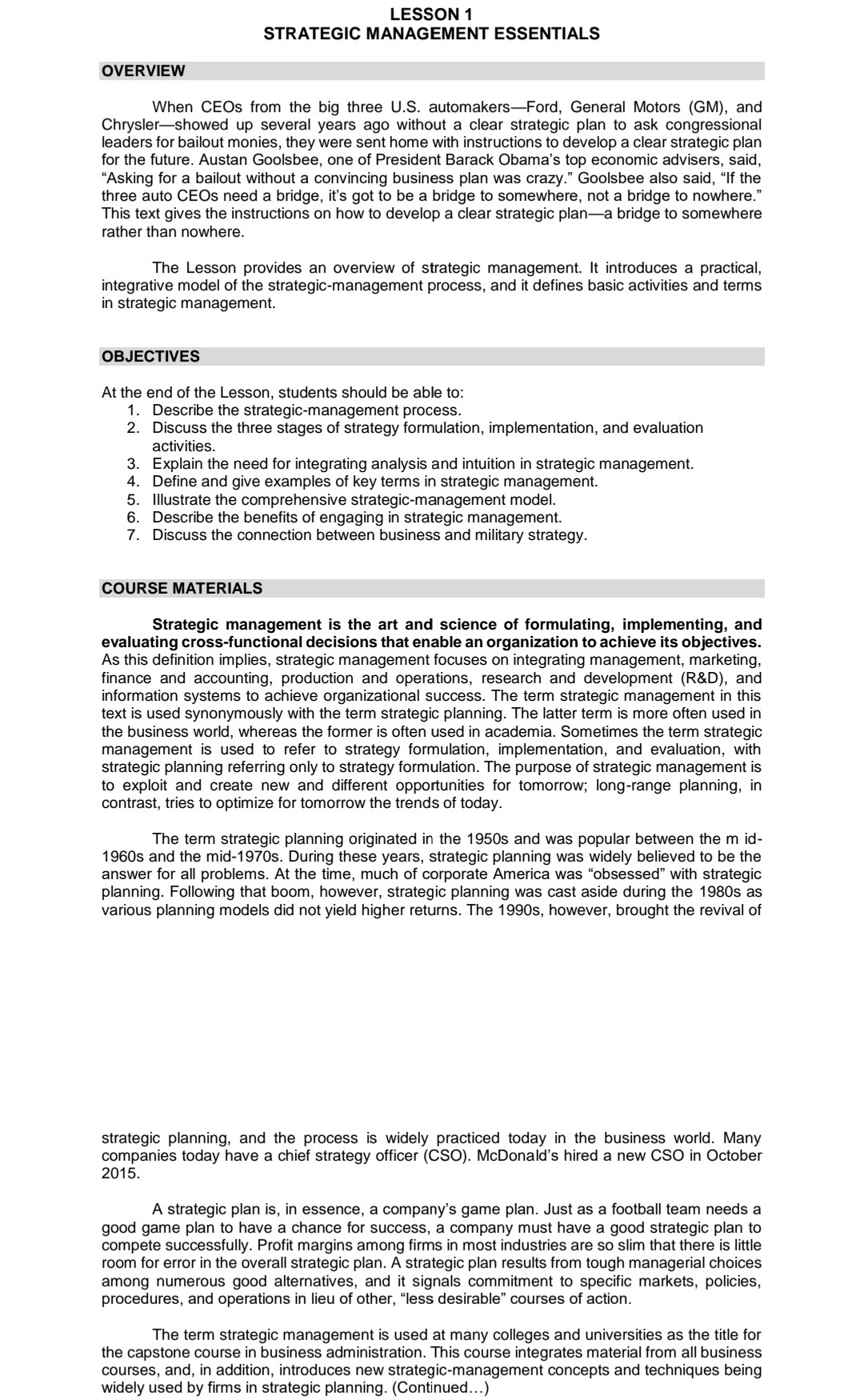
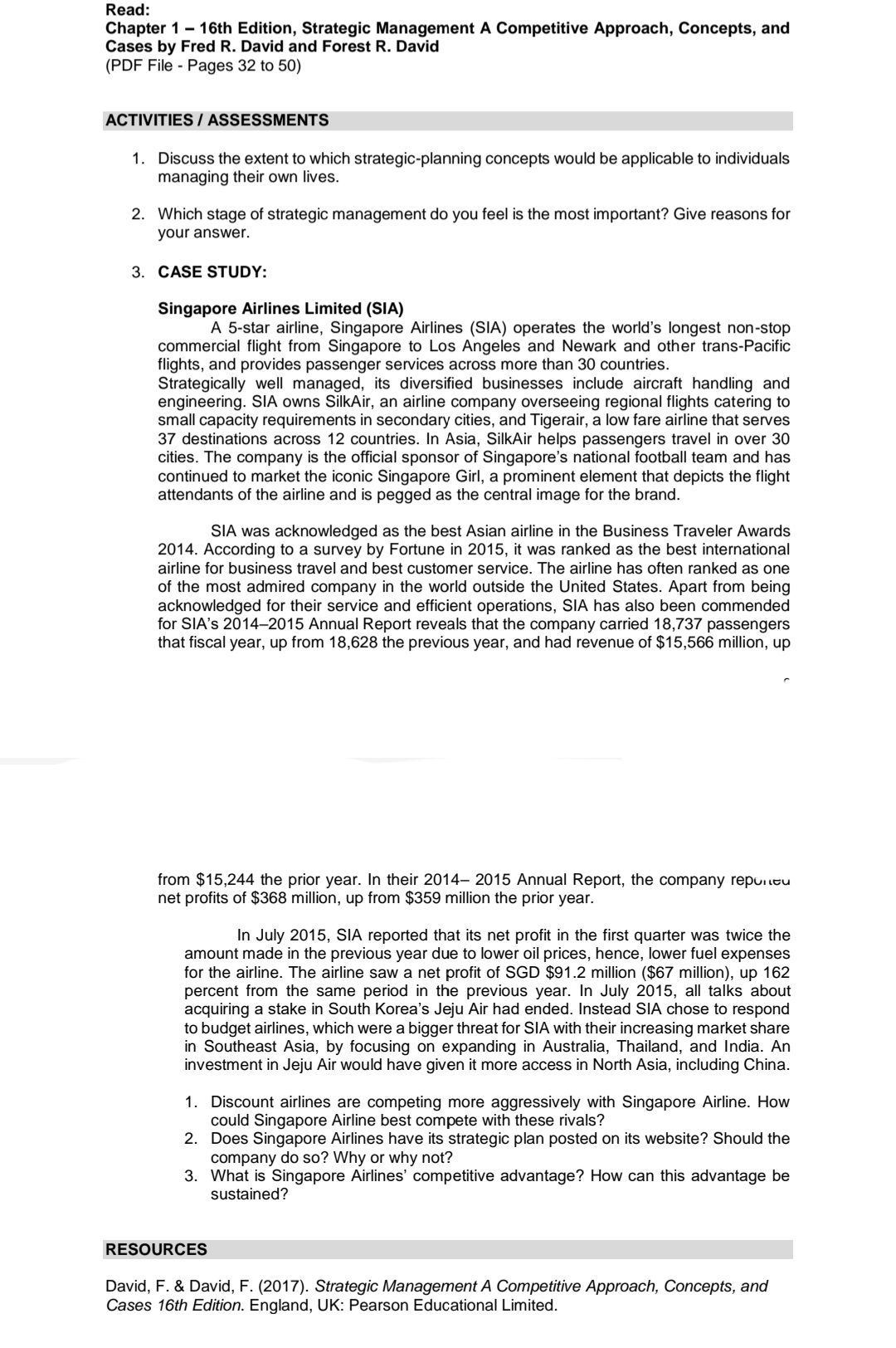
LESSON 1 STRATEGIC MANAGEMENT ESSENTIALS OVERVIEW When CEOs from the big three US. automakersFord, General Motors (GM), and Chryslershowed up several years ago without a clear strategic plan to ask congressional leaders for bailout monies. they were sent home with instructions to develop a clear strategic plan for the future. Austan Goolsbee, one of President Barack Obama's top economic advisers, said, \"Asking for a bailout without a convincing business plan was crazy.\" Goolsbee also said, \"If the three auto CEOs need a bridge, it's got to be a bridge to somewhere, not a bridge to nowhere.\" This text gives the instructions on how to develop a clear strategic plana bridge to somewhere rather than nowhere. The Lesson provides an overview of strategic management. It introduces a practical. integrative model of the strategic-management process. and it defines basic activities and terms in strategic management. OBJECTIVES At the end of the Lesson, students should be able to: 1. Describe the strategic-management process. 2. Discuss the three stages of strategy formulation, implementation, and evaluation activities. Explain the need for integrating analysis and intuition in strategic management. Define and give examples of key terms in strategic management. Illustrate the comprehensive strategic-management model. Describe the benefits of engaging in strategic management. Discuss the connection between business and military strategy. 749:9?!" COURSE MATERIALS Strategic management is the art and science of formulating, implementing, and evaluating cross-functional decisions that enable an organization to achieve its objectives. As this definition implies. strategic management focuses on integrating management, marketing, finance and acc0unting, production and operations, research and development (R&D), and information systems to achieve organizational success. The term strategic management in this text is used synonymously with the term strategic planning. The latter term is more often used in the business world, whereas the former is often used in academia. Sometimes the term strategic management is used to refer to strategy formulation, implementation, and evaluation, with strategic planning referring only to strategy formulation. The purpose of strategic management is to exploit and create new and different opportunities for tomorrow; long-range planning, in contrast, tries to optimize for tomorrow the trends of today. The term strategic planning originated in the 19505 and was popular between the m id- 19603 and the mid-1970s. During these years, strategic planning was widely believed to be the answer for all problems. At the time, much of corporate America was "obsessed\" with strategic planning. Following that boom, however, strategic planning was cast aside during the 19805 as various planning models did not yield higher returns. The 1990s, however, brought the revival of strategic planning, and the process is widely practiced today in the business world. Many companies today have a chief strategy officer (030). McDonald's hired a new 080 in October 2015. A strategic plan is, in essence, a company's game plan. Just as a football team needs a good game plan to have a chance for success, a company must have a good strategic plan to compete successfully. Profit margins among firms in most industries are so slim that there is little room for error in the overall strategic plan. A strategic plan results from tough managerial choices among numerous good alternatives, and it signals commitment to specific markets, policies, procedures, and operations in lieu of other, \"less desirable\" courses of action. The term strategic management is used at many colleges and universities as the title for the capstone course in business administration. This course integrates material from all business courses, and, in addition, introduces new strategic-management concepts and techniques being widely used by firms in strategic planning. (Continued...) Read: Chapter 1 - 16th Edition, Strategic Management A Competitive Approach, Concepts, and Cases by Fred R. David and Forest R. David (PDF File - Pages 32 to 50) ACTIVITIES I ASSESSMENTS 1 . Discuss the extent to which strategic-planning concepts would be applicable to individuals managing their own lives. 2. Which stage 0f strategic management do you feel is the most important? Give reasons for your answer. 3. CASE STUDY: Singapore Airlines Limited (SIA) A 5-star airline, Singapore Airlines (SIA) operates the wodd's longest non-stop commercial flight from Singapore to Los Angeles and Newark and other trans-Pacific flights. and provides passenger services across more than 30 countries. Strategically well managed. its diversified businesses include aircraft handling and engineering. SIA owns SilkAir, an airline company overseeing regional flights catering to small capacity requirements in secondary cities, and Tigerair. a low fare airline that serves 37 destinations across 12 countries. In Asia, SilkAir helps passengers travel in over 30 cities. The company is the official sponsor of Singapore's national football team and has continued to market the iconic Singapore Girl, a prominent element that depicts the flight attendants of the airline and is pegged as the central image for the brand. SIA was acknowledged as the best Asian airline in the Business Traveler Awards 2014. According to a survey by Fortune in 2015, it was ranked as the best international airline for business travel and best customer service. The airline has often ranked as one of the most admired company in the world outside the United States. Apart from being acknowledged for their service and efficient operations, SIA has also been commended for SIA's 2014201 5 Annual Report reveals that the company carried 18,737 passengers that fiscal year, up from 18,628 the previous year, and had revenue of $15,566 million, up f. from $15,244 the prior year. In their 2014 2015 Annual Report, the company repeneu net profits of $368 million, up from $359 million the prior year. In July 2015, SIA reported that its net profit in the first quarter was twice the amount made in the previous year due to lower oil prices, hence, lower fuel expenses for the airline. The airline saw a net profit of SGD $91.2 million ($67 million), up 162 percent from the same period in the previous year. In July 2015, all talks about acquiring a stake in South Korea's Jeju Air had ended. Instead SIA chose to respond to budget airlines, which were a bigger threat for SIA with their increasing market share in Southeast Asia, by focusing on expanding in Australia, Thailand, and India. An investment in Jeju Air would have given it more access in North Asia, including China. 1. Discount airlines are competing more aggressively with Singapore Airline. How could Singapore Airline best compete with these rivals? 2. Does Singapore Airlines have its strategic plan posted on its website? Should the company do so? Why or why not? 3. What is Singapore Airlines' competitive advantage? How can this advantage be sustained? RESOURCES David, F. 31 David, F. (2017). Strategic ManagementA Competitive Approach, Concepts, and Cases 16th Edition. England, UK: Pearson Educational Limited
Step by Step Solution
There are 3 Steps involved in it

Get step-by-step solutions from verified subject matter experts
 Study Help