







Question: Answer the following question by either: Handwrite your solution, take a photo/scan, upload/attach the image directly or copy and paste an image of your solution
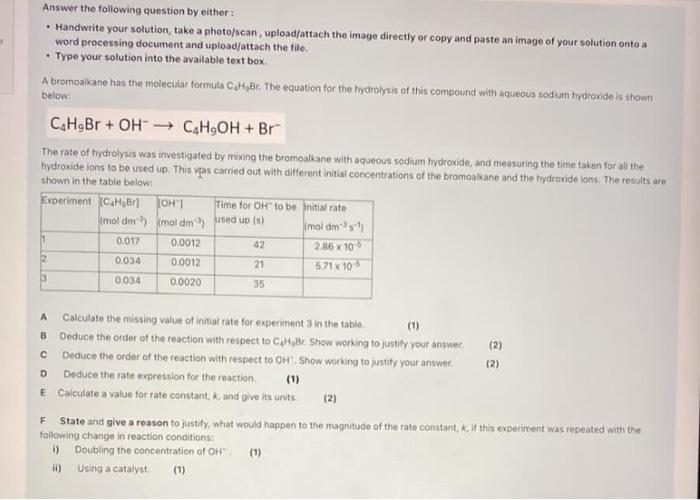
Answer the following question by either: Handwrite your solution, take a photo/scan, upload/attach the image directly or copy and paste an image of your solution onto a word processing document and upload/attach the file. Type your solution into the available text box. A bromoalkane has the molecular formula CaHaBr. The equation for the hydrolysis of this compound with aqueous sodium hydroxide is shown below: CH,Br+ OH CHOH + Br The rate of hydrolysis was investigated by mixing the bromoalkane with aqueous sodium hydroxide, and measuring the time taken for all the hydroxide ions to be used up. This was carried out with different initial concentrations of the bromoalkane and the hydroxide ions. The results are shown in the table below: Experiment (CaH,Br] [CH] Time for OH" to be initial rate used up (s) (mol dm) (mol dm-3) (mol dms) 0.017 0.0012 42 2.86 x 10 0.034 0.0012 21 5.71 x 10⁻⁵ 0.034 0.0020 35 A Calculate the missing value of initial rate for experiment 3 in the table. (1) 8 Deduce the order of the reaction with respect to CaHaBr. Show working to justify your answer. (2) (2) Deduce the order of the reaction with respect to OH. Show working to justify your answer. Deduce the rate expression for the reaction. D (1) E Calculate a value for rate constant, k, and give its units. (2) F State and give a reason to justify, what would happen to the magnitude of the rate constant, k, if this experiment was repeated with the following change in reaction conditions: () Doubling the concentration of OH (1) ii) Using a catalyst. (1)
Step by Step Solution
There are 3 Steps involved in it

Get step-by-step solutions from verified subject matter experts
 Study Help