







Question: Answer the following question with steps, note: don't copy from other sources, which are not correct at all. Thank you! Problem 1 [ll] marks] How
Answer the following question with steps, note: don't copy from other sources, which are not correct at all. Thank you!
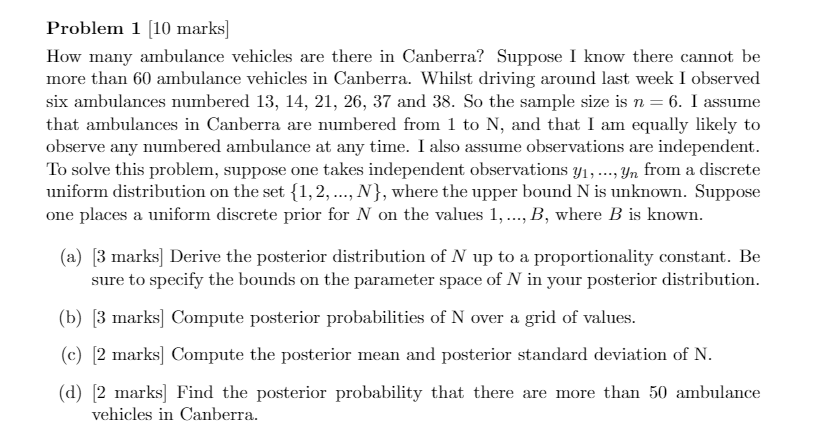
Problem 1 [ll] marks] How many ambulance vehicles are there in Canberra? lSuppose I lmow there cannot be more than fill ambulance vehicles in Canberra. Whilst driving around last week I observed six ambulances numbered 131 14, 21. 26, 37' and 38. So the sample size is n = 6. I assume that ambulances in Canberra are numbered from 1 to N, and that I am equally likely to observe any numbered ambulance at any time. I also assun'le observations are independent. To solve this problem, suppose one takes independent observations yl , ..., y\" from a discrete 1miform distribution on the set {1. 2, .-., N}, where the upper bound N is unknown. Suppose one places a uniform discrete prior for N on the values 1, ...,B, where B is known. (a) [3 marks] Derive the posterior distribution of N up to a proportionality constant. Be sure to specify the bounds on the parameter space of N in your posterior distribution. (b) [3 marks] Compute posterior probabilities of N over a grid of values. [c] [2 marks] Compute the posterior mean and posterior standard deviation of N. (d) [2 marks] Find the posterior probability that there are more than 51] ambulance vehicles in Canberra
Step by Step Solution
There are 3 Steps involved in it

Get step-by-step solutions from verified subject matter experts
 Study Help