



Question: Answer the following questions: 1. What are the root causes hindering effective change management for GSC? 2. What change management theory/model would you use to
Answer the following questions:
1. What are the root causes hindering effective change management for GSC?
2. What change management theory/model would you use to assist GSC with the impending change to their operational philosophy which incorporates TIC? (Explain why the chosen model would work.)
3. What are some possible data collection methods a consultant could use to better understand the deeper issue impacting staff willingness to adopt TIC?
4. When considering that people are the most important asset to any organization, what would you do to motivate the team to adopt TIC (tools, exercises, workshops, etc.)?
5. Leadership is often associated with power, authority, and a sense of privileged identity, especially in the Western context. Leaders are often rewarded for taking action and achieving results, but at what cost to the people in the organization and the constituents served? How is Dana critically and ethically reflecting on the use of her power to effect change at GSC?
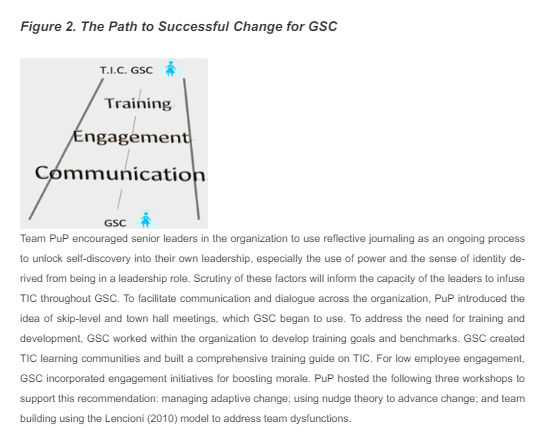
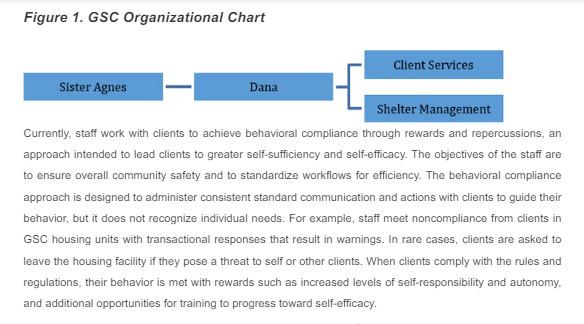
\fSAGE SAGE Business Cases '@ Bemice Ledbetter, Carla D. Gilhuys, Ed Hodge, Naomi Kelly, Somya Abstract Good Sister Center (GEC) for women and children experiencing homelessness has offered sup- portive resources through the help of private donations and public grants. In the past it operated using older philosophies, but now the trauma informed care (TIC) approach may change how staff provide day-to-day service for those who reside at GSC. The associate director in charge, howewer, found she had not gained staff buy-in, which was crucial to client services. This case encourages students to examine the impact of change on employees and how to address issues that may prevent change. Case Learning Outcomes By the end of this case study, students should be able to: = describe and discuss the change managemeant challenge that GSC is facing; - identify and describe the presenting issue, and discuss the difference between a presenting issue (symptom) and a deeper issue; = determing root causes hindering effective change management based on data findings; and = propose actions that will enable GSC to overcome change management challenges and successfully implement change. Introduction Drana has been the associate director at Good Sister Center (GSC) for homeless women and children for the past 18 months. To keep the center's doors open to the homeless women and children of Los Angeles, GSC needed an operational change, adopting the new industry standard of trauma informed care (TIC). GSC's funding has comprised private donations, public grants, and private grants from the government and corpora- tions, and recently these organizations have announced that they believe in the benefits of a TIC approach. Donors now require that all non-profit organizations verify they are TIC-compliant in order to receive funding. GS5C Management 535C's mission is to empower women and their children to move from homelessness to self-sufficiency, through housing, employment, and support services. GSC offers three core programs to address dients' needs for shelter, food. and case management. Clients who reside in G3C housing units are expected to comply with a set of rules and guidelines designed to assist them with this process. 55Cs management team consists of a resident nun, Sister Agnes, and an associate director, Dana, who work side-by-side with each other. Sister Agnes, who has served as the resident nun for several decades, is the face of the organization while Dana, the associate director, nuns the organization's day-to-day operations. The resident nun is responsible for every aspect of GSC and reports up to the Catholic Charities Office. The resident nun's approach with staff is relational, listening to their feelings and considering their well-being in each situation. The associate director is a licensed social worker. She manages all aspects of the clinical, financial and operational aspects of GSC. She reports directly to Sister Agnes. The associate director's man- agement approach to running the daily operations, and in particular when attempting to lead change, is task focused, which may be expenenced as insensitive by her staff. Figure 1. GSC Organizational Chart -[= Currently, staff work with clients to achieve behavioral compliance through rewards and repercussions, an approach intended to lead clients to greater self-sufficiency and self-eficacy. The objectives of the staff are to ensure overall community safety and to standardize workflows for efficiency. The behavioral compliance approach is designed to administer consistent standard communication and actions with clients to guide their behavior, but it does not recognize individual needs. For example, staff meet noncompliance from clients in GSC housing units with transactional responses that result in wamings. In rare cases, clients are asked to leave the housing facility if they pose a threat to self or other clients. When clients comply with the rules and requlations, their behavior is met with rewards such as increased levels of seli-responsibility and autonomy, and additional opportunities for training to progress toward self-efficacy. \fTIC TIC is a service delivery approach based on recognizing, comprehending and responding to the impact of trauma on individuals. This is achieved by the provider emphasizing the physical, psychological, and emo- tional safety of the individual and themselves. This creates opportunities for the individual to feel empowered, to heal, and to rebuild. An organization that focuses on applying the primary principles of TIC in its practices recognizes that individuals will have different types of trauma, acknowledges the effects of trauma, uses this information to respond appropriately, and takes steps to mitigate traumatization. To address this realization that clients have experienced trauma, human services organizations may choose to adjust their clinical practices and take a trauma-informed approach. A clinical practice approach responds to trauma through treatment methodologies applied to patients; the trauma-informed care approach seeks to transform the human services organizational culture to address the trauma of the clients served, as well as that of the staff in the organization.
Step by Step Solution
There are 3 Steps involved in it

Get step-by-step solutions from verified subject matter experts