Question: Answer the following questions respectively ASSIGNMENT ONE CHAPTER ONE - ASSIGNMENT ONE 1. What is the difference between an order winner and an order qualifier?
Answer the following questions respectively
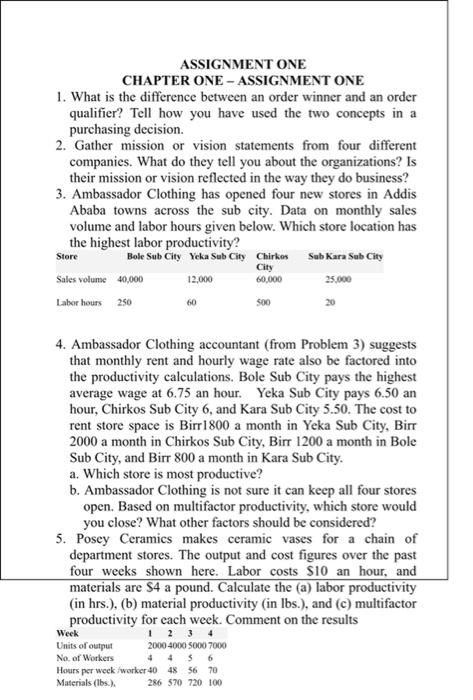
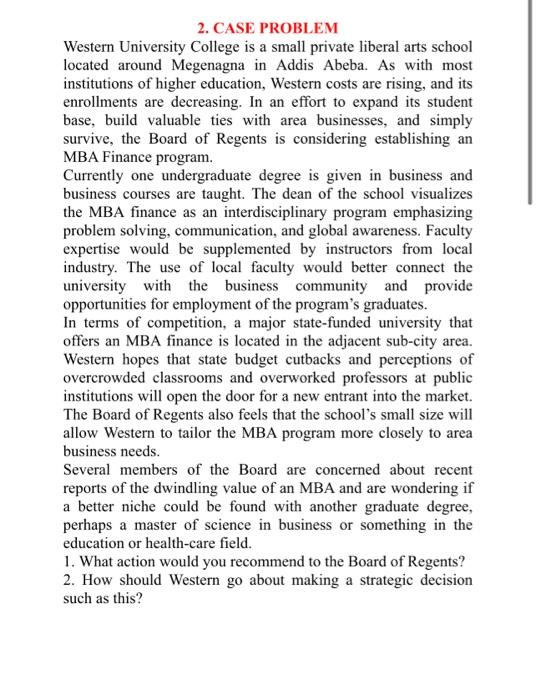
ASSIGNMENT ONE CHAPTER ONE - ASSIGNMENT ONE 1. What is the difference between an order winner and an order qualifier? Tell how you have used the two concepts in a purchasing decision. 2. Gather mission or vision statements from four different companies. What do they tell you about the organizations? Is their mission or vision reflected in the way they do business? 3. Ambassador Clothing has opened four new stores in Addis Ababa towns across the sub city. Data on monthly sales volume and labor hours given below. Which store location has the highest labor productivity? Bole Sub City Yeka Sub City Chirkos Sab Kara Sub City Store City 60,000 Sales volume 40,000 12,000 Laber hours 250 60 500 4. Ambassador Clothing accountant (from Problem 3) suggests that monthly rent and hourly wage rate also be factored into the productivity calculations. Bole Sub City pays the highest average wage at 6.75 an hour. Yeka Sub City pays 6.50 an hour, Chirkos Sub City 6, and Kara Sub City 5.50. The cost to rent store space is Birr 1800 a month in Yeka Sub City, Bir 2000 a month in Chirkos Sub City, Birr 1200 a month in Bole Sub City, and Birr 800 a month in Kara Sub City. a. Which store is most productive? b. Ambassador Clothing is not sure it can keep all four stores open. Based on multifactor productivity, which store would you close? What other factors should be considered? 5. Posey Ceramics makes ceramic vases for a chain of department stores. The output and cost figures over the past four weeks shown here. Labor costs $10 an hour, and materials are $4 a pound. Calculate the (a) labor productivity (in hrs.). (b) material productivity (in lbs.), and (c) multifactor productivity for each week. Comment on the results Week 1 2 3 Units of output 2000 4000 5000 7000 No. of Workers Hours per week werker 40 48 56 70 Materials (lbs.) 286 570 720 100 2. CASE PROBLEM Western University College is a small private liberal arts school located around Megenagna in Addis Abeba. As with most institutions of higher education, Western costs are rising, and its enrollments are decreasing. In an effort to expand its student base, build valuable ties with area businesses, and simply survive, the Board of Regents is considering establishing an MBA Finance program. Currently one undergraduate degree is given in business and business courses are taught. The dean of the school visualizes the MBA finance as an interdisciplinary program emphasizing problem solving, communication, and global awareness. Faculty expertise would be supplemented by instructors from local industry. The use of local faculty would better connect the university with the business community and provide opportunities for employment of the program's graduates. In terms of competition, a major state-funded university that offers an MBA finance is located in the adjacent sub-city area. Western hopes that state budget cutbacks and perceptions of overcrowded classrooms and overworked professors at public institutions will open the door for a new entrant into the market. The Board of Regents also feels that the school's small size will allow Western to tailor the MBA program more closely to area business needs. Several members of the Board are concerned about recent reports of the dwindling value of an MBA and are wondering if a better niche could be found with another graduate degree, perhaps a master of science in business or something in the education or health-care field. 1. What action would you recommend to the Board of Regents? 2. How should Western go about making a strategic decision such as this









 Study Help