







Question: answer the questioms below according to the case study Action learning Despite that last point, action learning (AL) is commonly associated with facilitating learning and
answer the questioms below according to the case study
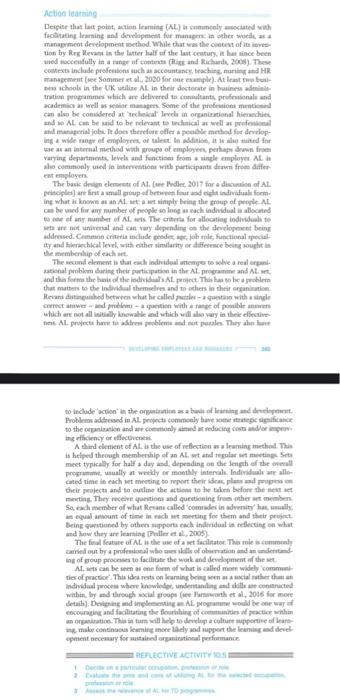
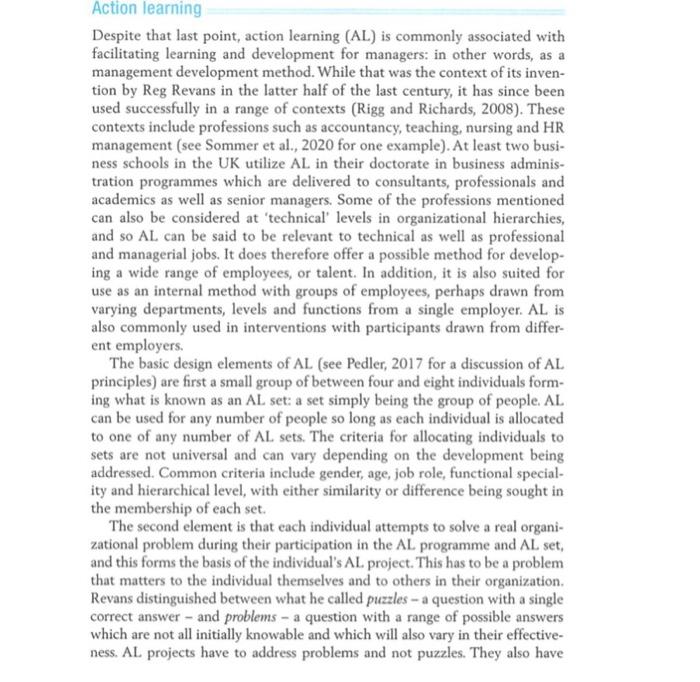
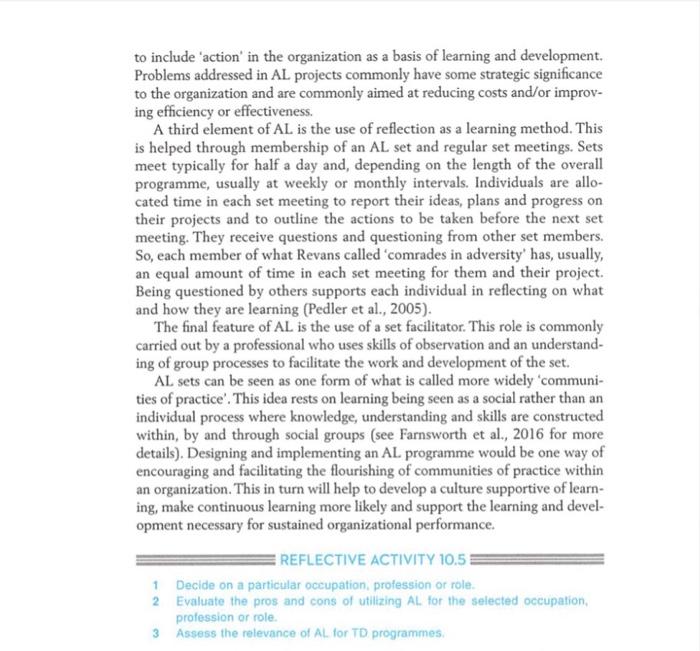
Action learning Despite that last point, action learning (AL) is commonly associated with facilitating learning and development for managers: in other words, as a management development method. While that was the context of its inven- tion by Reg Revans in the latter half of the last century, it has since been used successfully in a range of contexts (Rigg and Richards, 2008). These contexts include professions such as accountancy, teaching, nursing and HR management (see Sommer et al., 2020 for one example). At least two busi- ness schools in the UK utilize AL in their doctorate in business adminis- tration programmes which are delivered to consultants, professionals and academics as well as senior managers. Some of the professions mentioned can also be considered at 'technical levels in organizational hierarchies, and so AL can be said to be relevant to technical as well as professional and managerial jobs. It does therefore offer a possible method for develop- ing a wide range of employees, or talent. In addition, it is also suited for use as an internal method with groups of employees, perhaps drawn from varying departments, levels and functions from a single employer. AL is also commonly used in interventions with participants drawn from differ- ent employers. The basic design elements of AL (see Pedler, 2017 for a discussion of AL principles) are first a small group of between four and eight individuals form- ing what is known as an AL set: a set simply being the group of people. AL can be used for any number of people so long as each individual is allocated to one of any number of AL sets. The criteria for allocating individuals to sets are not universal and can vary depending on the development being addressed. Common criteria include gender, age, job role, functional special. ity and hierarchical level , with either similarity or difference being sought in the membership of each set. The second element is that each individual attempts to solve a real organi- zational problem during their participation in the AL programme and AL set, and this forms the basis of the individual's AL project. This has to be a problem that matters to the individual themselves and to others in their organization. Revans distinguished between what he called puzzles - a question with a single correct answer - and problems - a question with a range of possible answers which are not all initially knowable and which will also vary in their effective- ness. Al projects have to address problems and not puzzles. They also have to include 'action in the organization as a basis of learning and development, Problems addressed in AL projects commonly have some strategic significance to the organization and are commonly aimed at reducing costs and/or improve ing efficiency or effectiveness. A third element of AL is the use of reflection as a learning method. This is helped through membership of an AL set and regular set meetings. Sets meet typically for half a day and, depending on the length of the overall programme, usually at weekly or monthly intervals. Individuals are allo- cated time in each set meeting to report their ideas, plans and progress on their projects and to outline the actions to be taken before the next set meeting. They receive questions and questioning from other set members. So, each member of what Revans called "comrades in adversity' has, usually, an equal amount of time in each set meeting for them and their project. Being questioned by others supports each individual in reflecting on what and how they are learning (Pedler et al., 2005). The final feature of AL is the use of a set facilitator. This role is commonly carried out by a professional who uses skills of observation and an understand- ing of group processes to facilitate the work and development of the set. AL sets can be seen as one form of what is called more widely communi- ties of practice'. This idea rests on learning being seen as a social rather than an individual process where knowledge, understanding and skills are constructed within, by and through social groups (see Farnsworth et al., 2016 for more details), Designing and implementing an AL programme would be one way of encouraging and facilitating the flourishing of communities of practice within an organization. This in turn will help to develop a culture supportive of learn- ing, make continuous learning more likely and support the learning and devel- opment necessary for sustained organizational performance. REFLECTIVE ACTIVITY 10.5 1 Decide on a particular occupation profession or role. 2 Evaluate the pros and cons of utilizing AL for the selected occupation profession or role 3 Assess the relevance of AL for TD programmes Action learning Despite that last point, action learning (AL) is commonly associated with facilitating learning and development for managers: in other words, as a management development method. While that was the context of its inven- tion by Reg Revans in the latter half of the last century, it has since been used successfully in a range of contexts (Rigg and Richards, 2008). These contexts include professions such as accountancy, teaching, nursing and HR management (see Sommer et al., 2020 for one example). At least two busi- ness schools in the UK utilize AL in their doctorate in business adminis- tration programmes which are delivered to consultants, professionals and academics as well as senior managers. Some of the professions mentioned can also be considered at 'technical levels in organizational hierarchies, and so AL can be said to be relevant to technical as well as professional and managerial jobs. It does therefore offer a possible method for develop- ing a wide range of employees, or talent. In addition, it is also suited for use as an internal method with groups of employees, perhaps drawn from varying departments, levels and functions from a single employer. AL is also commonly used in interventions with participants drawn from differ- ent employers. The basic design elements of AL (see Pedler, 2017 for a discussion of AL principles) are first a small group of between four and eight individuals form- ing what is known as an AL set: a set simply being the group of people. AL can be used for any number of people so long as each individual is allocated to one of any number of AL sets. The criteria for allocating individuals to sets are not universal and can vary depending on the development being addressed. Common criteria include gender, age, job role, functional special. ity and hierarchical level , with either similarity or difference being sought in the membership of each set. The second element is that each individual attempts to solve a real organi- zational problem during their participation in the AL programme and AL set, and this forms the basis of the individual's AL project. This has to be a problem that matters to the individual themselves and to others in their organization. Revans distinguished between what he called puzzles - a question with a single correct answer - and problems - a question with a range of possible answers which are not all initially knowable and which will also vary in their effective- ness. Al projects have to address problems and not puzzles. They also have to include 'action in the organization as a basis of learning and development, Problems addressed in AL projects commonly have some strategic significance to the organization and are commonly aimed at reducing costs and/or improve ing efficiency or effectiveness. A third element of AL is the use of reflection as a learning method. This is helped through membership of an AL set and regular set meetings. Sets meet typically for half a day and, depending on the length of the overall programme, usually at weekly or monthly intervals. Individuals are allo- cated time in each set meeting to report their ideas, plans and progress on their projects and to outline the actions to be taken before the next set meeting. They receive questions and questioning from other set members. So, each member of what Revans called "comrades in adversity' has, usually, an equal amount of time in each set meeting for them and their project. Being questioned by others supports each individual in reflecting on what and how they are learning (Pedler et al., 2005). The final feature of AL is the use of a set facilitator. This role is commonly carried out by a professional who uses skills of observation and an understand- ing of group processes to facilitate the work and development of the set. AL sets can be seen as one form of what is called more widely communi- ties of practice'. This idea rests on learning being seen as a social rather than an individual process where knowledge, understanding and skills are constructed within, by and through social groups (see Farnsworth et al., 2016 for more details), Designing and implementing an AL programme would be one way of encouraging and facilitating the flourishing of communities of practice within an organization. This in turn will help to develop a culture supportive of learn- ing, make continuous learning more likely and support the learning and devel- opment necessary for sustained organizational performance. REFLECTIVE ACTIVITY 10.5 1 Decide on a particular occupation profession or role. 2 Evaluate the pros and cons of utilizing AL for the selected occupation profession or role 3 Assess the relevance of AL for TD programmes Step by Step Solution
There are 3 Steps involved in it
1 Expert Approved Answer
Step: 1 Unlock

Question Has Been Solved by an Expert!
Get step-by-step solutions from verified subject matter experts
Step: 2 Unlock
Step: 3 Unlock
 Study Help