







Question: ANSWER THE QUESTION DOWN BELOW BASED ON THE CASE STUDY Background Transport for London (TfL) is one of the functional bodies of the Greater London
ANSWER THE QUESTION DOWN BELOW BASED ON THE CASE STUDY
Background
Transport for London (TfL) is one of the functional bodies of the Greater London Authority (GLA),
responsible for delivering transport services throughout London to over 1,107 million passengers
every year. It is committed to reducing London's transport network's contribution to climate change
as part of wider ambitions to reduce London's CO2 emissions by 60% by 2025 (in comparison to 1990
levels).
The London Underground is perhaps the most famous part of London's public transit network, with
11 lines serving 270 stations. The fluorescent lighting technologies traditionally used to light these
stations represented a significant maintenance cost, and in 2015 TfL sought to reduce whole life-
cycle costs (WLC) by finding a range of new lighting solutions and products.
With support from the EU-funded Procurement of Lighting Innovation and Technology in Europe
(PRO-LITE) project, TfL introduced a new WLC and performance based process for lighting. The
process has been met with such success that it will now be applied to a range of other assets
commonly found across London's transport network.
Procurement Approach
PRO-LITE pre-procurement process
Tf is the lead partner of the PRO-LITE project, coordinating five other partners and two associate
partners across five European Member States.
In 2014, the PRO-LITE project partners implemented a novel Early Market Engagement strategy with
the aim of driving competition and stimulating innovation within the lighting market across Europe.
This approach was based on a Market Sounding Prospectus and included presenting at Europe's
largest lighting conferences, developing and using online submission tools, and distributing market
surveys to gather information on manufacturers' capabilities, innovative technologies, as well as
their experiences working with others to innovate. TfL also hosted a 'Suppliers Morning' event at
which over 70 manufacturers, suppliers and representatives from Europe's Lighting Industry
Association were in attendance. The event helped TfL acquire information on almost 300 different
innovative lighting technologies.
The expertise gathered through the early market engagement exercise was used to inform the
procurement processes employed, and in particular, the development of the performance based
technical specifications and procurement documents used for tendering.
In addition, the business case (for TfL) examined how WLCs can differ for the same product installed
in different locations across the Underground network (such as above escalators, on subway
platforms, in high and low access areas and at the back of house). This analysis was used to indicate
where the greatest value from an investment in a new technology could be achieved.
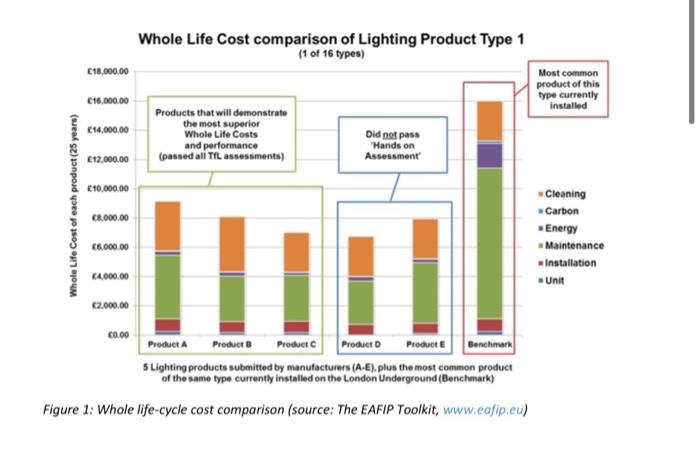
Using the WLC analysis of products allowed TfL to consider a range of information beyond unit price,
including installation, maintenance, energy use,
carbon, and cleaning costs. This approach demonstrated that the biggest savings were not from short-term material costs, or to a greater
extent energy costs, but from longer term labor costs (including cleaning, installation and
maintenance).
The calculation of WLC led to a massive increase in confidence among the TfL management to invest
in innovative solutions, as the long-term savings outweighed any additional upfront costs of LED
solutions, generating total cost savings of up to 50% (see figure below).
The business case also proved that the upfront investment risk could be mitigated by first installing
new LED lighting above escalators and high access areas, where the payback time was shortest and
return on investment high, allowing savings to be released to install LEDs in other parts of the
London Underground network.
Criteria used in the procurement process
Following extensive market engagement, the procurement process was split into three stages to
ensure all relevant risks were mitigated:
Stage one: Pre-qualification stage to sound out market interest and ensure manufacturers
understood TfL's requirements as a transport operator.
Stage two: Following the results of stage one, invitations to tender were sent out to a narrowed
group of manufacturers based on their ability to meet TfL's requirements at stage one. During this
stage, manufacturers provided technical information on their products to enable TfL to undertake a
WLC comparison of the technologies on offer. The products with the highest scores (those with the
best environment performance) were invited to stage three of the process.
Stage three: Manufacturers successful in stage two submitted samples for In Situ ('hands-on') testing
in order to validate their technical claims and the WLC modelling. Many were the same as the 'paper'
description received at stage two, however some were very different and were rejected as a result
(as shown in Figure 1, above). The hands-on assessment was the 'final filter', and gave those who will
maintain the products on a day-to-day basis (the engineers) an opportunity to input into the process.
Technical specifications
Following a comprehensive consultation process with over 80 lighting manufacturers and suppliers in
addition to a robust internal review, TfL prepared technical specifications for the procurement of
more advanced lighting technologies. These outlined the minimum requirements acceptable for
lighting products, and were provided for both a range of 'luminaires' and 'lamps'.
Requirements on the physical construction of luminaires stated that they should be modular in
design so that components could be readily replaceable upon failure, become life expired or
redundant. In addition, the specifications for both luminaires and lamps stated that they should be
designed to maintain their International Protection (IP) rating throughout their life cycle, without
degrading due to maintenance and periodic testing. The technical specifications for both lamps and
luminaires also included a number of reliability requirements - such as:
The Abrupt Failure Value (AFV) of the lamp at 50,000 hours shall be less than or equal to 10%
A failure fraction B50 (products' rated average life) or 50% shall be used for all lumen
maintenance values reported
All lumen maintenance values shall be given in respect to L70 (that is, the tested LEDs
produce 70% of the initial light output)
The lamp should provide a minimum of 50,000 hours of L70 performance verified by
demonstrating to a 90% level of confidence that the 50,000 hour success probability is 0.5 or
50% when subjected to a maximum operating temperature of 50C and mean operating
current
The lamp should provide 6,000 hours of L90 performance verified by demonstrating to a 90%
level of confidence that the 6,000 hour success probability is 0.9 or 90% when subjected to a
maximum operating temperature of 50C and mean operating current
Revisions were also made to the London Underground Lighting Standard (S1066) which states
upfront that lighting systems shall be: safe; enable the effective performance of all necessary tasks
by both passengers and staff; meet the requirements of the visually and sensory impaired; provide a
welcoming visual environment; designed to minimise energy use; and have an optimised design to
minimise WLC. Under environmental considerations, among other parameters, it emphasises that all lighting products used in the London Underground are subject to the Waste Electrical and Electronic
Equipment Directive (WEEE), and that lamps and luminaries shall be recycled where suitable product
recycling schemes exist. Furthermore, it was required that the lighting system be assembled from
system elements selected to optimise WLC. The WLC analysis for the lighting system assumed:
25 years operation
Discount factor of 3.5%
Electricity cost rate of f0.10 (approximately 0.12) per kWh
490g of CO, emitted per kWh of electricity used to power the system (based on 2014
emissions factors)
CO, valued at 3 (approximately 3.52) per tonne (based on the 2014 rate) increasing at 2%
compounded
Award criteria
In the third In Situ testing phase of the procurement process, products with appropriate WLCs which
met TfL's standards were then assessed against the following criteria:
Robustness and durability
D.
Ease of access to components
Ease to dismantle
d. Ease to reassemble
Integrity after reassembly
Ease to replace parts/components
&.
Ease to clean
Ease to install
Ease to remove/uninstall
Ability to accommodate wiring
Ease to switch on and off
The assessment was made following a number of different standards: national, EU, international, and
specific to TfL, such as the S1066 developed for the London Underground. All standards existed prior
to PRO-LITE, however were revised to ensure they drove the intended behaviour in the lighting
market, for fL's purposes. In total, manufacturers submitted just over 25,000 (approximately
29,500) worth of products for TfL's maintenance teams to assess
Contract performance clauses
The contract contains a 'product refresh' clause that incentivises manufacturers to continue to
innovate and produce products that will reduce TfL's WLCs and impact on the environment.
Results
The rail industry is naturally risk averse, with passenger safety being their top priority; by undertaking
a thorough pre- procurement process of research and engagement with the market, TfL was able to
develop a high level of confidence in innovative technologies, and in June 2016 awarded a framework
contract worth 8 million (10 million) for the long-term supply of LEDs for use across the London
Underground network. Over 50 suppliers responded to the pre-qualification stage. Invitations to
tender were then sent to 30 suppliers for over 170 products. In the final stage, samples of 120
products were requested for the In Situ assessment.
In June 2016, eight year long contracts were awarded to 13 manufacturers to supply 45 products.
These products fulfil the vast majority of TfL's lighting requirements, and are mandated for use
across the London Underground. The contracts were awarded to a sufficient number
manufacturers to ensure that they continue to compete within the contract to reduce TfL's WLC. The
more manufacturers improve their products, the more likely it is that TfL will order them in future.
Manufacturers are aware that other options are available if they 'drop' their standards, hence are
incentivised to continue to innovate in the interest of TfL and the environment. Furthermore, there
are currently well over 500 different lighting products installed across the London Underground.
Through the contracts put in place the London Underground will be able to reduce this number by
approximately 90% (to 45-50)
- creating economies of scale (tor TL) and the successtul
manufacturers.
As an indicative result of this procurement process, savings have been calculated for the ticket hall of
the London Underground Charing Cross Station, where a like-for-like replacement of current
technology with the products identified through the PRO- LITE process will save 25% in WLC,
including 75% on maintenance costs.
In terms of timeframes, TfL estimate that the process will take less than a year now they understand
the level of information they need to gather and how to effectively communicate requirements to
the market place.
Furthermore, regarding financial support, the PRO-LITE project was supported by a grant of two
million euro, and was co-ordinated by TfL. Approximately one quarter of the grant was used by TfL.
The financial support from the European Commission allowed TfL to recruit the expert resources, in
terms of personnel, to undertake the design work required to demonstrate how TfL can use its
procurement power to drive innovation.
Environmental impacts
Reducing maintenance costs was the primary concern for TfL during the development of the PRO-
LITE project. As LED technologies generally last longer - requiring fewer maintenance interventions and are more energy efficient than fluorescent technologies, TfL was able to build a robust business
case to invest in a technology that makes good business sense as well as being good for the
environment.
Over 90% of the environmental impact from the use of lamps in lighting comes from the use phase,
from energy consumption and associated greenhouse gas emissions while the light is being used. The
environmental effect of energy consumption originates from the power generation, where fossil
energy carriers like oil, natural gas or coal are converted into electricity (source: Green Public
Procurement, Indoor Lighting - Technical Background Report. European Commission (2011), page
13).
Lessons learned and future challenges
Identify and where possible quantify the potential benefits, including non-environmental
benefits in order to create a multi-dimensional business case.
Identify and engage all relevant stakeholders, understand their issues and ensure that their
issues or concerns are addressed as part of the solution identified.
Do not be afraid to engage the market early. The industry usually has information that can be
used to strengthen your business case.
Cast the net far and wide. Engage as many manufacturers and suppliers as possible and
encourage as much competition in the market as possible.
Consolidate your spend. Manufacturers are more likely to innovate if the prize for winning
the contract is big.
Q2 2. How did they manage the environmental impacts
Step by Step Solution
There are 3 Steps involved in it
1 Expert Approved Answer
Step: 1 Unlock

Question Has Been Solved by an Expert!
Get step-by-step solutions from verified subject matter experts
Step: 2 Unlock
Step: 3 Unlock
 Study Help