







Question: answer the question step by step, and if you using excel please show the screen Stphane Zanella took a second careful sip from the glass
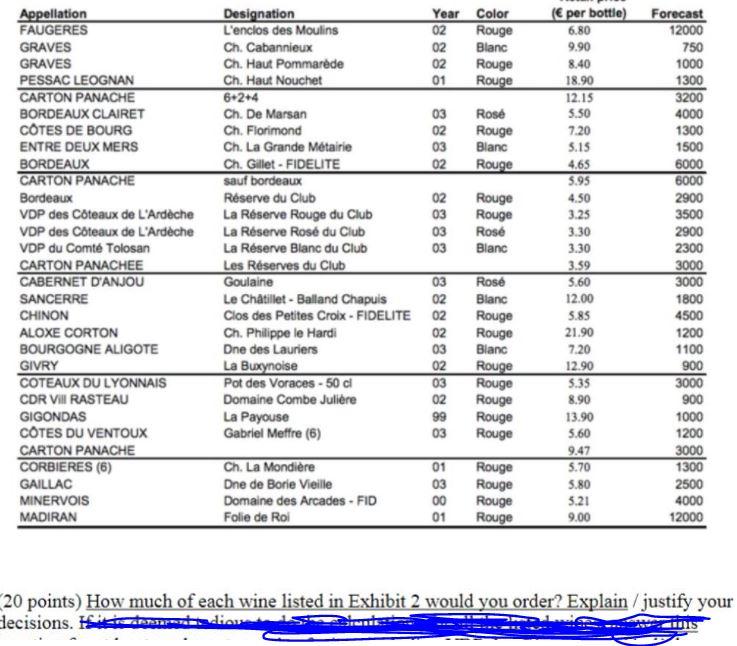
answer the question step by step, and if you using excel please show the screen
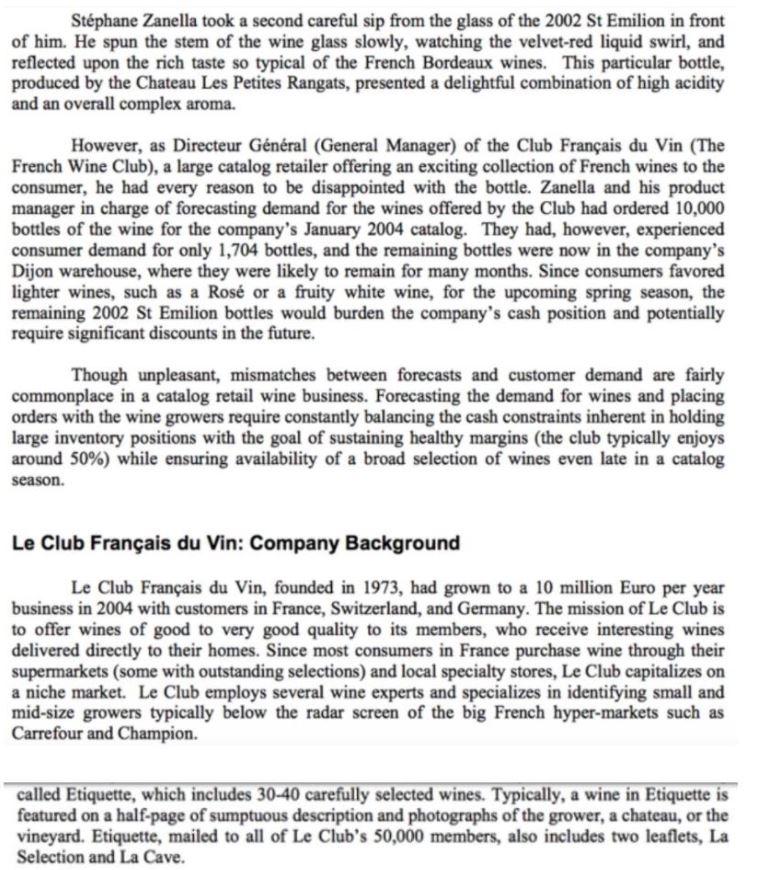
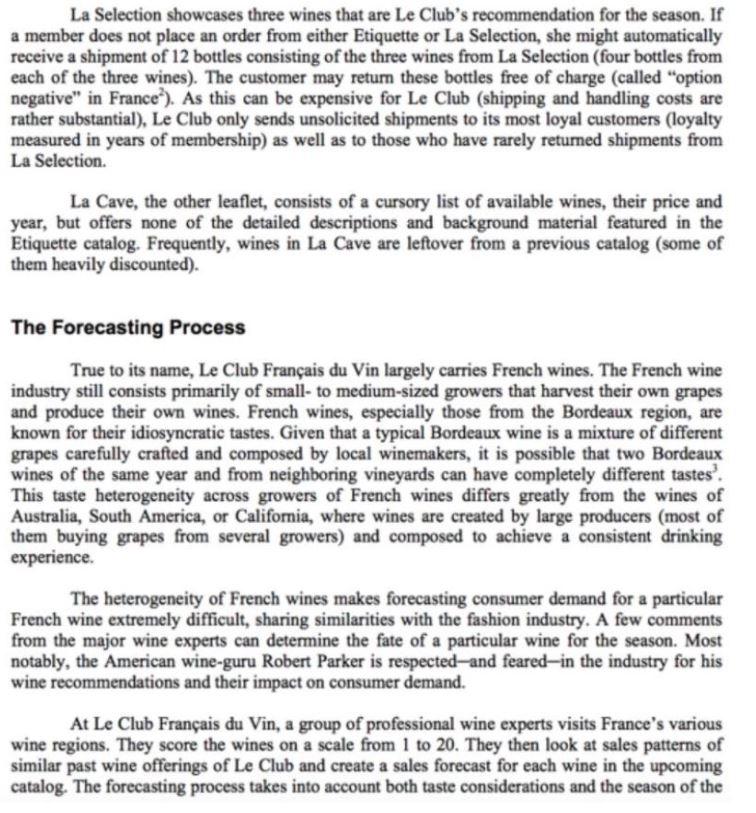
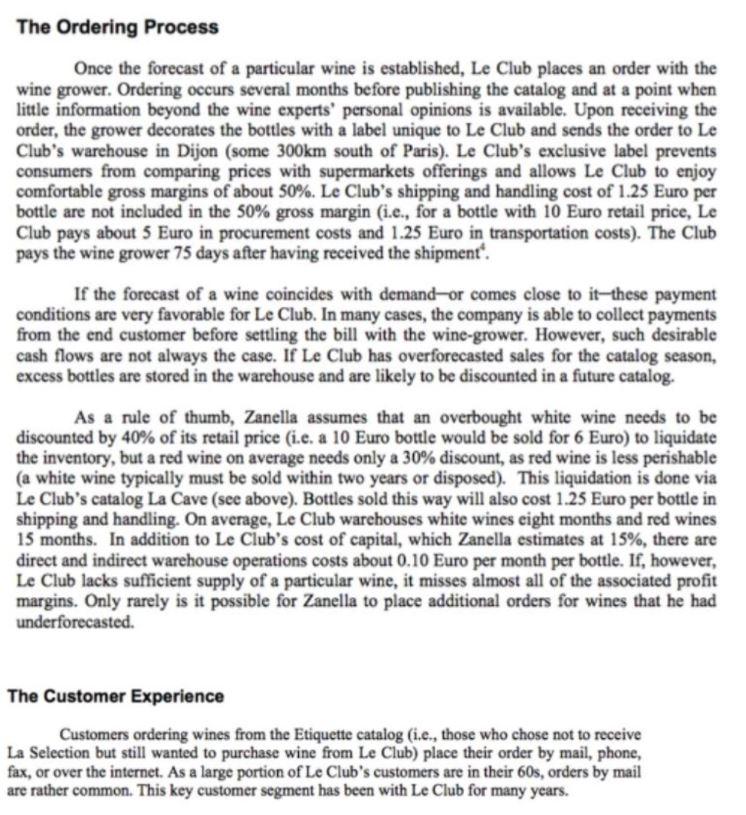
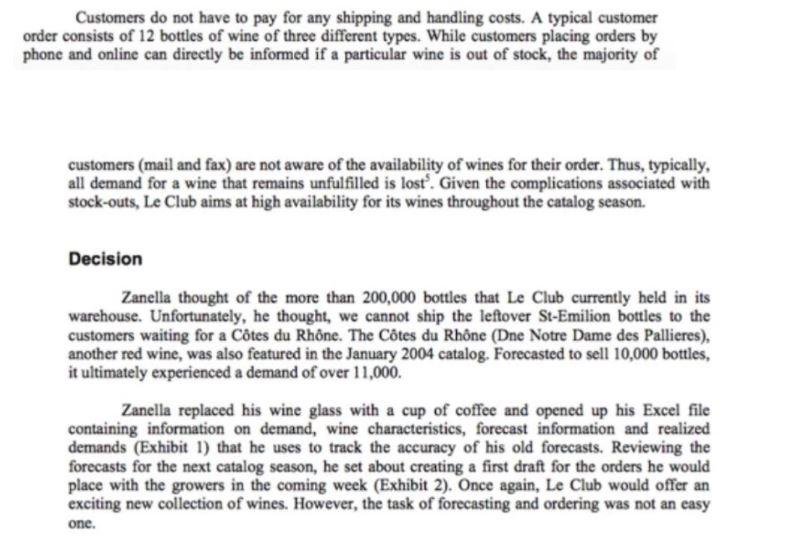
Stphane Zanella took a second careful sip from the glass of the 2002 St Emilion in front of him. He spun the stem of the wine glass slowly, watching the velvet-red liquid swirl, and reflected upon the rich taste so typical of the French Bordeaux wines. This particular bottle, produced by the Chateau Les Petites Rangats, presented a delightful combination of high acidity and an overall complex aroma. However, as Directeur Gnral (General Manager) of the Club Franais du Vin (The French Wine Club), a large catalog retailer offering an exciting collection of French wines to the consumer, he had every reason to be disappointed with the bottle. Zanella and his product manager in charge of forecasting demand for the wines offered by the Club had ordered 10,000 bottles of the wine for the company's January 2004 catalog. They had, however, experienced consumer demand for only 1,704 bottles, and the remaining bottles were now in the company's Dijon warehouse, where they were likely to remain for many months. Since consumers favored lighter wines, such as a Ros or a fruity white wine, for the upcoming spring season, the remaining 2002 St Emilion bottles would burden the company's cash position and potentially require significant discounts in the future. Though unpleasant, mismatches between forecasts and customer demand are fairly commonplace in a catalog retail wine business. Forecasting the demand for wines and placing orders with the wine growers require constantly balancing the cash constraints inherent in holding large inventory positions with the goal of sustaining healthy margins (the club typically enjoys around 50%) while ensuring availability of a broad selection of wines even late in a catalog season. Le Club Franais du Vin: Company Background Le Club Franais du Vin, founded in 1973, had grown to a 10 million Euro per year business in 2004 with customers in France, Switzerland, and Germany. The mission of Le Club is to offer wines of good to very good quality to its members, who receive interesting wines delivered directly to their homes. Since most consumers in France purchase wine through their supermarkets (some with outstanding selections) and local specialty stores, Le Club capitalizes on a niche market. Le Club employs several wine experts and specializes in identifying small and mid-size growers typically below the radar screen of the big French hyper-markets such as Carrefour and Champion. called Etiquette, which includes 30-40 carefully selected wines. Typically, a wine in Etiquette is featured on a half-page of sumptuous description and photographs of the grower, a chateau, or the vineyard. Etiquette, mailed to all of Le Club's 50,000 members, also includes two leaflets, La Selection and La Cave. La Selection showcases three wines that are Le Club's recommendation for the season. If a member does not place an order from either Etiquette or La Selection, she might automatically receive a shipment of 12 bottles consisting of the three wines from La Selection (four bottles from each of the three wines). The customer may return these bottles free of charge (called "option negative" in France). As this can be expensive for Le Club (shipping and handling costs are rather substantial), Le Club only sends unsolicited shipments to its most loyal customers (loyalty measured in years of membership) as well as to those who have rarely returned shipments from La Selection. La Cave, the other leaflet, consists of a cursory list of available wines, their price and year, but offers none of the detailed descriptions and background material featured in the Etiquette catalog. Frequently, wines in La Cave are leftover from a previous catalog (some of them heavily discounted). The Forecasting Process True to its name, Le Club Franais du Vin largely carries French wines. The French wine industry still consists primarily of small- to medium-sized growers that harvest their own grapes and produce their own wines. French wines, especially those from the Bordeaux region, are known for their idiosyncratic tastes. Given that a typical Bordeaux wine is a mixture of different grapes carefully crafted and composed by local winemakers, it is possible that two Bordeaux wines of the same year and from neighboring vineyards can have completely different tastes'. This taste heterogeneity across growers of French wines differs greatly from the wines of Australia, South America, or California, where wines are created by large producers (most of them buying grapes from several growers) and composed to achieve a consistent drinking experience. The heterogeneity of French wines makes forecasting consumer demand for a particular French wine extremely difficult, sharing similarities with the fashion industry. A few comments from the major wine experts can determine the fate of a particular wine for the season. Most notably, the American wine-guru Robert Parker is respected and feared in the industry for his wine recommendations and their impact on consumer demand. At Le Club Franais du Vin, a group of professional wine experts visits France's various wine regions. They score the wines on a scale from 1 to 20. They then look at sales patterns of similar past wine offerings of Le Club and create a sales forecast for each wine in the upcoming catalog. The forecasting process takes into account both taste considerations and the season of the The Ordering Process Once the forecast of a particular wine is established, Le Club places an order with the wine grower. Ordering occurs several months before publishing the catalog and at a point when little information beyond the wine experts' personal opinions is available. Upon receiving the order, the grower decorates the bottles with a label unique to Le Club and sends the order to Le Club's warehouse in Dijon (some 300km south of Paris). Le Club's exclusive label prevents consumers from comparing prices with supermarkets offerings and allows Le Club to enjoy comfortable gross margins of about 50%. Le Club's shipping and handling cost of 1.25 Euro per bottle are not included in the 50% gross margin (i.e., for a bottle with 10 Euro retail price, Le Club pays about 5 Euro in procurement costs and 1.25 Euro in transportation costs). The Club pays the wine grower 75 days after having received the shipment. If the forecast of a wine coincides with demand or comes close to it-these payment conditions are very favorable for Le Club. In many cases, the company is able to collect payments from the end customer before settling the bill with the wine-grower. However, such desirable cash flows are not always the case. If Le Club has overforecasted sales for the catalog season, excess bottles are stored in the warehouse and are likely to be discounted in a future catalog. As a rule of thumb, Zanella assumes that an overbought white wine needs to be discounted by 40% of its retail price (i.e. a 10 Euro bottle would be sold for 6 Euro) to liquidate the inventory, but a red wine on average needs only a 30% discount, as red wine is less perishable (a white wine typically must be sold within two years or disposed). This liquidation is done via Le Club's catalog La Cave (see above). Bottles sold this way will also cost 1.25 Euro per bottle in shipping and handling. On average, Le Club warehouses white wines eight months and red wines 15 months. In addition to Le Club's cost of capital, which Zanella estimates at 15%, there are direct and indirect warehouse operations costs about 0.10 Euro per month per bottle. If, however, Le Club lacks sufficient supply of a particular wine, it misses almost all of the associated profit margins. Only rarely is it possible for Zanella to place additional orders for wines that he had under forecasted. The Customer Experience Customers ordering wines from the Etiquette catalog (i.e., those who chose not to receive La Selection but still wanted to purchase wine from Le Club) place their order by mail, phone, fax, or over the internet. As a large portion of Le Club's customers are in their 60s, orders by mail are rather common. This key customer segment has been with Le Club for many years. Customers do not have to pay for any shipping and handling costs. A typical customer order consists of 12 bottles of wine of three different types. While customers placing orders by phone and online can directly be informed if a particular wine is out of stock, the majority of customers (mail and fax) are not aware of the availability of wines for their order. Thus, typically, all demand for a wine that remains unfulfilled is lost. Given the complications associated with stock-outs, Le Club aims at high availability for its wines throughout the catalog season. Decision Zanella thought of the more than 200,000 bottles that Le Club currently held in its warehouse. Unfortunately, he thought, we cannot ship the leftover St-Emilion bottles to the customers waiting for a Ctes du Rhne. The Ctes du Rhne (Dne Notre Dame des Pallieres), another red wine, was also featured in the January 2004 catalog. Forecasted to sell 10,000 bottles, it ultimately experienced a demand of over 11,000. Zanella replaced his wine glass with a cup of coffee and opened up his Excel file containing information on demand, wine characteristics, forecast information and realized demands (Exhibit 1) that he uses to track the accuracy of his old forecasts. Reviewing the forecasts for the next catalog season, he set about creating a first draft for the orders he would place with the growers in the coming week (Exhibit 2). Once again, Le Club would offer an exciting new collection of wines. However, the task of forecasting and ordering was not an easy one. Appellation FAUGERES GRAVES GRAVES PESSAC LEOGNAN CARTON PANACHE BORDEAUX CLAIRET COTES DE BOURG ENTRE DEUX MERS BORDEAUX CARTON PANACHE Bordeaux VDP des Cteaux de L'Ardche VDP des Cteaux de L'Ardche VDP du Comt Tolosan CARTON PANACHEE CABERNET D'ANJOU SANCERRE CHINON ALOXE CORTON BOURGOGNE ALIGOTE GIVRY COTEAUX DU LYONNAIS CDR V RASTEAU GIGONDAS COTES DU VENTOUX CARTON PANACHE CORBIERES (6) GAILLAC MINERVOIS MADIRAN Designation Year Color L'enclos des Moulins 02 Rouge Ch. Cabannieux 02 Blanc Ch. Haut Pommarede 02 Rouge Ch. Haut Nouchet 01 Rouge 6+24 Ch. De Marsan 03 Rose Ch. Florimond 02 Rouge Ch. La Grande Mtairie 03 Blanc Ch. Gillet - FIDELITE 02 Rouge sauf bordeaux Rserve du Club 02 Rouge La Rserve Rouge du Club 03 Rouge La Rserve Ros du Club 03 Ros La Rserve Blanc du Club 03 Blanc Les Rserves du Club Goulaine 03 Ros Le Chtillet - Balland Chapuis 02 Blanc Clos des Petites Croix - FIDELITE 02 Rouge Ch. Philippe le Hardi 02 Rouge Dne des Lauriers 03 Blanc La Buxynoise 02 Rouge Pot des Voraces - 50 cl 03 Rouge Domaine Combe Julire 02 Rouge La Payouse 99 Rouge Gabriel Meffre (6) 03 Rouge ( per bottle) 6.80 9.90 8.40 18.90 12.15 3.50 7.20 5.15 4.65 5.95 4.50 3.25 3.30 3.30 3.59 5.60 12.00 5.85 21.90 7.20 12.90 5.35 8.90 13.90 Forecast 12000 750 1000 1300 3200 4000 1300 1500 6000 6000 2900 3500 2900 2300 3000 3000 1800 4500 1200 1100 900 3000 900 1000 1200 3000 1300 2500 4000 12000 5.60 9.47 5.70 5.80 Ch. La Mondiere Dne de Borie Vieille Domaine des Arcades - FID Folie de Rol 01 03 00 01 Rouge Rouge Rouge Rouge 5.21 9.00 20 points) How much of each wine listed in Exhibit 2 would you order? Explain/justify your decisions. HittadionsStep by Step Solution
There are 3 Steps involved in it
1 Expert Approved Answer
Step: 1 Unlock

Question Has Been Solved by an Expert!
Get step-by-step solutions from verified subject matter experts
Step: 2 Unlock
Step: 3 Unlock
 Study Help