



Question: answer the three questions using 5 of the terms: Expectation: an outcome or event that a person anticipates or looks forward to. Trust: confidence a
answer the three questions using 5 of the terms:
Expectation: an outcome or event that a person anticipates or looks forward to.
Trust: confidence a person has in the promises or actions of another person, brand, or company.
Psychographics: analysis of a persons day-to-day pattern of living as expressed in that persons Activities, Interests, and Opinions.
Lifestyle analysis: same as psychographics.
Empty nesters: people whose children are grown and who are now able to spend their money in other ways.
Social class: group of people who have approximately equal social position as viewed by others in the society.
Reference group: people to whom an individual looks when forming attitudes about a particular topic.
Opinion leader: person who influences others.
Culture: whole set of beliefs, attitudes, and ways of doing things of a reasonably homogeneous set of people.
Purchase situation: takes into account the purchase, time available, and location where a purchase is made.
Extensive problem solving: much effort put into deciding how to satisfy a need.
Limited problem solving: used by consumers when some effort is required in deciding the best way to satisfy a need.
Routinized response behavior: when a consumer regularly selects a particular way of satisfying a need when it occurs.
Low-involvement purchases: that which have little importance or relevance for the customer.
Dissonance: a feeling of uncertainty about whether the correct decision was made.
Predictive analytics: a process used to analyze data to make predictions about unknown future events.
Adoption process: the steps individuals go through on the way to accepting or rejecting a new idea.
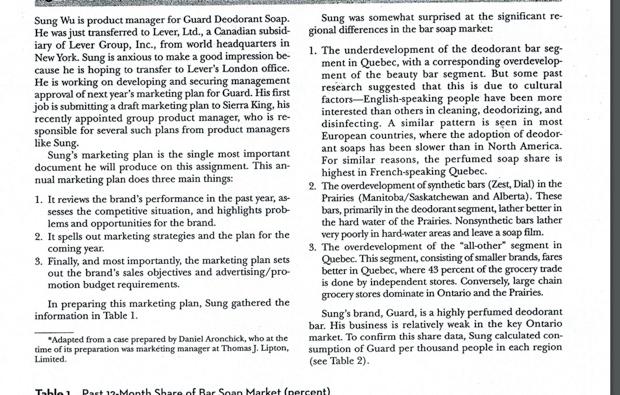
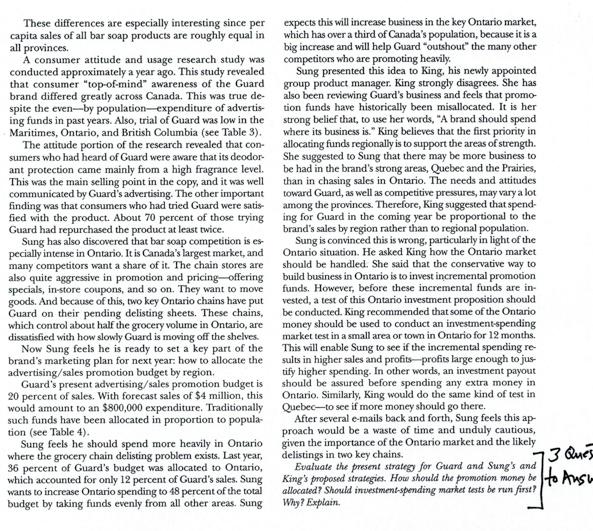
Sung Wu is product manager for Guard Deodorant Soap. He was just transferred to Lever, Ltd., a Canadian subsid- iary of Lever Group, Inc., from world headquarters in New York. Sung is anxious to make a good impression be- cause he is hoping to transfer to Lever's London office. He is working on developing and securing management approval of next year's marketing plan for Guard. His first job is submitting a draft marketing plan to Sierra King, his recently appointed group product manager, who is re- sponsible for several such plans from product managers like Sung. Sung's marketing plan is the single most important document he will produce on this assignment. This an nual marketing plan does three main things: 1. It reviews the brand's performance in the past year, as sesses the competitive situation, and highlights prob lems and opportunities for the brand. 2. It spells out marketing strategies and the plan for the coming year. 3. Finally, and most importantly, the marketing plan sets out the brand's sales objectives and advertising/pro motion budget requirements. In preparing this marketing plan, Sung gathered the information in Table 1 Sung was somewhat surprised at the significant re- gional differences in the bar soap market: 1. The underdevelopment of the deodorant bar seg- ment in Quebec, with a corresponding overdevelop ment of the beauty bar segment. But some past research suggested that this is due to cultural factors---English-speaking people have been more interested than others in cleaning, deodorizing, and disinfecting. A similar pattern is seen in most European countries, where the adoption of deodor- ant soaps has been slower than in North America. For similar reasons, the perfumed soap share is highest in French-speaking Quebec. 2. The overdevelopment of synthetic bars (Zest, Dial) in the Prairies (Manitoba/Saskatchewan and Alberta). These bars, primarily in the deodorant segment, lather better in the hard water of the Prairies. Nonsynthetic bars lather very poorly in hard-water areas and leave a soap film. 3. The overdevelopment of the "all-other" segment in Quebec. This segment, consisting of snaller brands, fares better in Quebec, where 43 percent of the grocery trade is done by independent stores. Conversely, large chain grocery stores dominate in Ontario and the Prairies. Sung's brand, Guard, is a highly perfumed deodorant bar. His business is relatively weak in the key Ontario market. To confirm this share data, Sung calculated con- sumption of Guard per thousand people in each region (see Table 2) *Adapted from a case prepared by Daniel Aronchick, who at the time of its preparation was marketing manager at Thomas J. Lipton, Limited Table Past 12. Month Share of Bar Soan Market (percent) These differences are especially interesting since per capita sales of all bar soap products are roughly equal in all provinces. A consumer attitude and usage research study was conducted approximately a year ago. This study revealed that consumer "top-of-mind" awareness of the Guard brand differed greatly across Canada. This was true de spite the even-- by population-expenditure of advertis- ing funds in past years. Also, trial of Guard was low in the Maritimes, Ontario, and British Columbia (see Table 3). The attitude portion of the research revealed that con- sumers who had heard of Guard were aware that its deodor ant protection came mainly from a high fragrance level. This was the main selling point in the copy, and it was well communicated by Guard's advertising. The other important finding was that consumers who had tried Guard were satis fied with the product. About 70 percent of those trying Guard had repurchased the product at least twice. Sung has also discovered that bar soap competition is es pecially intense in Ontario. It is Canada's largest market, and many competitors want a share of it. The chain stores are also quite aggressive in promotion and pricing-offering specials, in-store coupons, and so on. They want to move goods. And because of this, two key Ontario chains have put Guard on their pending delisting sheets. These chains, which control about half the grocery volume in Ontario, are dissatisfied with how slowly Guard is moving off the shelves. Now Sung feels he is ready to set a key part of the brand's marketing plan for next year: how to allocate the advertising/sales promotion budget by region. Guard's present advertising/sales promotion budget is 20 percent of sales. With forecast sales of $4 million, this would amount to an $800,000 expenditure. Traditionally such funds have been allocated in proportion to popula- tion (see Table 4). Sung feels he should spend more heavily in Ontario where the grocery chain delisting problem exists. Last year, 36 percent of Guard's budget was allocated to Ontario, which accounted for only 12 percent of Guard's sales. Sung wants to increase Ontario spending to 18 percent of the total budget by taking funds evenly from all other areas. Sung expects this will increase business in the key Ontario market, which has over a third of Canada's population, because it is a big increase and will help Guard outshout the many other competitors who are promoting heavily. Sung presented this idea to King, his newly appointed group product manager. King strongly disagrees. She has also been reviewing Guard's business and feels that promo tion funds have historically been misallocated. It is her strong belief that, to use her words, "A brand should spend where its business is." King believes that the first priority in allocating funds regionally is to support the areas of strength. She suggested to Sung that there may be more business to be had in the brand's strong areas, Quebec and the Prairies, than in chasing sales in Ontario. The needs and attitudes toward Guard, as well as competitive pressures, may vary a lot among the provinces. Therefore, King suggested that spend ing for Guard in the coming year be proportional to the brand's sales by region rather than to regional population. Sung is convinced this is wrong, particularly in light of the Ontario situation. He asked King how the Ontario market should be handled. She said that the conservative way to build business in Ontario is to invest incremental promotion funds. However, before these incremental funds are in vested, a test of this Ontario investment proposition should be conducted. King recommended that some of the Ontario money should be used to conduct an investment-spending market test in a small area or town in Ontario for 12 months. This will enable Sung to see if the incremental spending re sults in higher sales and profits-profits large enough to jus- tify higher spending. In other words, an investment payout should be assured before spending any extra money in Ontario. Similarly, King would do the same kind of test in Quebec--to see if more money should go there. After several e-mails back and forth, Sung feels this ap- proach would be a waste of time and unduly cautious, given the importance of the Ontario market and the likely delistings in two key chains. Evaluate the present strategy for Guard and Sung's and King's proposed strategies. How should the promotion money be allocated? Should investment-spending market tests be run first? Why? Explain. 13 Ques to AnswStep by Step Solution
There are 3 Steps involved in it

Get step-by-step solutions from verified subject matter experts