





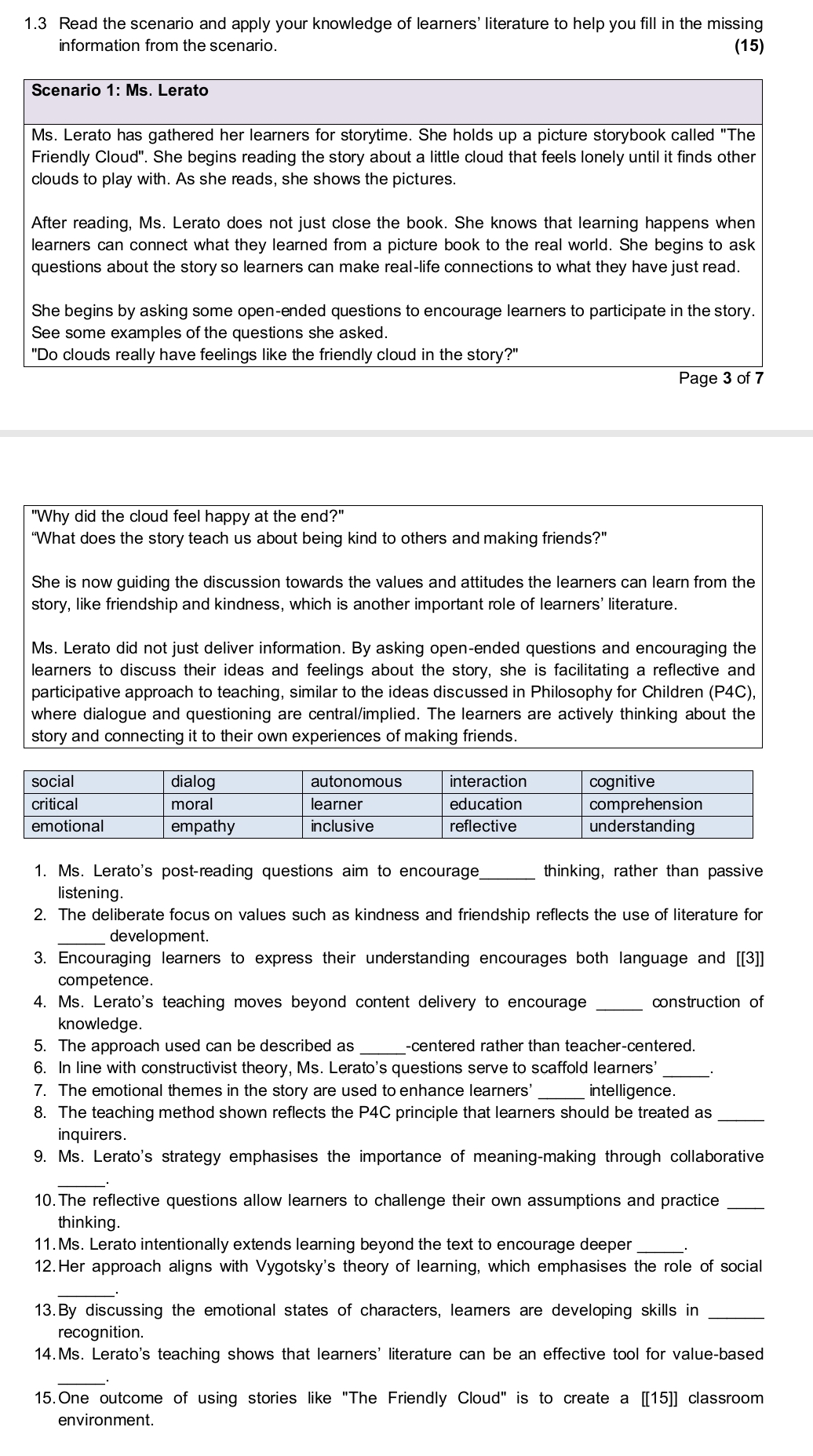
Question: Answer this 1.3 Read the scenario and apply your knowledge of learners' literature to help you fill in the missing information from the scenario. (15)

Answer this
Answer this 1.3 Read the scenario and apply your
1.3 Read the scenario and apply your knowledge of learners' literature to help you fill in the missing information from the scenario. (15) Scenario 1: Ms. Lerato Ms. Lerato has gathered her learners for storytime. She holds up a picture storybook called "The Friendly Cloud". She begins reading the story about a little cloud that feels lonely until it finds other clouds to play with. As she reads, she shows the pictures. After reading, Ms. Lerato does not just close the book. She knows that learning happens when learners can connect what they learned from a picture book to the real world. She begins to ask questions about the story so learners can make real-life connections to what they have just read. She begins by asking some open-ended questions to encourage learners to participate in the story. See some examples of the questions she asked. "Do clouds really have feelings like the friendly cloud in the story?" Page 3 of 7 "Why did the cloud feel happy at the end?" \"What does the story teach us about being kind to others and making friends?" She is now guiding the discussion towards the values and attitudes the learners can learn from the story, like friendship and kindness, which is another important role of learners' literature. Ms. Lerato did not just deliver information. By asking open-ended questions and encouraging the learners to discuss their ideas and feelings about the story, she is facilitating a reflective and participative approach to teaching, similar to the ideas discussed in Philosophy for Children (P4C), where dialogue and questioning are central/implied. The learners are actively thinking about the story and connecting it to their own experiences of making friends. social dialog autonomous interaction cognitive critical moral learner education comprehension emotional empathy inclusive reflective understanding 1. Ms. Lerato's post-reading questions aim to encourage listening. 2. The deliberate focus on values such as kindness and friendship reflects the use of literature for development. 3. Encouraging learners to express their understanding encourages both language and [[3]} competence. 4. Ms. Lerato's teaching moves beyond content delivery to encourage knowledge. The approach used can be described as -centered rather than teacher-centered. In line with constructivist theory, Ms. Lerato's questions serve to scaffold learners' The emotional themes in the story are used to enhance learners' intelligence. The teaching method shown reflects the P4C principle that learners should be treated as inquirers. 9. Ms. Lerato's strategy emphasises the importance of meaning-making through collaborative thinking, rather than passive construction of oN am 10. The reflective questions allow learners to challenge their own assumptions and practice thinking. 11.Ms. Lerato intentionally extends learning beyond the text to encourage deeper 12.Her approach aligns with Vygotsky's theory of learning, which emphasises the role of social 13.By discussing the emotional states of characters, leamers are developing skills in recognition. 14.Ms. Lerato's teaching shows that learners' literature can be an effective tool for value-based 15.One outcome of using stories like "The Friendly Cloud" is to create a [[15]] classroom environment

Step by Step Solution

There are 3 Steps involved in it

1 Expert Approved Answer
Step: 1 Unlock blur-text-image

Question Has Been Solved by an Expert!

Get step-by-step solutions from verified subject matter experts

Step: 2 Unlock
Step: 3 Unlock

Students Have Also Explored These Related Accounting Questions!