







Question: Answer this question using calculus: Household's problem: 'm.a:l:c__1U(C, 1) subject to C = w ' (h _ f) + 77 _ T where C 2
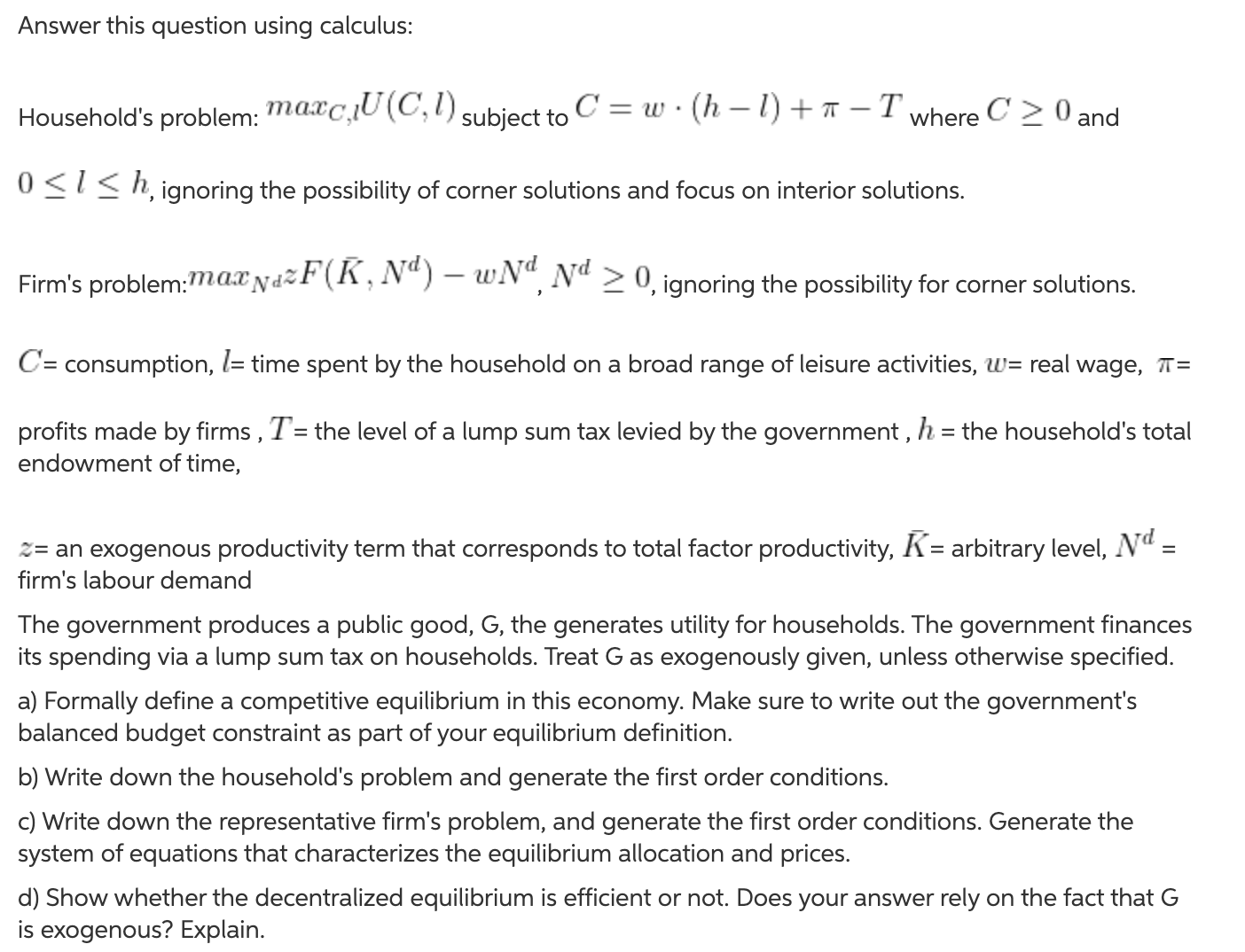
Answer this question using calculus: Household's problem: 'm.a:l:c__1U(C, 1) subject to C = w ' (h _ f) + 77 _ T where C 2 0 and 0 S l S h, ignoring the possibility of corner solutions and focus on interior solutions. ~ _ rd rd rd Firm's problem:'m'ade*F(Kr ' ) _ u" , 4 Z 0, ignoring the possibility for corner solutions. C: consumption, 1: time spent by the household on a broad range of leisure activities, 10: real wage, 71': profits made by firms , T: the level of a lump sum tax levied by the government , h. = the household's total endowment of time, :5: an exogenous productivity term that corresponds to total factor productivity, R: arbitrary level, Nd = firm's labour demand The government produces a public good, G, the generates utility for households. The government finances its spending via a lump sum tax on households. Treat G as exogenously given, unless otherwise specified. a) Formally define a competitive equilibrium in this economy. Make sure to write out the government's balanced budget constraint as part of your equilibrium definition. b] Write down the household's problem and generate the first order conditions. c) Write down the representative firm's problem, and generate the first order conditions. Generate the system of equations that characterizes the equilibrium allocation and prices. C!) Show whether the decentralized equilibrium is efficient or not. Does your answer rely on the fact that G is exogenous? Explain
Step by Step Solution
There are 3 Steps involved in it

Get step-by-step solutions from verified subject matter experts
 Study Help