Question: ARTICLE ANALYSIS Instructions: Use this document as a template to write your paper. But, format your paper in regular paragraphs rather than bullet points. The
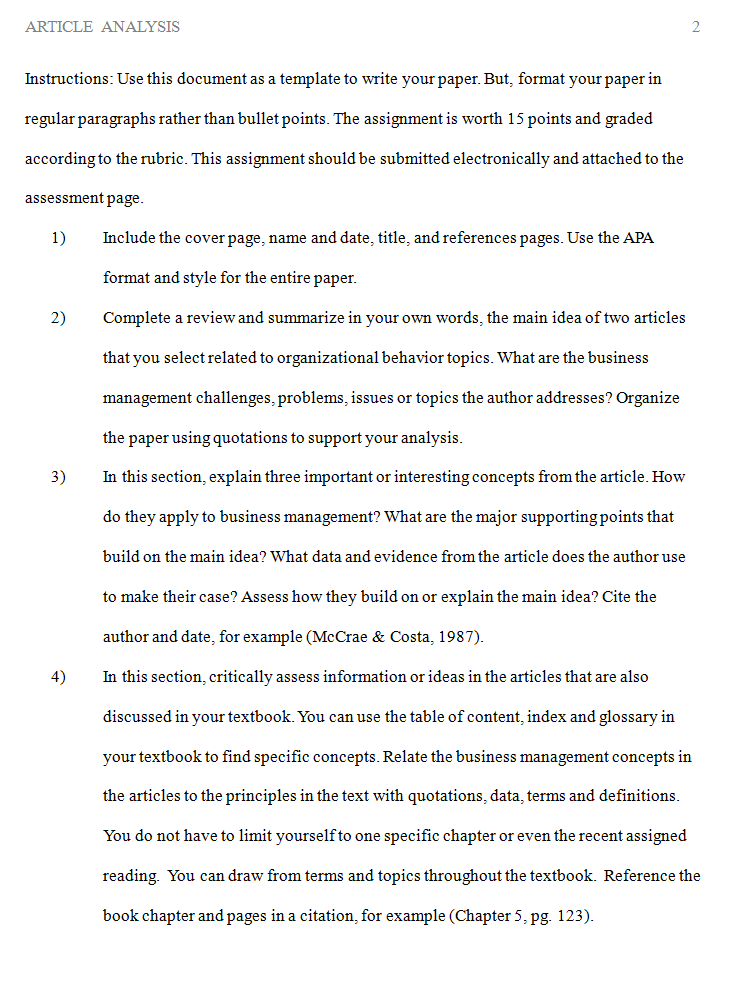
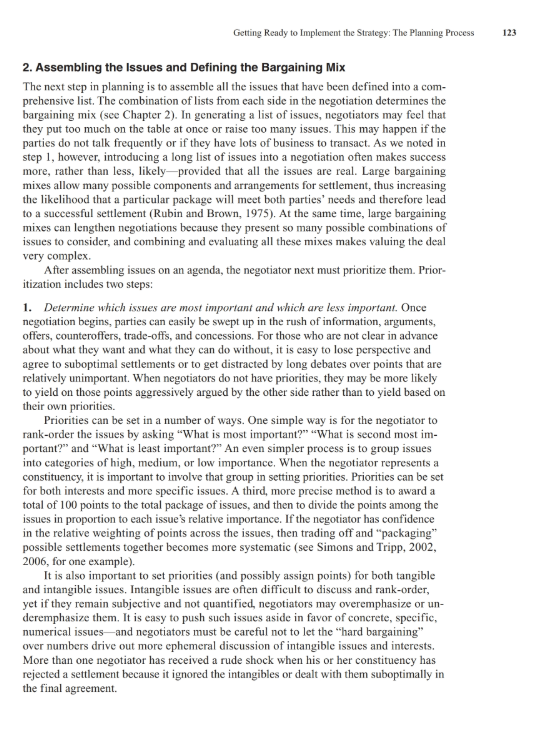
ARTICLE ANALYSIS Instructions: Use this document as a template to write your paper. But, format your paper in regular paragraphs rather than bullet points. The assignment is worth 15 points and graded according to the rubric. This assignment should be submitted electronically and attached to the assessment page. 1) Include the cover page, name and date, title, and references pages. Use the APA format and style for the entire paper. 2) Complete a review and summarize in your own words, the main idea of two articles that you select related to organizational behavior topics. What are the business management challenges, problems, issues or topics the author addresses? Organize the paper using quotations to support your analysis. 3) In this section, explain three important or interesting concepts from the article. How do they apply to business management? What are the major supporting points that build on the main idea? What data and evidence from the article does the author use to make their case? Assess how they build on or explain the main idea? Cite the author and date, for example (McCrae & Costa, 1987). 4) In this section, critically assess information or ideas in the articles that are also discussed in your textbook. You can use the table of content, index and glossary in your textbook to find specific concepts. Relate the business management concepts in the articles to the principles in the text with quotations, data, terms and definitions. You do not have to limit yourself to one specific chapter or even the recent assigned reading. You can draw from terms and topics throughout the textbook. Reference the book chapter and pages in a citation, for example (Chapter 5, pg. 123). ARTICLE ANALYSIS 5) Evaluate Evaluate the article in the conclusion section or paragraph as you analyze the outcome of the case. What application points did you agree with or disagree with? Are there any examples of faulty logic? Do you have open questions about the article? How does it relate to the course more generally? How would this case apply in your career? Getting Ready to Implement the Strategy. The Planning Process 123 2. Assembling the issues and Defining the Bargaining Mix The next step in planning is to assemble all the issues that have been defined into a com- prehensive list. The combination of lists from each side in the negotiation determines the bargaining mix (see Chapter 2). In generating a list of issues, negotiators may feel that they put too much on the table at once or raise too many issues. This may happen if the parties do not talk frequently or if they have lots of business to transact. As we noted in step 1, however, introducing a long list of issues into a negotiation often makes success more, rather than less, likely provided that all the issues are real. Large bargaining mixes allow many possible components and arrangements for settlement, thus increasing the likelihood that a particular package will meet both parties' needs and therefore lead to a successful settlement (Rubin and Brown, 1975). At the same time, large bargaining mixes can lengthen negotiations because they present so many possible combinations of issues to consider, and combining and evaluating all these mixes makes valuing the deal very complex After assembling issues on an agenda, the negotiator next must prioritize them. Prior- itization includes two steps: 1. Determine which issues are most important and which are less important. Once negotiation begins, parties can easily be swept up in the rush of information, arguments, offers, counteroffers, trade-offs, and concessions. For those who are not clear in advance about what they want and what they can do without, it is easy to lose perspective and agree to suboptimal settlements or to get distracted by long debates over points that are relatively unimportant. When negotiators do not have priorities, they may be more likely to yield on those points aggressively argued by the other side rather than to yield based on their own priorities. Priorities can be set in a number of ways. One simple way is for the negotiator to rank-order the issues by asking "What is most important?" "What is second most im- portant?" and "What is least important?" An even simpler process is to group issues into categories of high, medium, or low importance. When the negotiator represents a constituency, it is important to involve that group in setting priorities. Priorities can be set for both interests and more specific issues. A third, more precise method is to award a total of 100 points to the total package of issues, and then to divide the points among the issues in proportion to each issue's relative importance. If the negotiator has confidence in the relative weighting of points across the issues, then trading off and "packaging" possible settlements together becomes more systematic (see Simons and Tripp, 2002, 2006, for one example). It is also important to set priorities and possibly assign points) for both tangible and intangible issues. Intangible issues are often difficult to discuss and rank-order, yet if they remain subjective and not quantified, negotiators may overemphasize or un- deremphasize them. It is easy to push such issues aside in favor of concrete, specific, numerical issues and negotiators must be careful not to let the "hard bargaining" over numbers drive out more ephemeral discussion of intangible issues and interests. More than one negotiator has received a rude shock when his or her constituency has rejected a settlement because it ignored the intangibles or dealt with them suboptimally in the final agreement. ARTICLE ANALYSIS Instructions: Use this document as a template to write your paper. But, format your paper in regular paragraphs rather than bullet points. The assignment is worth 15 points and graded according to the rubric. This assignment should be submitted electronically and attached to the assessment page. 1) Include the cover page, name and date, title, and references pages. Use the APA format and style for the entire paper. 2) Complete a review and summarize in your own words, the main idea of two articles that you select related to organizational behavior topics. What are the business management challenges, problems, issues or topics the author addresses? Organize the paper using quotations to support your analysis. 3) In this section, explain three important or interesting concepts from the article. How do they apply to business management? What are the major supporting points that build on the main idea? What data and evidence from the article does the author use to make their case? Assess how they build on or explain the main idea? Cite the author and date, for example (McCrae & Costa, 1987). 4) In this section, critically assess information or ideas in the articles that are also discussed in your textbook. You can use the table of content, index and glossary in your textbook to find specific concepts. Relate the business management concepts in the articles to the principles in the text with quotations, data, terms and definitions. You do not have to limit yourself to one specific chapter or even the recent assigned reading. You can draw from terms and topics throughout the textbook. Reference the book chapter and pages in a citation, for example (Chapter 5, pg. 123). ARTICLE ANALYSIS 5) Evaluate Evaluate the article in the conclusion section or paragraph as you analyze the outcome of the case. What application points did you agree with or disagree with? Are there any examples of faulty logic? Do you have open questions about the article? How does it relate to the course more generally? How would this case apply in your career? Getting Ready to Implement the Strategy. The Planning Process 123 2. Assembling the issues and Defining the Bargaining Mix The next step in planning is to assemble all the issues that have been defined into a com- prehensive list. The combination of lists from each side in the negotiation determines the bargaining mix (see Chapter 2). In generating a list of issues, negotiators may feel that they put too much on the table at once or raise too many issues. This may happen if the parties do not talk frequently or if they have lots of business to transact. As we noted in step 1, however, introducing a long list of issues into a negotiation often makes success more, rather than less, likely provided that all the issues are real. Large bargaining mixes allow many possible components and arrangements for settlement, thus increasing the likelihood that a particular package will meet both parties' needs and therefore lead to a successful settlement (Rubin and Brown, 1975). At the same time, large bargaining mixes can lengthen negotiations because they present so many possible combinations of issues to consider, and combining and evaluating all these mixes makes valuing the deal very complex After assembling issues on an agenda, the negotiator next must prioritize them. Prior- itization includes two steps: 1. Determine which issues are most important and which are less important. Once negotiation begins, parties can easily be swept up in the rush of information, arguments, offers, counteroffers, trade-offs, and concessions. For those who are not clear in advance about what they want and what they can do without, it is easy to lose perspective and agree to suboptimal settlements or to get distracted by long debates over points that are relatively unimportant. When negotiators do not have priorities, they may be more likely to yield on those points aggressively argued by the other side rather than to yield based on their own priorities. Priorities can be set in a number of ways. One simple way is for the negotiator to rank-order the issues by asking "What is most important?" "What is second most im- portant?" and "What is least important?" An even simpler process is to group issues into categories of high, medium, or low importance. When the negotiator represents a constituency, it is important to involve that group in setting priorities. Priorities can be set for both interests and more specific issues. A third, more precise method is to award a total of 100 points to the total package of issues, and then to divide the points among the issues in proportion to each issue's relative importance. If the negotiator has confidence in the relative weighting of points across the issues, then trading off and "packaging" possible settlements together becomes more systematic (see Simons and Tripp, 2002, 2006, for one example). It is also important to set priorities and possibly assign points) for both tangible and intangible issues. Intangible issues are often difficult to discuss and rank-order, yet if they remain subjective and not quantified, negotiators may overemphasize or un- deremphasize them. It is easy to push such issues aside in favor of concrete, specific, numerical issues and negotiators must be careful not to let the "hard bargaining" over numbers drive out more ephemeral discussion of intangible issues and interests. More than one negotiator has received a rude shock when his or her constituency has rejected a settlement because it ignored the intangibles or dealt with them suboptimally in the final agreement









 Study Help