







Question: As a thermodynamics engineer, your task is to create a system that consistently produces 40kJ of work when heated for an extended period. Your engineering
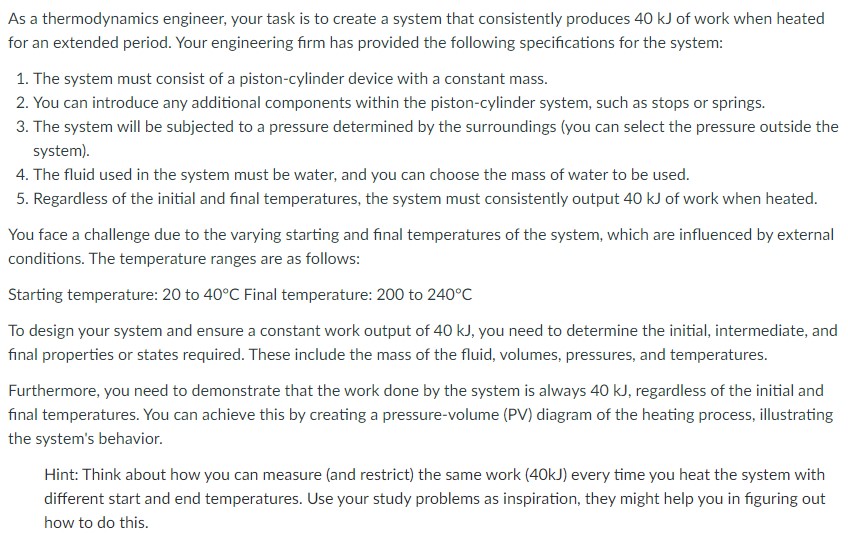

As a thermodynamics engineer, your task is to create a system that consistently produces 40kJ of work when heated for an extended period. Your engineering firm has provided the following specifications for the system: 1. The system must consist of a piston-cylinder device with a constant mass. 2. You can introduce any additional components within the piston-cylinder system, such as stops or springs. 3. The system will be subjected to a pressure determined by the surroundings (you can select the pressure outside the system). 4. The fluid used in the system must be water, and you can choose the mass of water to be used. 5. Regardless of the initial and final temperatures, the system must consistently output 40kJ of work when heated. You face a challenge due to the varying starting and final temperatures of the system, which are influenced by external conditions. The temperature ranges are as follows: Starting temperature: 20 to 40C Final temperature: 200 to 240C To design your system and ensure a constant work output of 40kJ, you need to determine the initial, intermediate, and final properties or states required. These include the mass of the fluid, volumes, pressures, and temperatures. Furthermore, you need to demonstrate that the work done by the system is always 40kJ, regardless of the initial and final temperatures. You can achieve this by creating a pressure-volume (PV) diagram of the heating process, illustrating the system's behavior. Hint: Think about how you can measure (and restrict) the same work (40kJ) every time you heat the system with different start and end temperatures. Use your study problems as inspiration, they might help you in figuring out how to do this. You can format your reponse as follows. - System design and specifications. (Pressure chosen, mass, etc...) - Proof that system does 40kJ of work when heated (mathematical calculation) - PV diagram of the system when heated from initial to final
Step by Step Solution
There are 3 Steps involved in it

Get step-by-step solutions from verified subject matter experts
 Study Help