Question: ASSESSMENT DESCRIPTION: This is an individual assessment task. Students will be provided a case study for critical analysis (Available in Assessment Brief folder in the
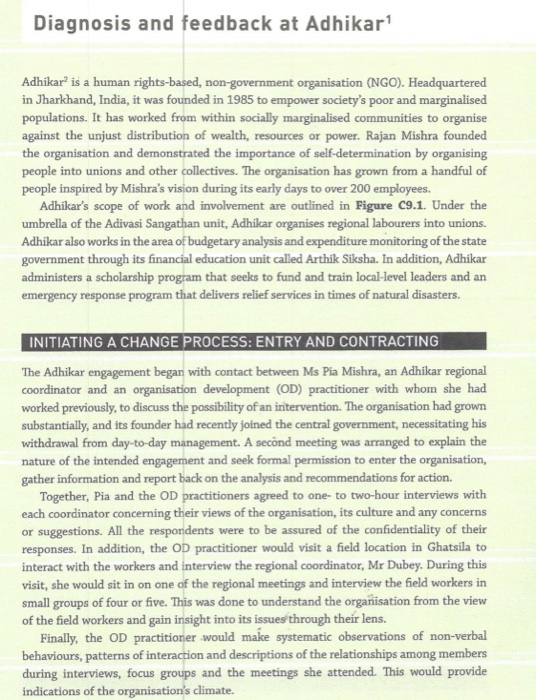
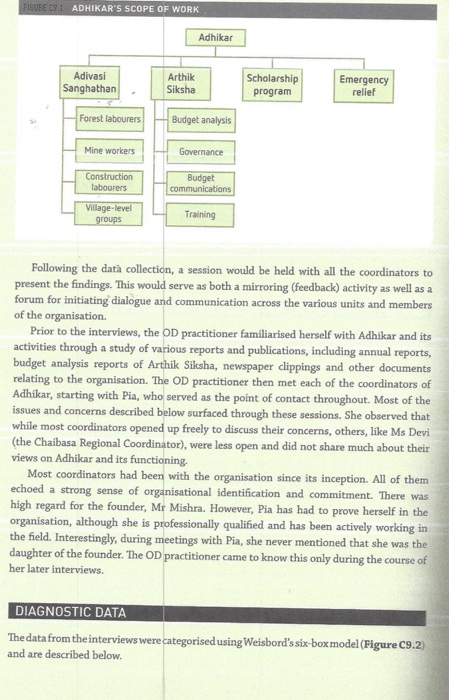
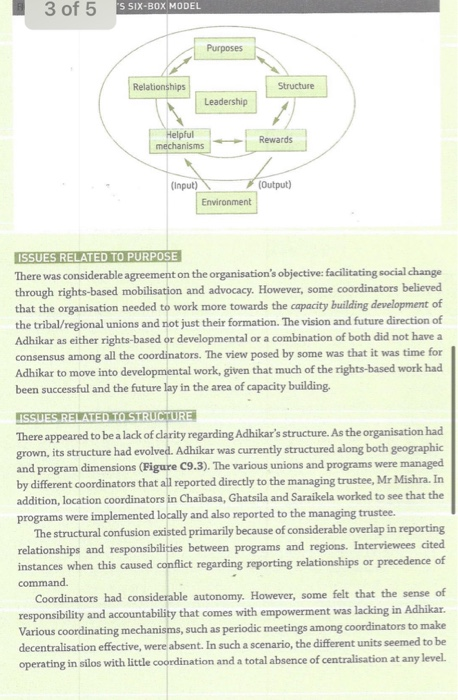
ASSESSMENT DESCRIPTION: This is an individual assessment task. Students will be provided a case study for critical analysis (Available in Assessment Brief folder in the moodle). Students are required to critically analyse the case using the relevant theories of change management learnt during the semester and answer the questions given below. Name of the case study: Diagnosis and Feedback on Adhikar. You have to answer all the three questions. Each question has a word limit of 750-800 words You are required to use 5 academic journals to support your answers. Reference list must be provided at the end of your answers Please read the case carefully prior to answering the questions. 1. Based on the data provided in the case, what is your analysis of the situation at Adhikar? Is the organisation in trouble? If so, how big s the problem? Is the organisation doing well? In other words, are all the data presented just symptoms of an organisation that is young and growing. 2. Design the feedback, meeting. What is the purpose of the meeting and what is the agenda and how will you present the data? 3. What actions do you believe the Adhikar organisation should take? What problems do you think these actions would solve? Diagnosis and feedback at Adhikari Adhikar is a human rights-based, non-government organisation (NGO). Headquartered in Jharkhand, India, it was founded in 1985 to empower society's poor and marginalised populations. It has worked from within socially marginalised communities to organise against the unjust distribution of wealth, resources or power. Rajan Mishra founded the organisation and demonstrated the importance of self-determination by organising people into unions and other collectives. The organisation has grown from a handful of people inspired by Mishra's vision during its early days to over 200 employees. Adhikar's scope of work and involvement are outlined in Figure 19.1. Under the umbrella of the Adivasi Sangathan unit, Adhikar organises regional labourers into unions. Adhikar also works in the area of budgetary analysis and expenditure monitoring of the state government through its financial education unit called Arthik Siksha. In addition, Adhikar administers a scholarship program that seeks to fund and train local-level leaders and an emergency response program that delivers relief services in times of natural disasters. INITIATING A CHANGE PROCESS: ENTRY AND CONTRACTING The Adhikar engagement began with contact between Ms Pia Mishra, an Adhikar regional coordinator and an organisation development (OD) practitioner with whom she had worked previously, to discuss the possibility of an intervention. The organisation had grown substantially, and its founder had recently joined the central government, necessitating his withdrawal from day-to-day management. A second meeting was arranged to explain the nature of the intended engagement and seek formal permission to enter the organisation, gather information and report back on the analysis and recommendations for action. Together, Pia and the OD practitioners agreed to one-to two-hour interviews with each coordinator concerning their views of the organisation, its culture and any concerns or suggestions. All the respondents were to be assured of the confidentiality of their responses. In addition, the OD practitioner would visit a field location in Ghatsila to interact with the workers and interview the regional coordinator, Mr Dubey. During this visit, she would sit in on one of the regional meetings and interview the field workers in small groups of four or five. This was done to understand the organisation from the view of the field workers and gain insight into its issues through their lens. Finally, the OD practitioner would make systematic observations of non-verbal behaviours, patterns of interaction and descriptions of the relationships among members during interviews, focus groups and the meetings she attended. This would provide indications of the organisation's climate. FIGURE 09.1 ADHIKAR'S SCOPE OF WORK Adhikar Adivasi Sanghathan Arthik Siksha Scholarship program Emergency relief Forest labourers Budget analysis Mine workers Governance Budget communications Construction labourers Village-level groups Training Following the data collection, a session would be held with all the coordinators to present the findings. This would serve as both a mirroring (feedback) activity as well as a forum for initiating dialogue and communication across the various units and members of the organisation Prior to the interviews, the OD practitioner familiarised herself with Adhikar and its activities through a study of various reports and publications, including annual reports, budget analysis reports of Arthik Siksha, newspaper clippings and other documents relating to the organisation. The OD practitioner then met each of the coordinators of Adhikar, starting with Pia, who served as the point of contact throughout. Most of the issues and concerns described below surfaced through these sessions. She observed that while most coordinators opened up freely to discuss their concerns, others, like Ms Devi (the Chaibasa Regional Coordinator), were less open and did not share much about their views on Adhikar and its functioning. Most coordinators had been with the organisation since its inception. All of them echoed a strong sense of organisational identification and commitment. There was high regard for the founder, Mr Mishra. However, Pia has had to prove herself in the organisation, although she is professionally qualified and has been actively working in the field. Interestingly, during meetings with Pia, she never mentioned that she was the daughter of the founder. The OD practitioner came to know this only during the course of her later interviews. DIAGNOSTIC DATA The data from the interviews were categorised using Weisbord's six-box model (Figure C9.2) and are described below. 3 of 5 S SIX-BOX MODEL Purposes Relationships Structure Leadership Helpful mechanisms Rewards (Input) (Output) Environment ISSUES RELATED TO PURPOSE There was considerable agreement on the organisation's objective: facilitating social change through rights-based mobilisation and advocacy. However, some coordinators believed that the organisation needed to work more towards the capacity building development of the tribal/regional unions and not just their formation. The vision and future direction of Adhikar as either rights-based or developmental or a combination of both did not have a consensus among all the coordinators. The view posed by some was that it was time for Adhikar to move into developmental work, given that much of the rights-based work had been successful and the future lay in the area of capacity building, ISSUES RELATED TO STRUCTURE There appeared to be a lack of clarity regarding Adhikar's structure. As the organisation had grown, its structure had evolved. Adhikar was currently structured along both geographic and program dimensions (Figure 19.3). The various unions and programs were managed by different coordinators that all reported directly to the managing trustee, Mr Mishra. In addition, location coordinators in Chaibasa, Ghatsila and Saraikela worked to see that the programs were implemented locally and also reported to the managing trustee. The structural confusion existed primarily because of considerable overlap in reporting relationships and responsibilities between programs and regions. Interviewees cited instances when this caused conflict regarding reporting relationships or precedence of command. Coordinators had considerable autonomy. However, some felt that the sense of responsibility and accountability that comes with empowerment was lacking in Adhikar. Various coordinating mechanisms, such as periodic meetings among coordinators to make decentralisation effective, were absent. In such a scenario, the different units seemed to be operating in silos with little coordination and a total absence of centralisation at any level. a 4 of 5 PART 6) INTEGRATIVE CASE STUDIES FIGURE 3 ADHIKAR REPORTING STRUCTURE Governing Body Managing Trustee (Mr Mishra Regional coordinators Program coordinators Ghatsila (Pia Mishra) Adivasi Sangathan Arthik Siksha Coordinator (Mr Dubey) Scholarship program Chaibasa (Ms Devil Construction union Saraikela ISSUES RELATED TO RELATIONSHIPS The most common theme in the interviews was the concern over a lack of coordination. Most of the program coordinators thought that there should be more integration among them. Each unit of Adhikar was performing well, but there was little sharing of information. Although there was a high degree of decentralisation and autonomy at the coordinator level, the coordinating mechanisms were absent. There had been a noticeable decline, over time, in the number of meetings when all the coordinators met, and many cited this as a reason for the disconnect they felt with Adhikar as a whole. In talling with old versus new coordinators, the data supported the conclusion that there was little trust between the two groups. The new coordinators felt their professional growth and program initiatives were stymied by the old guard, who appeared to be protecting their turf. New coordinators did not feel welcomed by the more senior coordinators. On the other hand, the older members in the organisation believed that the new coordinators were over ambitious and got right into the field without making an effort to understand the organisation. This concern was voiced by a few but not all coordinators, but the OD practitioner believed it had the potential to grow and create conflict if not properly addressed. A related theme was that new entrants did not go through any formal socialisation process, which also manifested in a feeling of not being welcomed into the organisation. The interviewees provided examples where new entrants had to seek information and figure things out for themselves, which further created a feeling of isolation. ISSUES RELATED TO REWARDS Adhikar began as a rights-based organisation and most of the older employees chose to work there because of their dedication to the original cause. The newer employees [CASE STUDY 1 DIAGNOSIS AND FEEDBACK AT ADHIKAR 525 (some better qualified professionally) were getting paid higher wages, which was perceived to be discriminatory and was a source of discontent among the older members. As an NGO that depended on external funding, the issue of job security was also a matter of concern. With Mr Mishra's declining involvement, there was a palpable fear that Adhikar might close its doors in the not-too-distant future. The interviewees suggested that some form of assurance from the leadership of Adhikar might ease the sense of insecurity. ISSUES RELATED TO HELPFUL MECHANISMS. Some coordinators were concerned about the irregularity of reporting. While some coordinators made progress reports on time, others were consistently tardy and this was pointed out as an example of inconsistency in leadership and authority. Most coordinators in the past had reported verbally on a regular basis to Mr Mishra, who was able to fill in gaps of information whenever required for other coordinators. Thus, the formal system of submitting and reading others' reports had never been emphasised. ISSUES RELATED TO LEADERSHIP Adhikar's founder and leader was considered dynamic and charismatic - a number of people had been attracted to the organisation by his personality. At the time of the interviews, Mr Mishra had taken a position in India's central government and was moving away from day-to-day management. This behaviour was interpreted as an appropriate response to keep political alignments transparent. However, it did create a leadership Perhaps because of his absence, many in the organisation were worried about a dearth of second-level leaders in the organisation. Even in his absence, Mr Mishra still appeared to be the de facto leader. The organisation seemed to be facing a crisis in terms of a leader who could command the same level of respect and following Two women, Ms Devi and Pia, were most often cited as potential future leaders of Adhikar. The Chaibasa coordinator, Ms Devi, had been with the organisation since its founding and was supported by the people in her region. In the eyes of some others, however, Ms Devi was a shadow of Mr Mishra and a surrogate leader for Pia. Ms Devi was viewed consistently as a good worker, but lacked the vision needed to lead a highly motivated team. Ms Devi had not been very forthcoming in the interview. In the absence of her father, Pia appeared to be the chief decision maker. She had been with the organisation for five years as the program director of Ghatsila, and operated from the headquarters while Ms Devi preferred to work from her Chaibasa location. Both women, independently, echoed reservations as potential next leaders and mentioned their gender as one of the reasons. They felt that the other male coordinators and the community they served might not be ready for a female leader. In discussions with most of the other coordinators, however, the OD practitioner got the sense that they were open to having a woman leader. Some of the coordination issues were expected to be addressed if a new leader was appointed. vacuum. ASSESSMENT DESCRIPTION: This is an individual assessment task. Students will be provided a case study for critical analysis (Available in Assessment Brief folder in the moodle). Students are required to critically analyse the case using the relevant theories of change management learnt during the semester and answer the questions given below. Name of the case study: Diagnosis and Feedback on Adhikar. You have to answer all the three questions. Each question has a word limit of 750-800 words You are required to use 5 academic journals to support your answers. Reference list must be provided at the end of your answers Please read the case carefully prior to answering the questions. 1. Based on the data provided in the case, what is your analysis of the situation at Adhikar? Is the organisation in trouble? If so, how big s the problem? Is the organisation doing well? In other words, are all the data presented just symptoms of an organisation that is young and growing. 2. Design the feedback, meeting. What is the purpose of the meeting and what is the agenda and how will you present the data? 3. What actions do you believe the Adhikar organisation should take? What problems do you think these actions would solve? Diagnosis and feedback at Adhikari Adhikar is a human rights-based, non-government organisation (NGO). Headquartered in Jharkhand, India, it was founded in 1985 to empower society's poor and marginalised populations. It has worked from within socially marginalised communities to organise against the unjust distribution of wealth, resources or power. Rajan Mishra founded the organisation and demonstrated the importance of self-determination by organising people into unions and other collectives. The organisation has grown from a handful of people inspired by Mishra's vision during its early days to over 200 employees. Adhikar's scope of work and involvement are outlined in Figure 19.1. Under the umbrella of the Adivasi Sangathan unit, Adhikar organises regional labourers into unions. Adhikar also works in the area of budgetary analysis and expenditure monitoring of the state government through its financial education unit called Arthik Siksha. In addition, Adhikar administers a scholarship program that seeks to fund and train local-level leaders and an emergency response program that delivers relief services in times of natural disasters. INITIATING A CHANGE PROCESS: ENTRY AND CONTRACTING The Adhikar engagement began with contact between Ms Pia Mishra, an Adhikar regional coordinator and an organisation development (OD) practitioner with whom she had worked previously, to discuss the possibility of an intervention. The organisation had grown substantially, and its founder had recently joined the central government, necessitating his withdrawal from day-to-day management. A second meeting was arranged to explain the nature of the intended engagement and seek formal permission to enter the organisation, gather information and report back on the analysis and recommendations for action. Together, Pia and the OD practitioners agreed to one-to two-hour interviews with each coordinator concerning their views of the organisation, its culture and any concerns or suggestions. All the respondents were to be assured of the confidentiality of their responses. In addition, the OD practitioner would visit a field location in Ghatsila to interact with the workers and interview the regional coordinator, Mr Dubey. During this visit, she would sit in on one of the regional meetings and interview the field workers in small groups of four or five. This was done to understand the organisation from the view of the field workers and gain insight into its issues through their lens. Finally, the OD practitioner would make systematic observations of non-verbal behaviours, patterns of interaction and descriptions of the relationships among members during interviews, focus groups and the meetings she attended. This would provide indications of the organisation's climate. FIGURE 09.1 ADHIKAR'S SCOPE OF WORK Adhikar Adivasi Sanghathan Arthik Siksha Scholarship program Emergency relief Forest labourers Budget analysis Mine workers Governance Budget communications Construction labourers Village-level groups Training Following the data collection, a session would be held with all the coordinators to present the findings. This would serve as both a mirroring (feedback) activity as well as a forum for initiating dialogue and communication across the various units and members of the organisation Prior to the interviews, the OD practitioner familiarised herself with Adhikar and its activities through a study of various reports and publications, including annual reports, budget analysis reports of Arthik Siksha, newspaper clippings and other documents relating to the organisation. The OD practitioner then met each of the coordinators of Adhikar, starting with Pia, who served as the point of contact throughout. Most of the issues and concerns described below surfaced through these sessions. She observed that while most coordinators opened up freely to discuss their concerns, others, like Ms Devi (the Chaibasa Regional Coordinator), were less open and did not share much about their views on Adhikar and its functioning. Most coordinators had been with the organisation since its inception. All of them echoed a strong sense of organisational identification and commitment. There was high regard for the founder, Mr Mishra. However, Pia has had to prove herself in the organisation, although she is professionally qualified and has been actively working in the field. Interestingly, during meetings with Pia, she never mentioned that she was the daughter of the founder. The OD practitioner came to know this only during the course of her later interviews. DIAGNOSTIC DATA The data from the interviews were categorised using Weisbord's six-box model (Figure C9.2) and are described below. 3 of 5 S SIX-BOX MODEL Purposes Relationships Structure Leadership Helpful mechanisms Rewards (Input) (Output) Environment ISSUES RELATED TO PURPOSE There was considerable agreement on the organisation's objective: facilitating social change through rights-based mobilisation and advocacy. However, some coordinators believed that the organisation needed to work more towards the capacity building development of the tribal/regional unions and not just their formation. The vision and future direction of Adhikar as either rights-based or developmental or a combination of both did not have a consensus among all the coordinators. The view posed by some was that it was time for Adhikar to move into developmental work, given that much of the rights-based work had been successful and the future lay in the area of capacity building, ISSUES RELATED TO STRUCTURE There appeared to be a lack of clarity regarding Adhikar's structure. As the organisation had grown, its structure had evolved. Adhikar was currently structured along both geographic and program dimensions (Figure 19.3). The various unions and programs were managed by different coordinators that all reported directly to the managing trustee, Mr Mishra. In addition, location coordinators in Chaibasa, Ghatsila and Saraikela worked to see that the programs were implemented locally and also reported to the managing trustee. The structural confusion existed primarily because of considerable overlap in reporting relationships and responsibilities between programs and regions. Interviewees cited instances when this caused conflict regarding reporting relationships or precedence of command. Coordinators had considerable autonomy. However, some felt that the sense of responsibility and accountability that comes with empowerment was lacking in Adhikar. Various coordinating mechanisms, such as periodic meetings among coordinators to make decentralisation effective, were absent. In such a scenario, the different units seemed to be operating in silos with little coordination and a total absence of centralisation at any level. a 4 of 5 PART 6) INTEGRATIVE CASE STUDIES FIGURE 3 ADHIKAR REPORTING STRUCTURE Governing Body Managing Trustee (Mr Mishra Regional coordinators Program coordinators Ghatsila (Pia Mishra) Adivasi Sangathan Arthik Siksha Coordinator (Mr Dubey) Scholarship program Chaibasa (Ms Devil Construction union Saraikela ISSUES RELATED TO RELATIONSHIPS The most common theme in the interviews was the concern over a lack of coordination. Most of the program coordinators thought that there should be more integration among them. Each unit of Adhikar was performing well, but there was little sharing of information. Although there was a high degree of decentralisation and autonomy at the coordinator level, the coordinating mechanisms were absent. There had been a noticeable decline, over time, in the number of meetings when all the coordinators met, and many cited this as a reason for the disconnect they felt with Adhikar as a whole. In talling with old versus new coordinators, the data supported the conclusion that there was little trust between the two groups. The new coordinators felt their professional growth and program initiatives were stymied by the old guard, who appeared to be protecting their turf. New coordinators did not feel welcomed by the more senior coordinators. On the other hand, the older members in the organisation believed that the new coordinators were over ambitious and got right into the field without making an effort to understand the organisation. This concern was voiced by a few but not all coordinators, but the OD practitioner believed it had the potential to grow and create conflict if not properly addressed. A related theme was that new entrants did not go through any formal socialisation process, which also manifested in a feeling of not being welcomed into the organisation. The interviewees provided examples where new entrants had to seek information and figure things out for themselves, which further created a feeling of isolation. ISSUES RELATED TO REWARDS Adhikar began as a rights-based organisation and most of the older employees chose to work there because of their dedication to the original cause. The newer employees [CASE STUDY 1 DIAGNOSIS AND FEEDBACK AT ADHIKAR 525 (some better qualified professionally) were getting paid higher wages, which was perceived to be discriminatory and was a source of discontent among the older members. As an NGO that depended on external funding, the issue of job security was also a matter of concern. With Mr Mishra's declining involvement, there was a palpable fear that Adhikar might close its doors in the not-too-distant future. The interviewees suggested that some form of assurance from the leadership of Adhikar might ease the sense of insecurity. ISSUES RELATED TO HELPFUL MECHANISMS. Some coordinators were concerned about the irregularity of reporting. While some coordinators made progress reports on time, others were consistently tardy and this was pointed out as an example of inconsistency in leadership and authority. Most coordinators in the past had reported verbally on a regular basis to Mr Mishra, who was able to fill in gaps of information whenever required for other coordinators. Thus, the formal system of submitting and reading others' reports had never been emphasised. ISSUES RELATED TO LEADERSHIP Adhikar's founder and leader was considered dynamic and charismatic - a number of people had been attracted to the organisation by his personality. At the time of the interviews, Mr Mishra had taken a position in India's central government and was moving away from day-to-day management. This behaviour was interpreted as an appropriate response to keep political alignments transparent. However, it did create a leadership Perhaps because of his absence, many in the organisation were worried about a dearth of second-level leaders in the organisation. Even in his absence, Mr Mishra still appeared to be the de facto leader. The organisation seemed to be facing a crisis in terms of a leader who could command the same level of respect and following Two women, Ms Devi and Pia, were most often cited as potential future leaders of Adhikar. The Chaibasa coordinator, Ms Devi, had been with the organisation since its founding and was supported by the people in her region. In the eyes of some others, however, Ms Devi was a shadow of Mr Mishra and a surrogate leader for Pia. Ms Devi was viewed consistently as a good worker, but lacked the vision needed to lead a highly motivated team. Ms Devi had not been very forthcoming in the interview. In the absence of her father, Pia appeared to be the chief decision maker. She had been with the organisation for five years as the program director of Ghatsila, and operated from the headquarters while Ms Devi preferred to work from her Chaibasa location. Both women, independently, echoed reservations as potential next leaders and mentioned their gender as one of the reasons. They felt that the other male coordinators and the community they served might not be ready for a female leader. In discussions with most of the other coordinators, however, the OD practitioner got the sense that they were open to having a woman leader. Some of the coordination issues were expected to be addressed if a new leader was appointed. vacuum









 Study Help