Question: Assignment 1 Reference Source: Textbook:- Colquitt, J. A., LePine, J. A., & Wesson, M. J. (2019). Organizational behaviour: Improving performance and commitment in the workplace
Assignment 1
Reference Source:
Textbook:-
Colquitt, J. A., LePine, J. A., & Wesson, M. J. (2019). Organizational behaviour: Improving performance and commitment in the workplace (6th ed). Burr Ridge, IL: McGraw-Hill Irwin.
Case Study: -
Case: Google
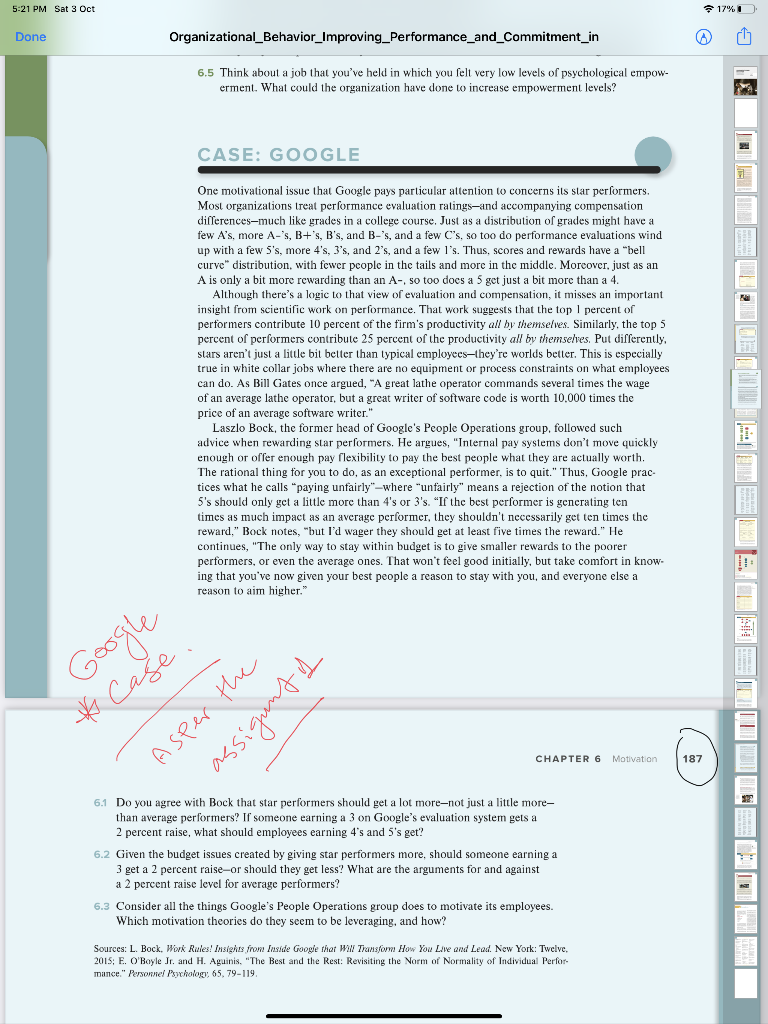
Please read the case Google from Chapter 6 Motivation. Page: - 187 given in your textbook Organizational behaviour: Improving performance and commitment in the workplace (6th ed). by Colquitt, J. A., LePine, J. A., & Wesson, M. J. (2019) and Answer the following Questions:
Assignment Question(s):
1. Do you agree with Bock that star performers should get a lot morenot just a little morethan average performers? If someone earning a 3 on Googles evaluation system gets a 2 percent raise, what should employees earning 4s and 5s get? (1.25 Marks )
2. Given the budget issues created by giving star performers more, should someone earning a 3 get a 2 percent raiseor should they get less? What are the arguments for and against a 2 percent raise level for average performers? (1.25 Marks )
3. Consider all the things Googles People Operations group does to motivate its employees. Which motivation theories do they seem to be leveraging, and how? (1.25 Marks )
Part:-2
Discussion question: Page: -167, please see the table and read carefully and then give your answers on the basis of your understanding.
4. Which of the outcomes in Table 6-2 are most appealing to you? Are you more attracted to extrinsic outcomes or intrinsic outcomes? Do you think that your preferences will change as you get older? (1.25 Marks )
5-21 PM Sat 3 Oct 17% Done Organizational_Behavior_Improving Performance_and_Commitment_in 6.5 Think about a job that you've held in which you felt very low levels of psychological empow- erment. What could the organization have done to increase empowerment levels? CASE: GOOGLE One motivational issue that Google pays particular attention to concerns ils star performers. Most organizations treat performance evaluation ratings and accompanying compensation differences-much like grades in a college course. Just as a distribution of grades might have a few A's, more A-'s, B+'s, B's, and B-'s, and a few C's, so too do performance evaluations wind up with a few S's, more 4's, 3's, and 2's, and a few l's. Thus, scores and rewards have a "bell curve" distribution, with fewer people in the tails and more in the middle. Moreover, just as an A is only a bit more rewarding than an A-, so too does a 5 get just a bit more than a 4. Although there's a logic to that view of evaluation and compensation, it misses an important insight from scientific work on performance. That work suggests that the top 1 percent of performers contribute 10 percent of the firm's productivity all by themselves. Similarly, the top 5 percent of performers contribute 25 percent of the productivity all by themselves. Put differently, Stars aren't just a little bit better than typical employees-they're worlds better. This is especially true in white collar jobs where there are no equipment or process constraints on what employees can do. As Bill Gates once argued, "A great lathe operator commands several times the wage of an average lathe operator, but a great writer of software code is worth 10.000 times the price of an average software writer." Laszlo Bock, the former head of Google's People Operations group, followed such advice when rewarding star performers. He argues, "Internal pay systems don't move quickly enough or offer enough pay flexibility to pay the best people what they are actually worth. The rational thing for you to do, as an exceptional performer, is to quit." Thus, Google prac- tices what he calls paying unfairly" where "unfairly" means a rejection of the notion that 5's should only get a little more than 4's or 3's. "If the best performer is generating ten much impact as an average performer, they shouldn't necessarily get ten times the reward." Bock notes, "but I'd wager they should get at least five times the reward." He continues, "The only way to stay within budget is to give smaller rewards to the poorer performers, or even the average ones. That won't feel good initially, but take comfort in know- ing that you've now given your best people a reason to stay with you, and everyone else a reason to aim higher. times Google * case the assigunty Asper CHAPTER 6 Motivation 187 6.1 Do you agree with Bock that star performers should get a lot more-not just a little more- than average performers? If someone earning a 3 on Google's evaluation system gets a 2 percent raise, what should employees earning 4's and 5's get? 6.2 Given the budget issues created by giving star performers more, should someone earning a 3 get a 2 percent raise-or should they get less? What are the arguments for and against a 2 percent raise level for average performers? 6.3 Consider all the things Google's People Operations group does to motivate its employees. Which motivation theories do they seem to be leveraging, and how? Sources: L. Bock, Work Rules! Insights from Inside Google that will Transform How You Live and Lead. New York: Twelve, 2015: E. O'Bayle Jr. and H. Aguinis, "The Best and the Rest: Revisiting the Norm of Normality of Individual Perfor mance." Personnel Psychology: 65.79-119









 Study Help