Question: Assignment #5 Instructions: Read Case 6.1 and Case 6.2. Then, answer its respective questions as shown at the bottom of the case. After this assignment
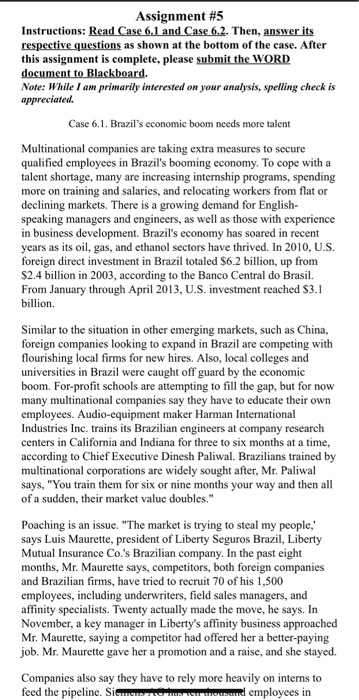
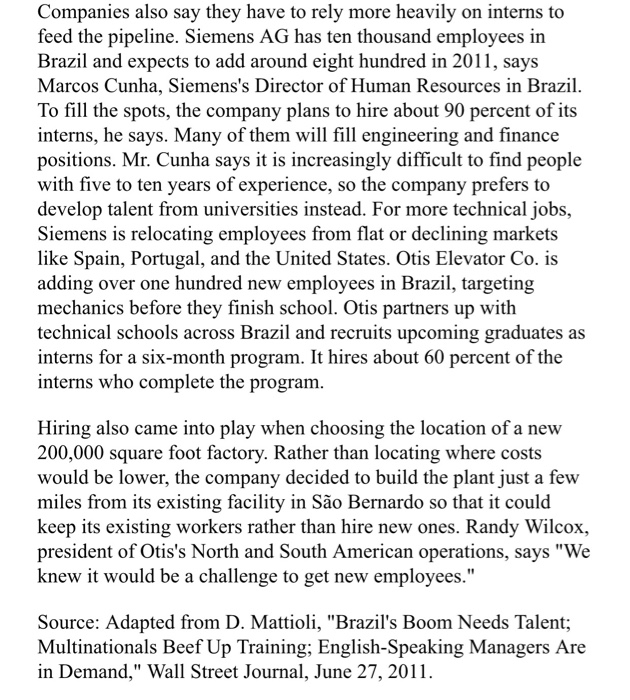
Assignment #5 Instructions: Read Case 6.1 and Case 6.2. Then, answer its respective questions as shown at the bottom of the case. After this assignment is complete, please submit the WORD document to Blackboard. Note: While I am primarily interested on your analysis, spelling check is appreciated. Case 6.1. Brazil's economic boom needs more talent Multinational companies are taking extra measures to secure qualified employees in Brazil's booming economy. To cope with a talent shortage, many are increasing internship programs, spending more on training and salaries, and relocating workers from flat or declining markets. There is a growing demand for English- speaking managers and engineers, as well as those with experience in business development. Brazil's economy has soared in recent years as its oil, gas, and ethanol sectors have thrived. In 2010, U.S. foreign direct investment in Brazil totaled $6.2 billion, up from $2.4 billion in 2003, according to the Banco Central do Brasil. From January through April 2013, U.S. investment reached $3.1 billion. Similar to the situation in other emerging markets, such as China, foreign companies looking to expand in Brazil are competing with flourishing local firms for new hires. Also, local colleges and universities in Brazil were caught off guard by the economic boom. For-profit schools are attempting to fill the gap, but for now many multinational companies say they have to educate their own employees. Audio-equipment maker Harman International Industries Inc. trains its Brazilian engineers at company research centers in California and Indiana for three to six months at a time, according to Chief Executive Dinesh Paliwal. Brazilians trained by multinational corporations are widely sought after, Mr. Paliwal says, "You train them for six or nine months your way and then all of a sudden, their market value doubles." Poaching is an issue. "The market is trying to steal my people, says Luis Maurette, president of Liberty Seguros Brazil, Liberty Mutual Insurance Co.'s Brazilian company. In the past eight months, Mr. Maurette says, competitors, both foreign companies and Brazilian firms, have tried to recruit 70 of his 1,500 employees, including underwriters, field sales managers, and affinity specialists. Twenty actually made the move, he says. In November, a key manager in Liberty's affinity business approached Mr. Maurette, saying a competitor had offered her a better-paying job. Mr. Maurette gave her a promotion and a raise, and she stayed. Companies also say they have to rely more heavily on interns to feed the pipeline. SICH SICH employees in Companies also say they have to rely more heavily on interns to feed the pipeline. Siemens AG has ten thousand employees in Brazil and expects to add around eight hundred in 2011, says Marcos Cunha, Siemens's Director of Human Resources in Brazil. To fill the spots, the company plans to hire about 90 percent of its interns, he says. Many of them will fill engineering and finance positions. Mr. Cunha says it is increasingly difficult to find people with five to ten years of experience, so the company prefers to develop talent from universities instead. For more technical jobs, Siemens is relocating employees from flat or declining markets like Spain, Portugal, and the United States. Otis Elevator Co. is adding over one hundred new employees in Brazil, targeting mechanics before they finish school. Otis partners up with technical schools across Brazil and recruits upcoming graduates as interns for a six-month program. It hires about 60 percent of the interns who complete the program. Hiring also came into play when choosing the location of a new 200,000 square foot factory. Rather than locating where costs would be lower, the company decided to build the plant just a few miles from its existing facility in So Bernardo so that it could keep its existing workers rather than hire new ones. Randy Wilcox, president of Otis's North and South American operations, says "We knew it would be a challenge to get new employees." Source: Adapted from D. Mattioli, "Brazil's Boom Needs Talent; Multinationals Beef Up Training; English-Speaking Managers Are in Demand," Wall Street Journal, June 27, 2011. 3. What are the main concerns and practices of MNCs in retaining talented employees










 Study Help