







Question: Assignment Chapter 4, (page 90) Ethical Dilemma: Having a (Not-So) Private Party Subject: Business Negotiations Integrative Negotiations Ethical Dilemma: Having a [Not-So] Private Party Summerville
Assignment
Chapter 4, (page 90)
Ethical Dilemma: Having a (Not-So) Private Party
Subject: Business Negotiations
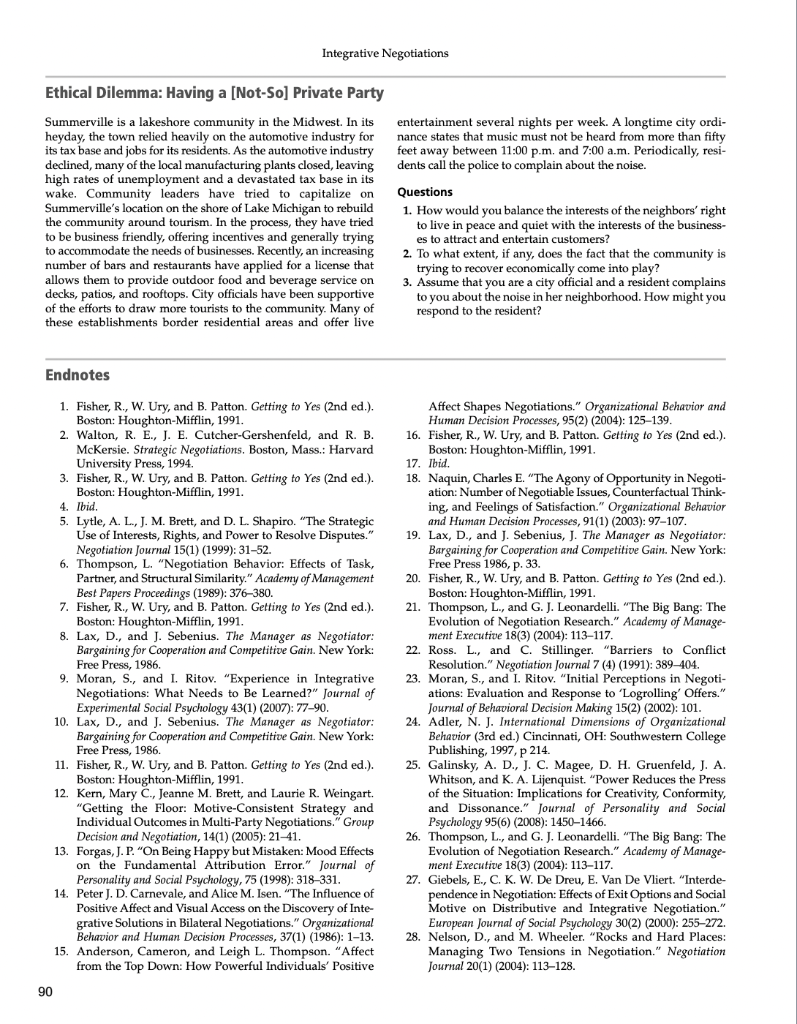
Integrative Negotiations Ethical Dilemma: Having a [Not-So] Private Party Summerville is a lakeshore community in the Midwest. In its heyday, the town relied heavily on the automotive industry for its tax base and jobs for its residents. As the automotive industry declined, many of the local manufacturing plants closed, leaving high rates of unemployment and a devastated tax base in its wake. Community leaders have tried to capitalize on Summerville's location on the shore of Lake Michigan to rebuild the community around tourism. In the process, they have tried to be business friendly, offering incentives and generally trying to accommodate the needs of businesses. Recently, an increasing number of bars and restaurants have applied for a license that allows them to provide outdoor food and beverage service on decks, patios, and rooftops. City officials have been supportive of the efforts to draw more tourists to the community. Many of these establishments border residential areas and offer live entertainment several nights per week. A longtime city ordi- nance states that music must not be heard from more than fifty feet away between 11:00 p.m. and 7:00 a.m. Periodically, resi- dents call the police to complain about the noise. Questions 1. How would you balance the interests of the neighbors' right to live in peace and quiet with the interests of the business- es to attract and entertain customers? 2. To what extent, if any, does the fact that the community is trying to recover economically come into play? 3. Assume that you are a city official and a resident complains to you about the noise in her neighborhood. How might you respond to the resident? Endnotes 1. Fisher, R., W. Ury, and B. Patton. Getting to Yes (2nd ed.). Boston: Houghton Mifflin, 1991. 2. Walton, R. E., J. E. Cutcher-Gershenfeld, and R. B. McKersie. Strategic Negotiations. Boston, Mass.: Harvard University Press, 1994. 3. Fisher, R., W. Ury, and B. Patton. Getting to Yes (2nd ed.). Boston: Houghton-Mifflin, 1991. 4. Ibid 5. Lytle, A. L., J. M. Brett, and D. L. Shapiro. "The Strategic Use of Interests, Rights, and Power to Resolve Disputes." Negotiation Journal 15(1) (1999): 31-52. 6. Thompson, L. "Negotiation Behavior: Effects of Task, Partner, and Structural Similarity." Academy of Management Best Papers Proceedings (1989): 376-380. 7. Fisher, R., W. Ury, and B. Patton. Getting to Yes (2nd ed.). Boston: Houghton Mifflin, 1991. 8. Lax, D., and J. Sebenius. The Manager as Negotiator: Bargaining for Cooperation and Competitive Gain. New York: Free Press, 1986. 9. Moran, S., and I. Ritov. "Experience in Integrative Negotiations: What Needs to Be Learned?" Journal of Experimental Social Psychology 43(1) (2007): 7790. 10. Lax, D., and J. Sebenius. The Manager as Negotiator: Bargaining for Cooperation and Competitive Gain. New York: Free Press, 1986. 11. Fisher, R., W. Ury, and B. Patton. Getting to Yes (2nd ed.). Boston: Houghton Mifflin, 1991. 12. Kern, Mary C., Jeanne M. Brett, and Laurie R. Weingart. "Getting the Floor: Motive-Consistent Strategy and Individual Outcomes in Multi-Party Negotiations." Group Decision and Negotiation, 14(1) (2005): 21-41. 13. Forgas, J. P. "On Being Happy but Mistaken: Mood Effects on the Fundamental Attribution Error." Journal of Personality and Social Psychology, 75 (1998): 318-331. 14. Peter J. D. Carnevale, and Alice M. Isen. "The Influence of Positive Affect and Visual Access on the Discovery of Inte- grative Solutions in Bilateral Negotiations." Organizational Behavior and Human Decision Processes, 37(1) (1986): 1-13. 15. Anderson, Cameron, and Leigh L. Thompson. "Affect from the Top Down: How Powerful Individuals' Positive Affect Shapes Negotiations." Organizational Behavior and Human Decision Processes, 95(2) (2004): 125-139. 16. Fisher, R., W. Ury, and B. Patton. Getting to Yes (2nd ed.). Boston: Houghton Mifflin, 1991. 17. Ibid. 18. Naquin, Charles E. "The Agony of Opportunity in Negoti- ation: Number of Negotiable Issues, Counterfactual Think- ing, Feelings of Satisfaction." Organizational Behavior and Human Decision Processes, 91(1)(2003): 97-107. 19. Lax, D., and J. Sebenius, J. The Manager as Negotiator: Bargaining for Cooperation and Competitive Gain. New York: Free Press 1986, p. 33. 20. Fisher, R., W. Ury, and B. Patton. Getting to Yes (2nd ed.). Boston: Houghton-Mifflin, 1991. 21. Thompson, L., and G. J. Leonardelli. "The Big Bang: The Evolution of Negotiation Research." Academy of Manage- ment Executive 18(3) (2004): 113117. 22. Ross. L., and C. Stillinger. "Barriers to Conflict Resolution." Negotiation Journal 7 (4) (1991): 389-404. 23. Moran, S., and I. Ritov. "Initial Perceptions in Negoti- ations: Evaluation and Response to Logrolling Offers." Journal of Behavioral Decision Making 15(2) (2002): 101. 24. Adler, N. J. International Dimensions of Organizational Behavior (3rd ed.) Cincinnati, OH: Southwestern College Publishing, 1997, p 214. 25. Galinsky, A. D., J. C. Magee, D. H. Gruenfeld, J. A. Whitson, and K. A. Lijenquist. "Power Reduces the Press of the Situation: Implications for Creativity, Conformity, and Dissonance." Journal of Personality and Social Psychology 956) (2008): 1450-1466. 26. Thompson, L., and G. J. Leonardelli. "The Big Bang: The Evolution of Negotiation Research." Academy of Manage- ment Executive 18(3) (2004): 113117. 27. Giebels, E., C.K. W. De Dreu, E. Van De Vliert. "Interde- pendence in Negotiation: Effects of Exit Options and Social Motive on Distributive and Integrative Negotiation." European Journal of Social Psychology 30(2) (2000): 255-272. 28. Nelson, D., and M. Wheeler. "Rocks and Hard Places: Managing Two Tensions in Negotiation." Negotiation Journal 20(1) (2004): 113128. 90
Step by Step Solution
There are 3 Steps involved in it
1 Expert Approved Answer
Step: 1 Unlock

Question Has Been Solved by an Expert!
Get step-by-step solutions from verified subject matter experts
Step: 2 Unlock
Step: 3 Unlock
 Study Help