Question: Assignment Read chapter 3 then consider the scenario below. You are CEO of a company with declining sales. You have experienced significant staff turnover in
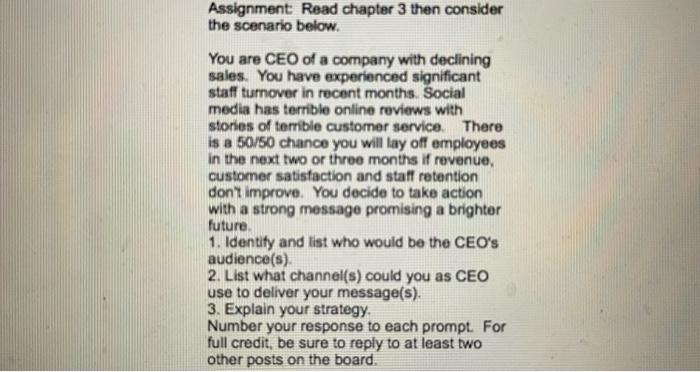
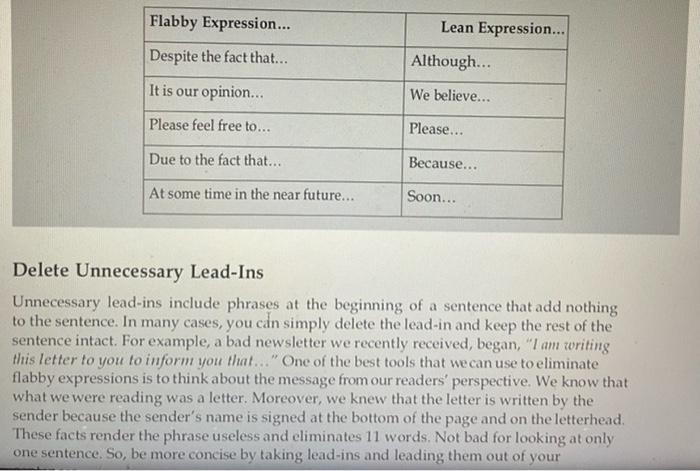
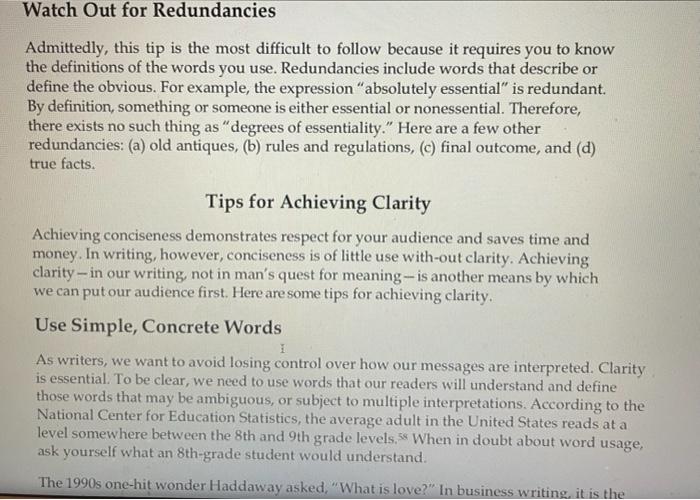
Assignment Read chapter 3 then consider the scenario below. You are CEO of a company with declining sales. You have experienced significant staff turnover in recent months. Social media has terrible online reviews with stories of terrible customer service. There is a 50/50 chance you will lay off employees in the next two or three months if revenue, customer satisfaction and staff retention don't improve. You decide to take action with a strong message promising a brighter future 1. Identity and list who would be the CEO's audience(s) 2. List what channel(s) could you as CEO use to deliver your message(s). 3. Explain your strategy Number your response to each prompt. For full credit, be sure to reply to at least two other posts on the board. Flabby Expression... Lean Expression... Despite the fact that... Although... It is our opinion... We believe... Please feel free to... Please... Due to the fact that... Because... At some time in the near future... Soon... Delete Unnecessary Lead-Ins Unnecessary lead-ins include phrases at the beginning of a sentence that add nothing to the sentence. In many cases, you can simply delete the lead-in and keep the rest of the sentence intact. For example, a bad newsletter we recently received, began, "I am writing this letter to you to inform you that..." One of the best tools that we can use to eliminate flabby expressions is to think about the message from our readers' perspective. We know that what we were reading was a letter. Moreover, we knew that the letter is written by the sender because the sender's name is signed at the bottom of the page and on the letterhead. These facts render the phrase useless and eliminates 11 words. Not bad for looking at only one sentence. So, be more concise by taking lead-ins and leading them out of your Watch Out for Redundancies Admittedly, this tip is the most difficult to follow because it requires you to know the definitions of the words you use. Redundancies include words that describe or define the obvious. For example, the expression "absolutely essential" is redundant. By definition, something or someone is either essential or nonessential. Therefore, there exists no such thing as "degrees of essentiality." Here are a few other redundancies: (a) old antiques, (b) rules and regulations, (e) final outcome, and (d) true facts. Tips for Achieving Clarity Achieving conciseness demonstrates respect for your audience and saves time and money. In writing, however, conciseness is of little use with-out clarity. Achieving clarity - in our writing, not in man's quest for meaning -- is another means by which we can putour audience first. Here are some tips for achieving clarity. Use Simple, Concrete Words 1 As writers, we want to avoid losing control over how our messages are interpreted. Clarity is essential. To be clear, we need to use words that our readers will understand and define those words that may be ambiguous, or subject to multiple interpretations. According to the National Center for Education Statistics, the average adult in the United States reads at a level somewhere between the 8th and 9th grade levels. When in doubt about word usage, ask yourself what an 8th-grade student would understand. The 1990s one-hit wonder Haddaway asked, "What is love?" In business writing, it is the









 Study Help