







Question: ASSIGNMENT REQUIREMENTS: 1. Using the notation as described in the PowerPoint slides and chapters 2 and 3 of the Hoffer textbook, prepare a conceptual model
ASSIGNMENT REQUIREMENTS: 1. Using the notation as described in the PowerPoint slides and chapters 2 and 3 of the Hoffer textbook, prepare a conceptual model (ERD) that reflects the data and relationships of the following organization: A dispatch center for a local sheriff's office keeps track of the callers who call the center requesting police assistance. The information they capture for each caller is the caller's name, address, and phone number. The center also tracks information about each of its police officers including name, address, and any area(s) of expertise (crisis negotiation, SWAT team member, criminal investigation division (CID), etc.). An officer can have more than one area of expertise. When a call is made to the dispatch center, the call number, date, time, and nature of the call (motor vehicle accident (MVA), theft, domestic dispute, etc.) must be captured. For each call, at least one officer must be assigned to the call, but multiple officers may be assigned to respond. The dispatch center wants to keep track of the time when each officer is dispatched to a call. When the call is resolved, the disposition of the call (resolved, citation issued, arrest made, etc.) must be recorded. Sometimes a call may require emergency medical services (EMS) to respond via an ambulance. The dispatch center keeps track of the number of each ambulance (medic 1, medic 2, medic 3, etc.) and the type of ambulance - either Basic Life Support
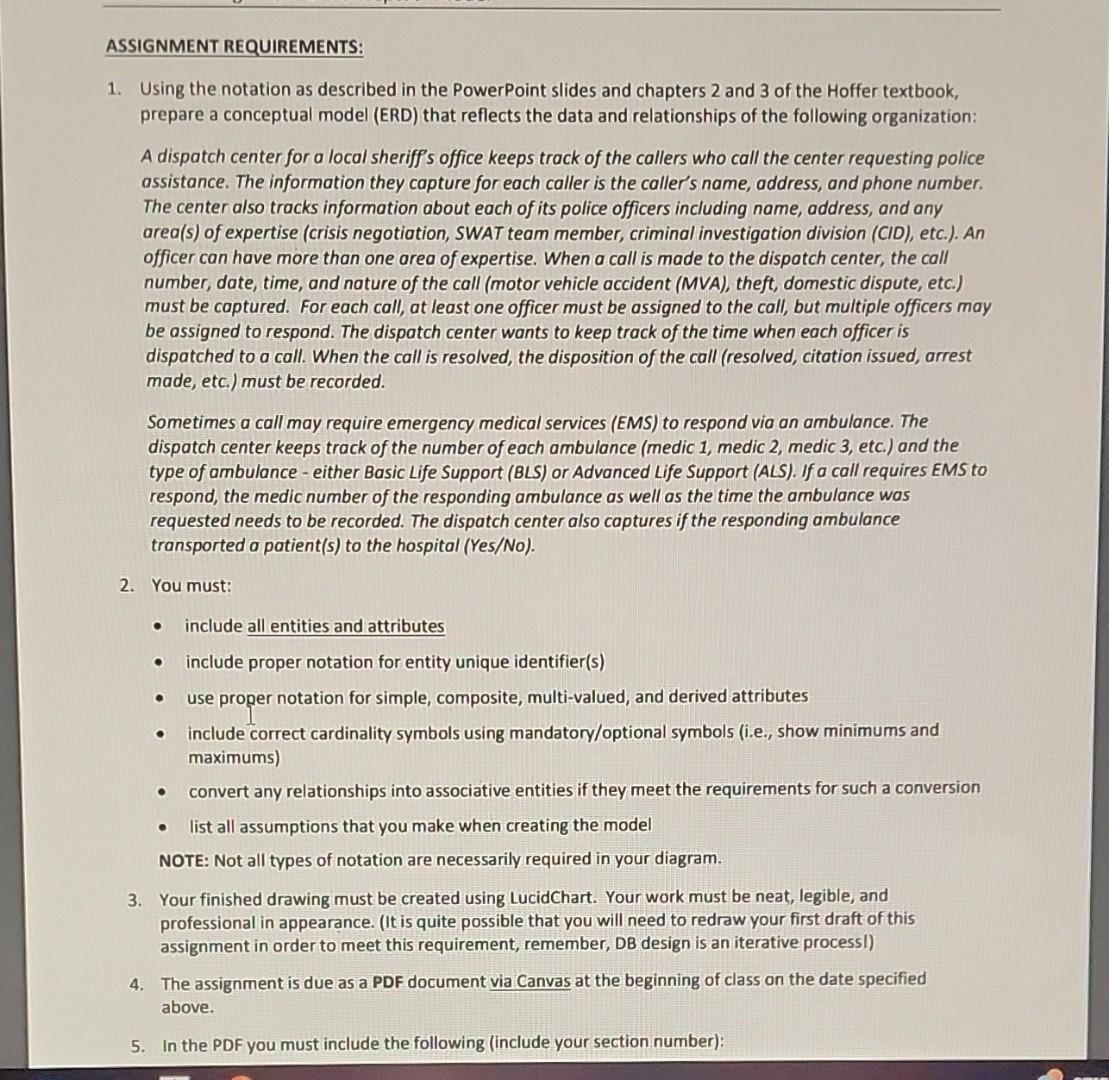
(BLS) or Advanced Life Support (ALS). If a call requires EMS to respond, the medic number of the responding ambulance as well as the time the ambulance was requested needs to be recorded. The dispatch center also captures if the responding ambulance transported a patient(s) to the hospital (Yes/No). 2. You must: include all entities and attributes include proper notation for entity unique identifier(s) use proper notation for simple, composite, multi-valued, and derived attributes include correct cardinality symbols using mandatory/optional symbols (i.e., show minimums and maximums) convert any relationships into associative entities if they meet the requirements for such a conversion list all assumptions that you make when creating the model NOTE: Not all types of notation are necessarily required in your diagram. 3. Your finished drawing must be created using LucidChart. Your work must be neat, legible, and professional in appearance. (It is quite possible that you will need to redraw your first draft of this assignment in order to meet this requirement, remember, DB design is an iterative process!) 4. The assignment is due as a PDF document via Canvas at the beginning of class on the date specified above. 5. In the PDF you must include the following (include your section number):
ASSIGNMENT REQUIREMENTS: 1. Using the notation as described in the PowerPoint slides and chapters 2 and 3 of the Hoffer textbook, prepare a conceptual model (ERD) that reflects the data and relationships of the following organization: A dispatch center for a local sheriff's office keeps track of the callers who call the center requesting police assistance. The information they capture for each caller is the caller's name, address, and phone number. The center also tracks information about each of its police officers including name, address, and any area(s) of expertise (crisis negotiotion, SWAT team member, criminal investigation division (CID), etc.). An officer can have more than one area of expertise. When a call is made to the dispatch center, the call number, date, time, and nature of the call (motor vehicle accident (MVA), theft, domestic dispute, etc.) must be captured. For each call, at least one officer must be assigned to the call, but multiple officers may be assigned to respond. The dispatch center wants to keep track of the time when each officer is dispatched to a call. When the call is resolved, the disposition of the call (resolved, citation issued, arrest made, etc.) must be recorded. Sometimes a call may require emergency medical services (EMS) to respond via an ambulance. The dispatch center keeps track of the number of each ambulance (medic 1, medic 2, medic 3, etc.) and the type of ambulance - either Basic Life Support (BLS) or Advanced Life Support (ALS). If a call requires EMS to respond, the medic number of the responding ambulance as well as the time the ambulance was requested needs to be recorded. The dispatch center also captures if the responding ambulance transported a patient(s) to the hospital (Yes/No). 2. You must: - include all entities and attributes - include proper notation for entity unique identifier(s) - use proper notation for simple, composite, multi-valued, and derived attributes - include correct cardinality symbols using mandatory/optional symbols (i.e., show minimums and maximums) - convert any relationships into associative entities if they meet the requirements for such a conversion - list all assumptions that you make when creating the model NOTE: Not all types of notation are necessarily required in your diagram. 3. Your finished drawing must be created using LucidChart. Your work must be neat, legible, and professional in appearance. (It is quite possible that you will need to redraw your first draft of this assignment in order to meet this requirement, remember, DB design is an iterative processI) 4. The assignment is due as a PDF document via Canvas at the beginning of class on the date specified above. 5. In the PDF you must include the following (include your section number): ASSIGNMENT REQUIREMENTS: 1. Using the notation as described in the PowerPoint slides and chapters 2 and 3 of the Hoffer textbook, prepare a conceptual model (ERD) that reflects the data and relationships of the following organization: A dispatch center for a local sheriff's office keeps track of the callers who call the center requesting police assistance. The information they capture for each caller is the caller's name, address, and phone number. The center also tracks information about each of its police officers including name, address, and any area(s) of expertise (crisis negotiotion, SWAT team member, criminal investigation division (CID), etc.). An officer can have more than one area of expertise. When a call is made to the dispatch center, the call number, date, time, and nature of the call (motor vehicle accident (MVA), theft, domestic dispute, etc.) must be captured. For each call, at least one officer must be assigned to the call, but multiple officers may be assigned to respond. The dispatch center wants to keep track of the time when each officer is dispatched to a call. When the call is resolved, the disposition of the call (resolved, citation issued, arrest made, etc.) must be recorded. Sometimes a call may require emergency medical services (EMS) to respond via an ambulance. The dispatch center keeps track of the number of each ambulance (medic 1, medic 2, medic 3, etc.) and the type of ambulance - either Basic Life Support (BLS) or Advanced Life Support (ALS). If a call requires EMS to respond, the medic number of the responding ambulance as well as the time the ambulance was requested needs to be recorded. The dispatch center also captures if the responding ambulance transported a patient(s) to the hospital (Yes/No). 2. You must: - include all entities and attributes - include proper notation for entity unique identifier(s) - use proper notation for simple, composite, multi-valued, and derived attributes - include correct cardinality symbols using mandatory/optional symbols (i.e., show minimums and maximums) - convert any relationships into associative entities if they meet the requirements for such a conversion - list all assumptions that you make when creating the model NOTE: Not all types of notation are necessarily required in your diagram. 3. Your finished drawing must be created using LucidChart. Your work must be neat, legible, and professional in appearance. (It is quite possible that you will need to redraw your first draft of this assignment in order to meet this requirement, remember, DB design is an iterative processI) 4. The assignment is due as a PDF document via Canvas at the beginning of class on the date specified above. 5. In the PDF you must include the following (include your section number)
Step by Step Solution
There are 3 Steps involved in it

Get step-by-step solutions from verified subject matter experts
 Study Help