Question: Assignment Task The task involves discussion of the use of is for an online business start-up as detailed below. Businesses can sell two things -
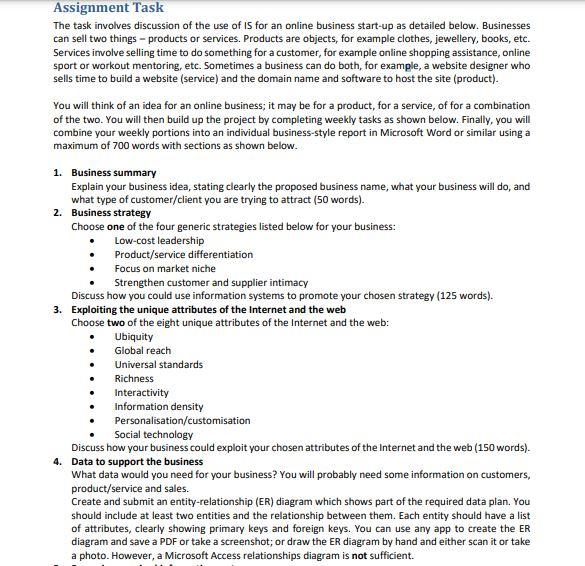
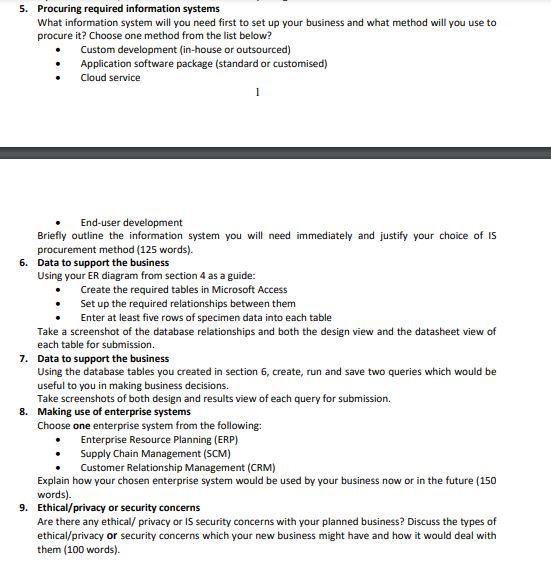
Assignment Task The task involves discussion of the use of is for an online business start-up as detailed below. Businesses can sell two things - products or services. Products are objects, for example clothes, jewellery, books, etc. Services involve selling time to do something for a customer, for example online shopping assistance, online sport or workout mentoring, etc. Sometimes a business can do both, for example, a website designer who sells time to build a website (service) and the domain name and software to host the site (product). You will think of an idea for an online business; it may be for a product, for a service, of for a combination of the two. You will then build up the project by completing weekly tasks as shown below. Finally, you will combine your weekly portions into an individual business-style report in Microsoft Word or similar using a maximum of 700 words with sections as shown below. 1. Business summary Explain your business idea, stating clearly the proposed business name, what your business will do, and what type of customer/client you are trying to attract (50 words). 2. Business strategy Choose one of the four generic strategies listed below for your business: Low-cost leadership Product/Service differentiation Focus on market niche Strengthen customer and supplier intimacy Discuss how you could use information systems to promote your chosen strategy (125 words). 3. Exploiting the unique attributes of the Internet and the web Choose two of the eight unique attributes of the Internet and the web: Ubiquity Global reach Universal standards Richness Interactivity Information density Personalisation/customisation Social technology Discuss how your business could exploit your chosen attributes of the Internet and the web (150 words). 4. Data to support the business What data would you need for your business? You will probably need some information on customers, product/service and sales. Create and submit an entity-relationship (ER) diagram which shows part of the required data plan. You should include at least two entities and the relationship between them. Each entity should have a list of attributes, clearly showing primary keys and foreign keys. You can use any app to create the ER diagram and save a PDF or take a screenshot; or draw the ER diagram by hand and either scan it or take a photo. However, a Microsoft Access relationships diagram is not sufficient. 5. Procuring required information systems What information system will you need first to set up your business and what method will you use to procure it? Choose one method from the list below? Custom development (in-house or outsourced) Application software package (standard or customised) Cloud service End-user development Briefly outline the information system you will need immediately and justify your choice of is procurement method (125 words). 6. Data to support the business Using your ER diagram from section 4 as a guide: Create the required tables in Microsoft Access Set up the required relationships between them Enter at least five rows of specimen data into each table Take a screenshot of the database relationships and both the design view and the datasheet view of each table for submission. 7. Data to support the business Using the database tables you created in section 6, create, run and save two queries which would be useful to you in making business decisions. Take screenshots of both design and results view of each query for submission. 8. Making use of enterprise systems Choose one enterprise system from the following: Enterprise Resource Planning (ERP) Supply Chain Management (SCM) Customer Relationship Management (CRM) Explain how your chosen enterprise system would be used by your business now or in the future (150 words). 9. Ethical/privacy or security concerns Are there any ethical/privacy or is security concerns with your planned business? Discuss the types of ethical/privacy or security concerns which your new business might have and how it would deal with them (100 words). Assignment Task The task involves discussion of the use of is for an online business start-up as detailed below. Businesses can sell two things - products or services. Products are objects, for example clothes, jewellery, books, etc. Services involve selling time to do something for a customer, for example online shopping assistance, online sport or workout mentoring, etc. Sometimes a business can do both, for example, a website designer who sells time to build a website (service) and the domain name and software to host the site (product). You will think of an idea for an online business; it may be for a product, for a service, of for a combination of the two. You will then build up the project by completing weekly tasks as shown below. Finally, you will combine your weekly portions into an individual business-style report in Microsoft Word or similar using a maximum of 700 words with sections as shown below. 1. Business summary Explain your business idea, stating clearly the proposed business name, what your business will do, and what type of customer/client you are trying to attract (50 words). 2. Business strategy Choose one of the four generic strategies listed below for your business: Low-cost leadership Product/Service differentiation Focus on market niche Strengthen customer and supplier intimacy Discuss how you could use information systems to promote your chosen strategy (125 words). 3. Exploiting the unique attributes of the Internet and the web Choose two of the eight unique attributes of the Internet and the web: Ubiquity Global reach Universal standards Richness Interactivity Information density Personalisation/customisation Social technology Discuss how your business could exploit your chosen attributes of the Internet and the web (150 words). 4. Data to support the business What data would you need for your business? You will probably need some information on customers, product/service and sales. Create and submit an entity-relationship (ER) diagram which shows part of the required data plan. You should include at least two entities and the relationship between them. Each entity should have a list of attributes, clearly showing primary keys and foreign keys. You can use any app to create the ER diagram and save a PDF or take a screenshot; or draw the ER diagram by hand and either scan it or take a photo. However, a Microsoft Access relationships diagram is not sufficient. 5. Procuring required information systems What information system will you need first to set up your business and what method will you use to procure it? Choose one method from the list below? Custom development (in-house or outsourced) Application software package (standard or customised) Cloud service End-user development Briefly outline the information system you will need immediately and justify your choice of is procurement method (125 words). 6. Data to support the business Using your ER diagram from section 4 as a guide: Create the required tables in Microsoft Access Set up the required relationships between them Enter at least five rows of specimen data into each table Take a screenshot of the database relationships and both the design view and the datasheet view of each table for submission. 7. Data to support the business Using the database tables you created in section 6, create, run and save two queries which would be useful to you in making business decisions. Take screenshots of both design and results view of each query for submission. 8. Making use of enterprise systems Choose one enterprise system from the following: Enterprise Resource Planning (ERP) Supply Chain Management (SCM) Customer Relationship Management (CRM) Explain how your chosen enterprise system would be used by your business now or in the future (150 words). 9. Ethical/privacy or security concerns Are there any ethical/privacy or is security concerns with your planned business? Discuss the types of ethical/privacy or security concerns which your new business might have and how it would deal with them (100 words)









 Study Help