Question: Assignment This activity will bridge chapters 1 and 2 from your reading. 1. Identify and list one example of each of the major elements of
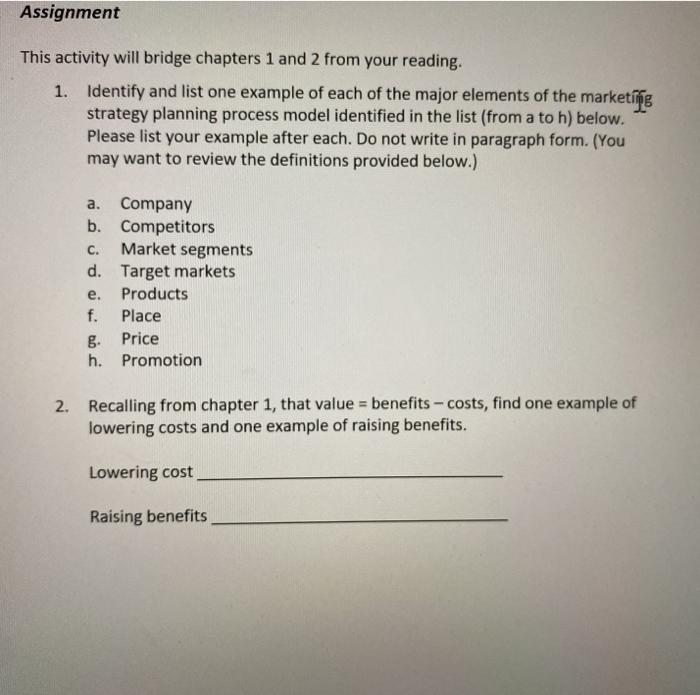
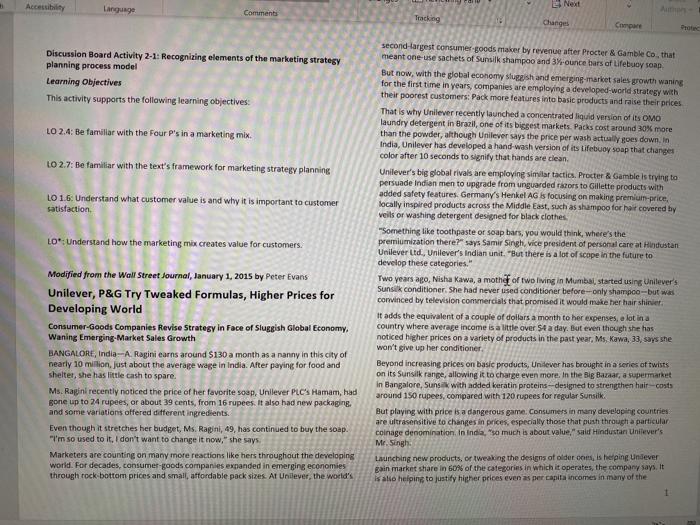
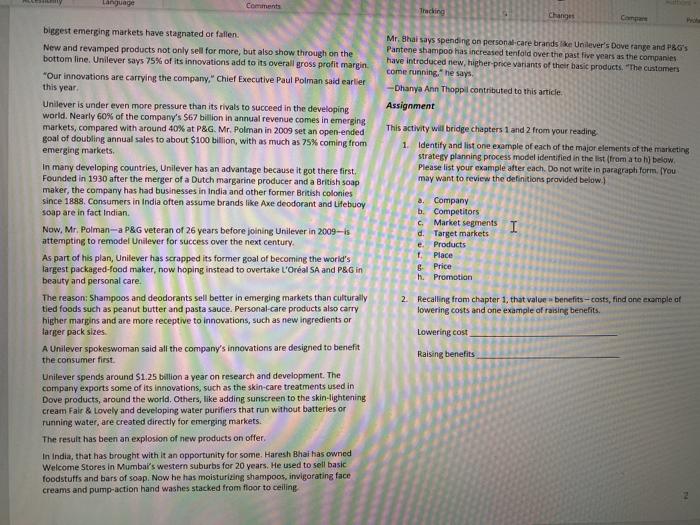
Assignment This activity will bridge chapters 1 and 2 from your reading. 1. Identify and list one example of each of the major elements of the marketing strategy planning process model identified in the list (from a to h) below. Please list your example after each. Do not write in paragraph form. (You may want to review the definitions provided below.) a. C. Company b. Competitors Market segments d. Target markets e. Products f. Place Price h. Promotion DO 2. Recalling from chapter 1, that value = benefits - costs, find one example of lowering costs and one example of raising benefits. Lowering cost Raising benefits Accessibility Language El Next Comments Tracking Changes Come Pro Discussion Board Activity 2-1: Recognizing elements of the marketing strategy planning process model Learning Objectives This activity supports the following learning objectives: LO 2.A: Be familiar with the Four P's in a marketing mix. LO 2.7: Be familiar with the text's framework for marketing strategy planning LO 1.6. Understand what customer value is and why it is important to customer satisfaction LO: Understand how the marketing mix creates value for customers. Modified from the Wall Street Journal, January 1, 2015 by Peter Evans Unilever, P&G Try Tweaked Formulas, Higher Prices for Developing World Consumer Goods Companies Revise Strategy in Face of Sluggish Global Economy, Waning Emerging Market Sales Growth BANGALORE, India - A. Ragini earns around $130 a month as a nanny in this city of nearly 10 million, just about the average wage in India. After paying for food and shelter, she has little cash to spare. Ms. Ragini recently noticed the price of her favorite soep, Unilever PLC's Hamam, had gone up to 24 rupees, or about 39 cents, from 16 rupees. It also had new packaging. and some variations offered different ingredients. Even though it stretches her budget, Ms. Ragini, 49, has continued to buy the soap. i'm so used to it. I don't want to change it now," she says. Marketers are counting on many more reactions like hers throughout the developing world. For decades, consumer goods companies expanded in emerging economies through rock bottom prices and small, affordable pack sizes. At Unilever, the world's second-largest consumer goods maker by revenue after Procter & Gamble Co, that meant one-use sachets of Sunsilk shampoo and 3 rounce bars of Lifebuoy soap But now, with the global economy slush and emerging market sales growth waning for the first time in years, companies are employing a developed world strategy with their poorest customers: Pack more features into basic products and raise their prices That is why Unilever recently launched a concentrated liquid version of its OMO laundry detergent in Brazil, one of its biggest markets. Packs cost around 30% more than the powder, although Unilever says the price per wash actually goes down. In India, Unilever has developed a hand-wash version of its tifebuoy soap that changes color after 10 seconds to signify that hands are clean Unilever's big global rivals are employing similar tactics. Procter & Gamble is trying to persuade Indian men to upgrade from unguarded razors to Gillette products with added safety features Germany's Henkel AG is focusing on making premium-price, locally inspired products across the Middle East, such as shampoo for hair covered by veils or washing detergent designed for black clothes "Something like toothpaste or soap bars, you would think, where's the premiumization there?" says Samir Singh, vice president of personal care at Hindustan Unilever Ltd., Unilever's Indian unit. But there is a lot of scope in the future to develop these categories." Two years ago, Nisha Kawa, a mother of two living in Mumbai, started using Unilever's Sunsilk conditioner. She had never used conditioner before-only shampoo--but was convinced by television commercials that promised it would make her hair shinier it adds the equivalent of a couple of dollars a month to her expenses, a lotina country where average income is a little over 54 a day. But even though she has noticed higher prices on a variety of products in the past year, Ms. Kawa, 33, says she won't give up her conditioner Beyond increasing prices on basic products, Unilever has brought in a series of twists on its Sunsilk range, allowing it to charge even more. In the Big Bazaar, a supermarket in Bangalore, Sunsilk with added keratin proteins-designed to strengthen hair-costs around 150 rupees, compared with 120 rupees for regular Sunsilk. But playing with price is a dangerous game. Consumers in many developing countries are ultrasensitive to changes in prices, especially those that push through a particular coinage denomination in India, so much is about value," said Hindustani Unilever's Mr. Singh Launching new products, or tweaking the designs of older con, is helping Undever gain market share in 60% of the categories in which it operates, the company says. It is also helping to justify higher prices even as per capita incomes in many of the 1 Language Comments Trading Changes Mr. Bhai says spending on personal care brands like Unilever's Dove range and P&G'S Pantene shampoo has increased tenfald over the past five years as the companies have introduced new, higher-price variants of their basic products. The customers come running," he says Dhanya Ann Thoppil contributed to this article Assignment This activity will bridge chapters 1 and 2 from your reading 1. Identify and list one example of each of the major elements of the marketing strategy planning process model identified in the list (from a toh below. Please list your example after each. Do not write in paragraph form. You may want to review the definitions provided below biggest emerging markets have stagnated or fallen. New and revamped products not only sell for more, but also show through on the bottom line. Unilever says 75% of its innovations add to its overall gross profit margin "Our innovations are carrying the company." Chief Executive Paul Polman said earlier this year Unilever is under even more pressure than its rivals to succeed in the developing world. Nearly 60% of the company's $67 billion in annual revenue comes in emerging markets, compared with around 40% at P&G. Mr. Polman in 2009 set an open-ended goal of doubling annual sales to about $100 billion, with as much as 75% coming from emerging markets In many developing countries, Unilever has an advantage because it got there first Founded in 1930 after the merger of a Dutch margarine producer and a British soap maker, the company has had businesses in India and other former British colonies since 1888. Consumers in India often assume brands like Axe deodorant and Lifebuoy soap are in fact Indian Now, Mr. Polmana P&G veteran of 26 years before joining Unilever in 2009- attempting to remodel Unilever for success over the next century. As part of his plan, Unilever has scrapped its former goal of becoming the world's largest packaged-food maker, now hoping instead to overtake L'Oral SA and P&G in beauty and personal care. The reason: Shampoos and deodorants sell better in emerging markets than culturally tied foods such as peanut butter and pasta sauce. Personal-care products also carry higher margins and are more receptive to innovations, such as new ingredients or larger pack sizes A Unilever spokeswoman said all the company's innovations are designed to benefit the consumer first Unilever spends around $1.25 billion a year on research and development. The company exports some of its innovations, such as the skin care treatments used in Dove products, around the world. Others, like adding sunscreen to the skin lightening cream Fair & Lovely and developing water purifiers that run without batteries or running water, are created directly for emerging markets. The result has been an explosion of new products on offer In India, that has brought with it an opportunity for some. Haresh Bhai has owned Welcome Stores in Mumbai's western suburbs for 20 years. He used to sell basic foodstuffs and bars of soap. Now he has moisturizing shampoos, invigorating face creams and pump-action hand washes stacked from floor to ceiling Company b. Competitors C Market segments I d. Target markets e. Products 1 Place Price h Promotion 2. Recalling from chapter 1, that value benefits-costs, find one example of lowering costs and one example of raising benefits. Lowering cost Raising benefits









 Study Help