



Question: Assume that problem Q1 reduces to problem Q2 in polynomial time and both Q1 and Q2 are in NP. (a) If Q1 can be solved
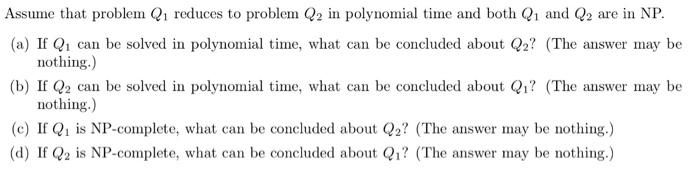
Assume that problem Q1 reduces to problem Q2 in polynomial time and both Q1 and Q2 are in NP. (a) If Q1 can be solved in polynomial time, what can be concluded about Q2 (The answer may be nothing.) (b) If Q2 can be solved in polynomial time, what can be concluded about Q1 (The answer may be nothing.) (c) If Q is NP-complete, what can be concluded about Q2? (The answer may be nothing.) (d) If Q2 is NP-complete, what can be concluded about Q1 (The answer may be nothing.)
Step by Step Solution
There are 3 Steps involved in it
1 Expert Approved Answer
Step: 1 Unlock

Question Has Been Solved by an Expert!
Get step-by-step solutions from verified subject matter experts
Step: 2 Unlock
Step: 3 Unlock