







Question: assume that the cost function on each link is: Route 1 a, + bV Route 2 a + bV/ Without loss of generality, assume
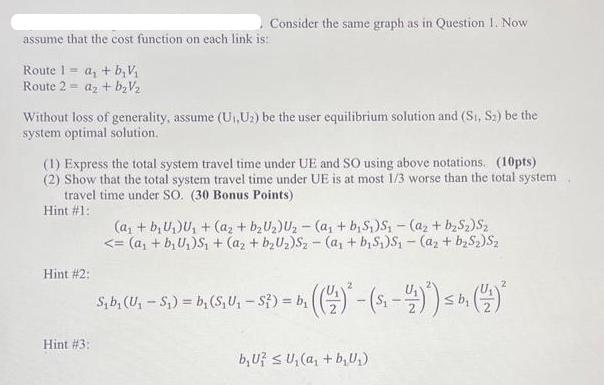
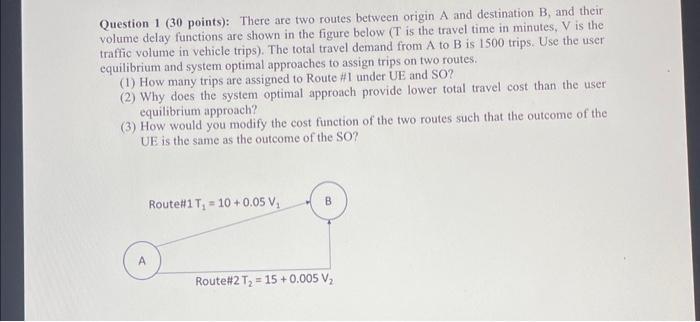
assume that the cost function on each link is: Route 1 a, + bV Route 2 a + bV/ Without loss of generality, assume (U,U2) be the user equilibrium solution and (S, S) be the system optimal solution. Consider the same graph as in Question 1. Now (1) Express the total system travel time under UE and SO using above notations. (10pts) (2) Show that the total system travel time under UE is at most 1/3 worse than the total system. travel time under SO. (30 Bonus Points) Hint #1: Hint #2: Hint #3: (a + bU)U + (a + b U)U - (a + bS)S - (az + bS)Sz Question 1 (30 points): There are two routes between origin A and destination B, and their volume delay functions are shown in the figure below (T is the travel time in minutes, V is the traffic volume in vehicle trips). The total travel demand from A to B is 1500 trips. Use the user equilibrium and system optimal approaches to assign trips on two routes. (1) How many trips are assigned to Route #1 under UE and SO? (2) Why does the system optimal approach provide lower total travel cost than the user equilibrium approach? (3) How would you modify the cost function of the two routes such that the outcome of the UE is the same as the outcome of the SO? Route#1 T=10+ 0.05 V B Route#2 T = 15 +0.005 V
Step by Step Solution
3.46 Rating (156 Votes )
There are 3 Steps involved in it
1 How many trips are assigned to Route 1 under UE and SO User equilibrium UE Under UE each driver selfishly chooses the route with the shortest travel time Since the travel time on each route depends ... View full answer

Get step-by-step solutions from verified subject matter experts
 Study Help