







Question: Assume (, U , P) is a probability space with a Brownian motion (W (t), t 0). Let n(:c, t) := ]E[e{T'*](S(T) K)+] where S'-'(T)
Assume (, U , P) is a probability space with a Brownian motion (W (t), t 0).
![motion (W (t), t 0). Let n(:c, t) := ]E[e"{T'*](S\""(T) K)+] where](https://dsd5zvtm8ll6.cloudfront.net/si.experts.images/questions/2024/10/670cc21e65b9e_374670cc21e5976d.jpg)
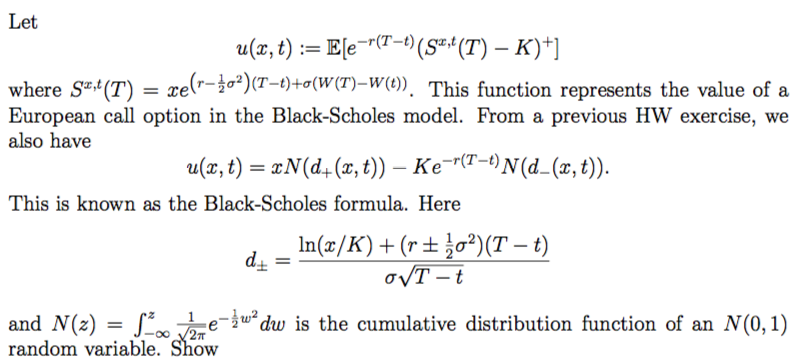
Let n(:c, t) := ]E[e"{T'*](S\""(T) K)+] where S'-'(T) = 9:30"\"2)':T"3+\"Wm'w[m. This function represents the value of a. European call option in the Black-Scholes model. From a previous HW exercise, we also have 11.01:, t) = mN(d+(:t, ) Ke"iT't3N(d_(:n, t)) This is known as the Black-Scholes formula. Here _ 1n(a:/K) + (r i o2)(T t) _ o'y'T t and N(z) = ffm :e'wndw is the cumulative distribution function of en N(0,1) random variable. ow 01 \f
Step by Step Solution
There are 3 Steps involved in it
1 Expert Approved Answer
Step: 1 Unlock

Question Has Been Solved by an Expert!
Get step-by-step solutions from verified subject matter experts
Step: 2 Unlock
Step: 3 Unlock
 Study Help