



Question: At a local university, the Student Commission on Programming and Entertainment ( SCOPE ) is preparing to host its first music concert of the school
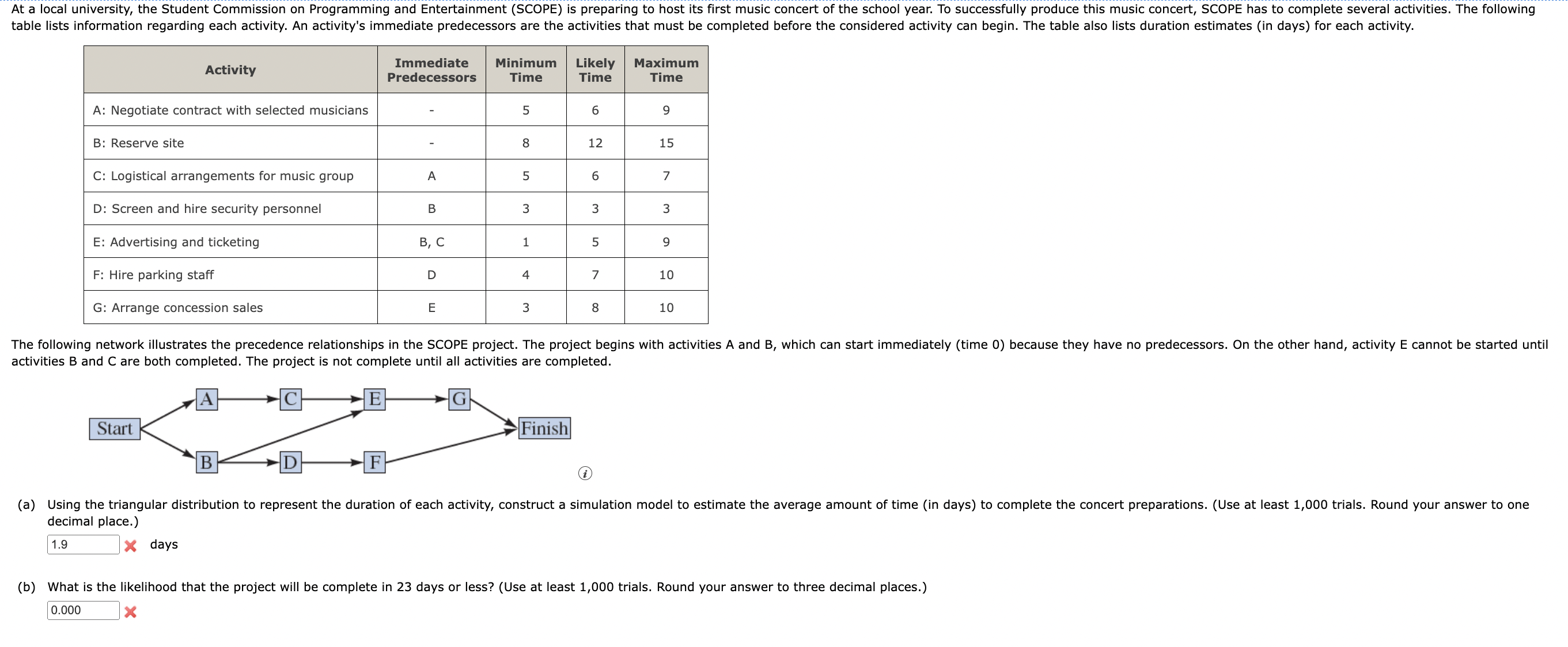
At a local university, the Student Commission on Programming and Entertainment SCOPE is preparing to host its first music concert of the school year. To successfully produce this music concert, SCOPE has to complete several activities. The following table lists information regarding each activity. An activity's immediate predecessors are the activities that must be completed before the considered activity can begin. The table also lists duration estimates in days for each activity.
ActivityImmediate
PredecessorsMinimum
TimeLikely
TimeMaximum
TimeA: Negotiate contract with selected musiciansB: Reserve siteC: Logistical arrangements for music groupAD: Screen and hire security personnelBE: Advertising and ticketingB, CF: Hire parking staffDG: Arrange concession salesE
The following network illustrates the precedence relationships in the SCOPE project. The project begins with activities A and B which can start immediately time because they have no predecessors. On the other hand, activity E cannot be started until activities B and C are both completed. The project is not complete until all activities are completed.
A network with nodes is shown. The node labeled "Start" points to nodes labeled A and B The node labeled A points to the node labeled CC points to the node labeled EE points to the node labeled G and G points to the node labeled "Finish." The node labeled B points to E and the node labeled DD points to the node labeled F and F points "Finish."
a
Using the triangular distribution to represent the duration of each activity, construct a simulation model to estimate the average amount of time in days to complete the concert preparations. Use at least trials. Round your answer to one decimal place.
days
b
What is the likelihood that the project will be complete in days or less? Use at least trials. Round your answer to three decimal places.begintabularlcccc
hline multicolumnc Activity & begintabularc
Immediate
Predecessors
endtabular & begintabularc
Minimum
Time
endtabular & begintabularc
Likely
Time
endtabular & begintabularc
Maximum
Time
endtabular
hline A: Negotiate contract with selected musicians & & & &
hline B: Reserve site & & & &
hline C: Logistical arrangements for music group & A & & &
hline D: Screen and hire security personnel & B & & &
hline E: Advertising and ticketing & B C & & &
hline F: Hire parking staff & D & & &
hline G: Arrange concession sales & E & & &
hline
endtabular
activities B and C are both completed. The project is not complete until all activities are completed. decimal place.
square
x text days
b What is the likelihood that the project will be complete in days or less? Use at least trials. Round your answer to three decimal places.
Step by Step Solution
There are 3 Steps involved in it
1 Expert Approved Answer
Step: 1 Unlock

Question Has Been Solved by an Expert!
Get step-by-step solutions from verified subject matter experts
Step: 2 Unlock
Step: 3 Unlock