







Question: Attempts Average / 3 5. From consumer equilibrium to the law of demand Frances has a $10 dessert budget that she uses to buy pie
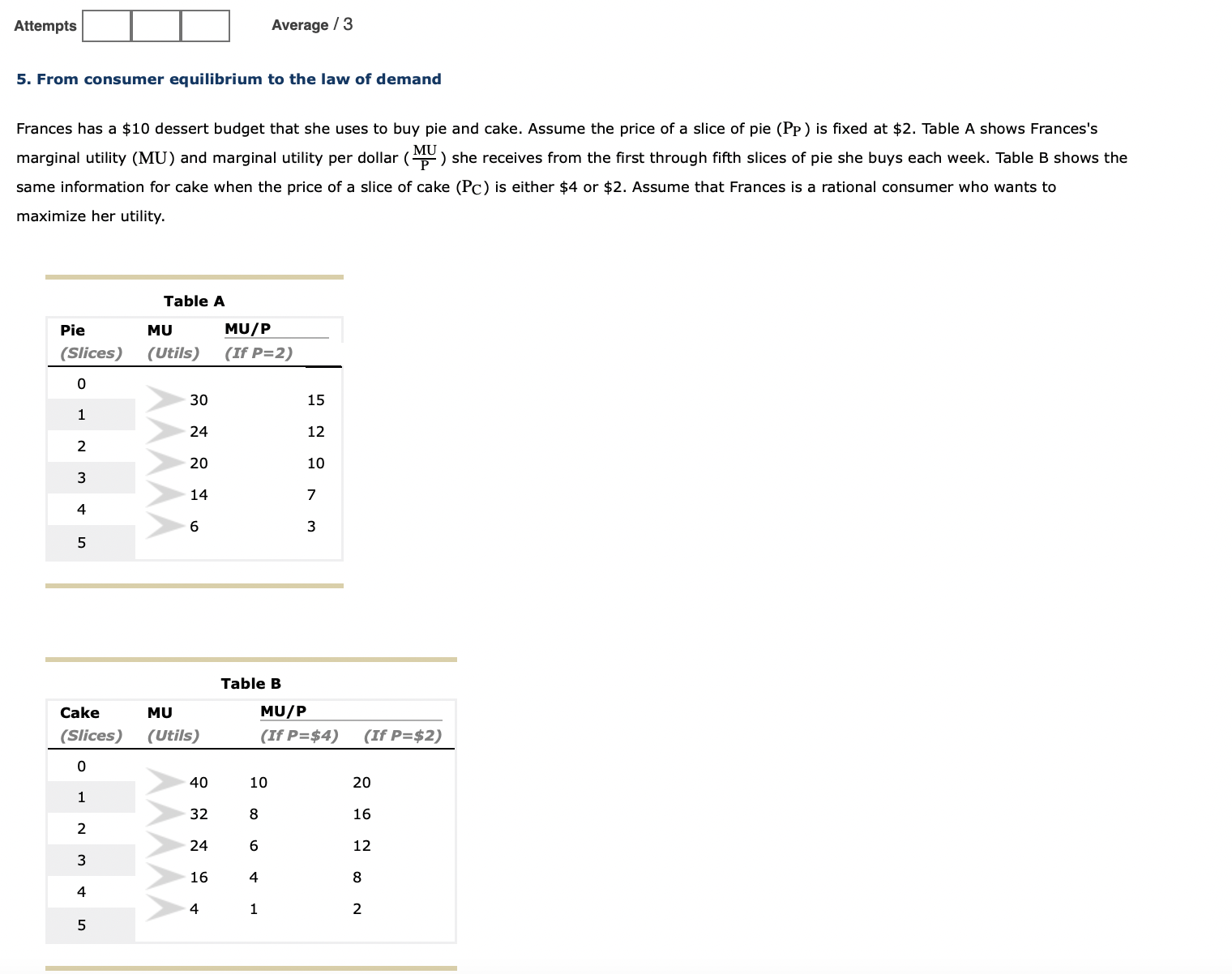
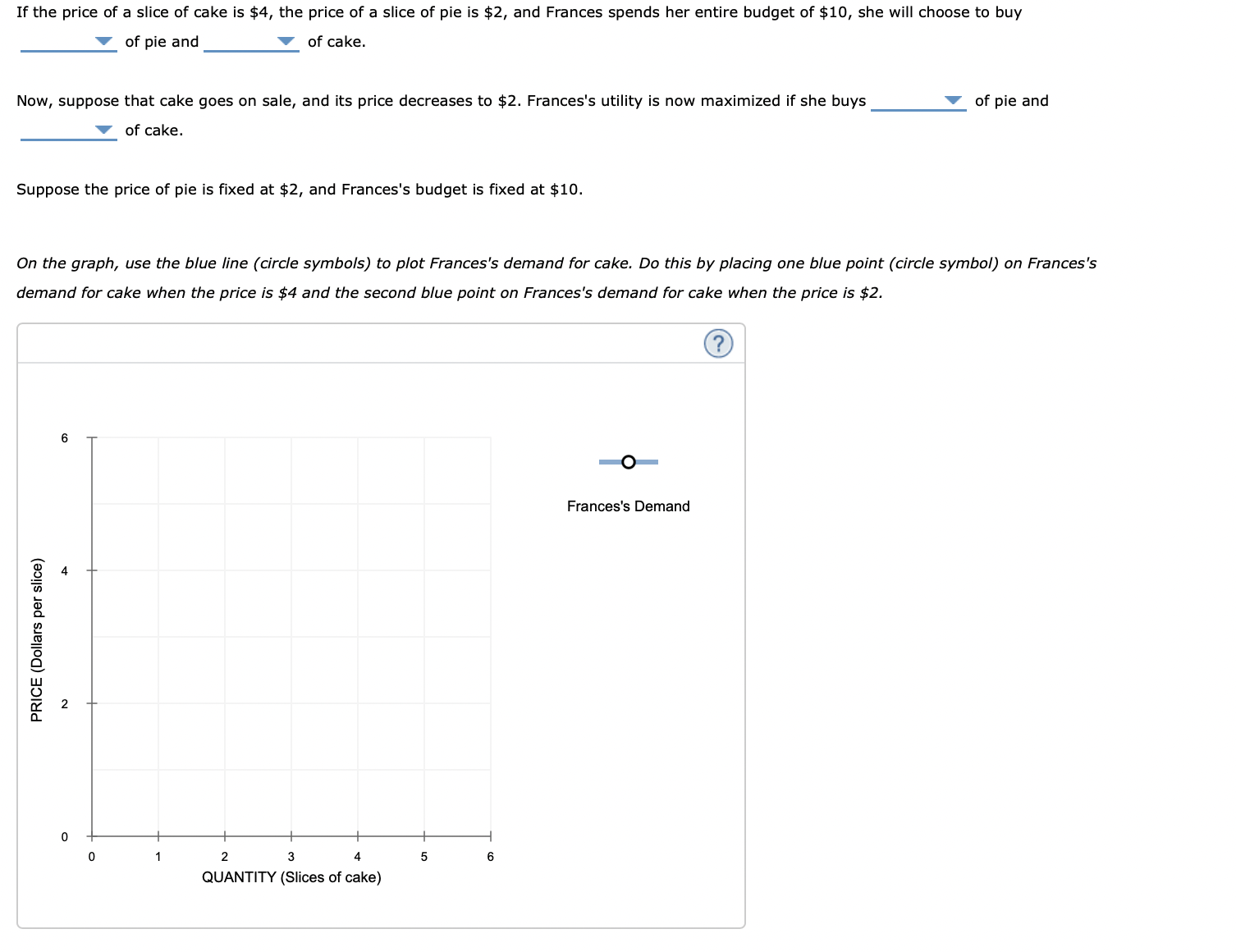
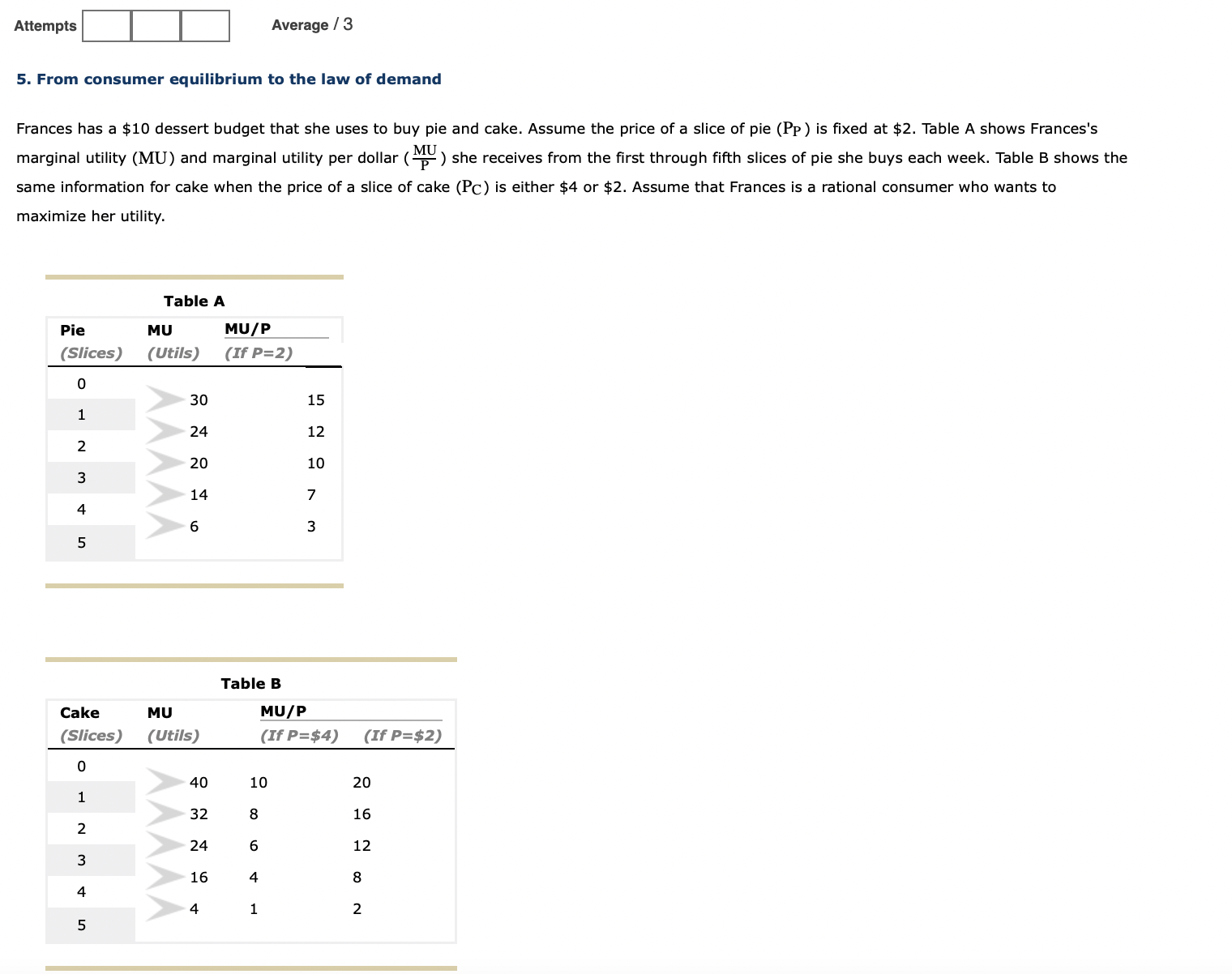
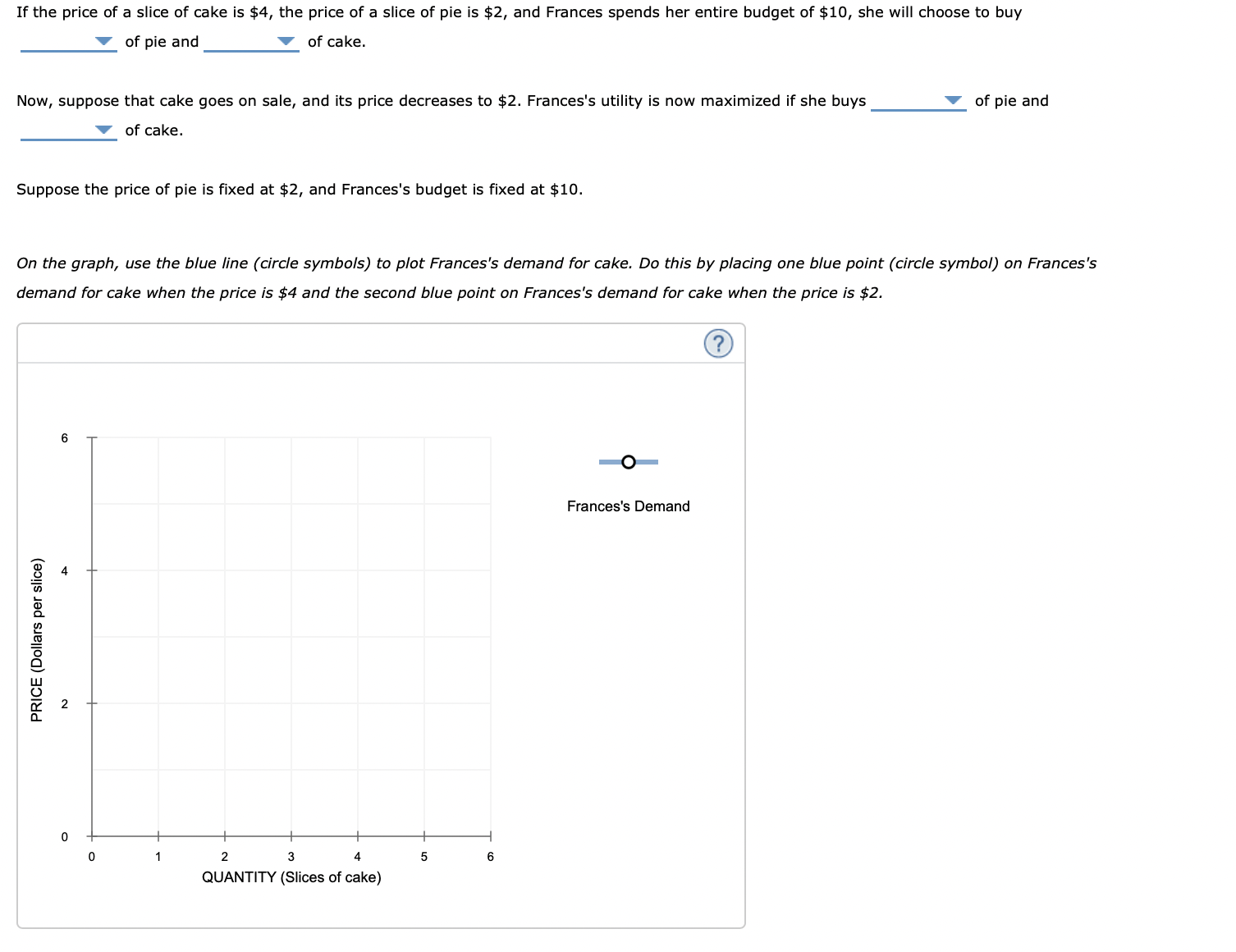
Attempts Average / 3 5. From consumer equilibrium to the law of demand Frances has a $10 dessert budget that she uses to buy pie and cake. Assume the price of a slice of pie (Pp ) is fixed at $2. Table A shows Frances's marginal utility (MU) and marginal utility per dollar (-p- ) she receives from the first through fifth slices of pie she buys each week. Table B shows the same information for cake when the price of a slice of cake (Pc) is either $4 or $2. Assume that Frances is a rational consumer who wants to maximize her utility. Table A Pie MU MU/P Slices (Utils) (If P=2) 30 15 1 24 12 2 20 10 3 14 7 4 6 3 5 Table B Cake MU MU/P (Slices) (Utils) (If P=$4) (If P=$2) 0 40 10 20 1 32 8 16 2 24 6 12 3 A 8 4 N 5If the price of a slice of cake is $4, the price of a slice of pie is $2, and Frances spends her entire budget of $10, she will choose to buy V of pie and V of cake. Now, suppose that cake goes on sale, and its price decreases to $2. Frances's utility is now maximized if she buys V of pie and V of cake. Suppose the price of pie is xed at $2, and Frances's budget is fixed at $10. On the graph, use the blue line (circle symbols) to plot Frances's demand for cake. Do this by placing one blue point (circle symbol) on Frances's demand for cake when the price is $4 and the second blue point on Frances's demand for cake when the price is $2. 6) 6 o Fre noes's Demand 3 4 E a D. E E E 9. Lu 2 II 2 o. 0 1 2 3 4 5 6 QUANTITY (Slices of cake)
Step by Step Solution
There are 3 Steps involved in it

Get step-by-step solutions from verified subject matter experts
 Study Help