







Question: Attempts Average/7 1. Apply What You've Learned - Managing Your Employer's RetirementPlan Scenario: You are 29-years-old and working in the marketing department of a medium-sized
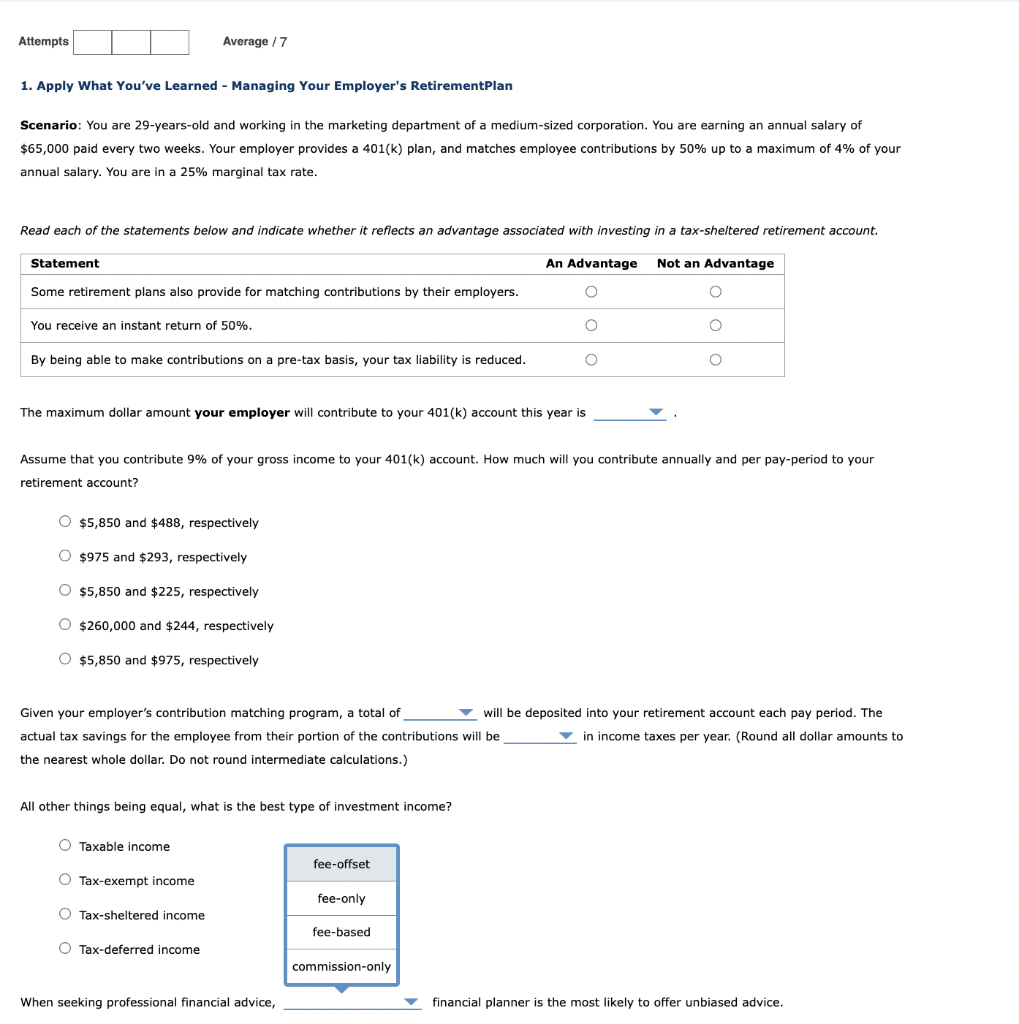
Attempts Average/7 1. Apply What You've Learned - Managing Your Employer's RetirementPlan Scenario: You are 29-years-old and working in the marketing department of a medium-sized corporation. You are earning an annual salary of $65,000 paid every two weeks. Your employer provides a 401(k) plan, and matches employee contributions by 50% up to a maximum of 4% of your annual salary. You are in a 25% marginal tax rate. Read each of the statements below and indicate whether it reflects an advantage associated with investing in a tax-sheltered retirement account. Statement An Advantage Not an Advantage Some retirement plans also provide for matching contributions by their employers. O You receive an instant return of 50%. O 0 By being able to make contributions on a pre-tax basis, your tax liability is reduced. O The maximum dollar amount your employer will contribute to your 401(k) account this year is Assume that you contribute 9% of your gross income to your 401(k) account. How much will you contribute annually and per pay-period to your retirement account? O $5,850 and $488, respectively $975 and $293, respectively O $5,850 and $225, respectively O $260,000 and $244, respectively $5,850 and $975, respectively Given your employer's contribution matching program, a total of will be deposited into your retirement account each pay period. The actual tax savings for the employee from their portion of the contributions will be in income taxes per year. (Round all dollar amounts to the nearest whole dollar. Do not round intermediate calculations.) All other things being equal, what is the best type of investment income? Taxable income fee-offset O Tax-exempt income fee-only O Tax-sheltered income fee-based O Tax-deferred income commission-only When seeking professional financial advice, financial planner is the most likely to offer unbiased advice. Attempts Average/7 1. Apply What You've Learned - Managing Your Employer's RetirementPlan Scenario: You are 29-years-old and working in the marketing department of a medium-sized corporation. You are earning an annual salary of $65,000 paid every two weeks. Your employer provides a 401(k) plan, and matches employee contributions by 50% up to a maximum of 4% of your annual salary. You are in a 25% marginal tax rate. Read each of the statements below and indicate whether it reflects an advantage associated with investing in a tax-sheltered retirement account. Statement An Advantage Not an Advantage Some retirement plans also provide for matching contributions by their employers. O You receive an instant return of 50%. O 0 By being able to make contributions on a pre-tax basis, your tax liability is reduced. O The maximum dollar amount your employer will contribute to your 401(k) account this year is Assume that you contribute 9% of your gross income to your 401(k) account. How much will you contribute annually and per pay-period to your retirement account? O $5,850 and $488, respectively $975 and $293, respectively O $5,850 and $225, respectively O $260,000 and $244, respectively $5,850 and $975, respectively Given your employer's contribution matching program, a total of will be deposited into your retirement account each pay period. The actual tax savings for the employee from their portion of the contributions will be in income taxes per year. (Round all dollar amounts to the nearest whole dollar. Do not round intermediate calculations.) All other things being equal, what is the best type of investment income? Taxable income fee-offset O Tax-exempt income fee-only O Tax-sheltered income fee-based O Tax-deferred income commission-only When seeking professional financial advice, financial planner is the most likely to offer unbiased advice
Step by Step Solution
There are 3 Steps involved in it

Get step-by-step solutions from verified subject matter experts
 Study Help