







Question: b) (20 points) Now we can use the simpler u, v, w, and z terms to make our calculations easier to understand. First we write
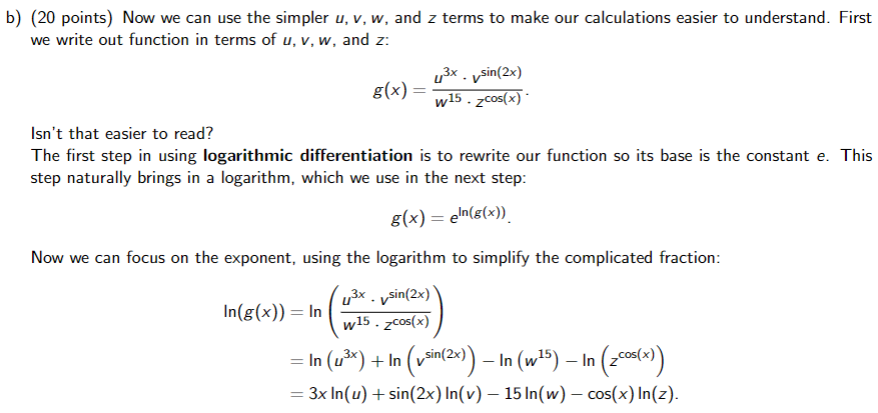
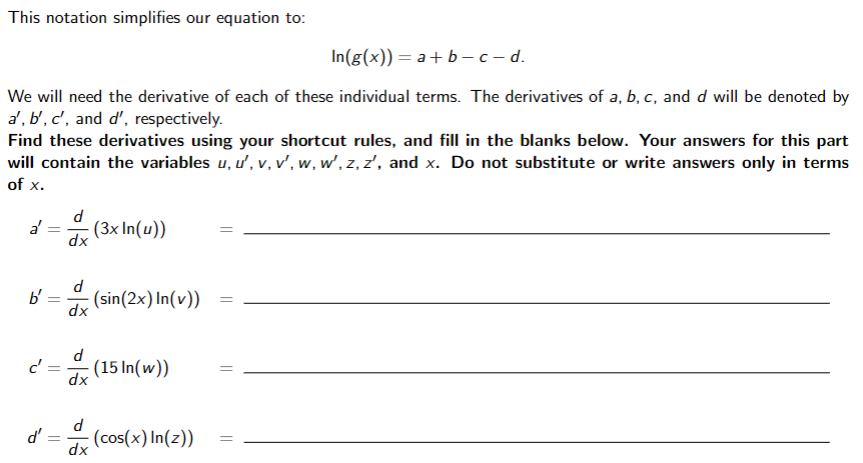
b) (20 points) Now we can use the simpler u, v, w, and z terms to make our calculations easier to understand. First we write out function in terms of u, v, w, and z: 13x . sin(2x) g (x ) = w15 . zcos(x) " Isn't that easier to read? The first step in using logarithmic differentiation is to rewrite our function so its base is the constant e. This step naturally brings in a logarithm, which we use in the next step: g(x) = eln(8(x)). Now we can focus on the exponent, using the logarithm to simplify the complicated fraction: 3x . sin(2x) In(g(x)) = In w15 . >cos(x) = In (13x) + In sin(2x) - In (w15) - In(zcos(x)) = 3x In(u) + sin(2x) In(v) - 15 In(w) - cos(x) In(z).This notation simplifies our equation to: In(g(x)) =a+bcd. We will need the derivative of each of these individual terms. The derivatives of a, b, , and d will be denoted by a', b, c, and d', respectively. Find these derivatives using your shortcut rules, and fill in the blanks below. Your answers for this part will contain the variables u, o', v, v/, w, w', z, z', and x. Do not substitute or write answers only in terms of x. y d a= 5{3): In(u)) ,od b' = (sin(2x)In(v)) = y . d o= a{lSin{w]) F d S (cos(x)In(z))
Step by Step Solution
There are 3 Steps involved in it

Get step-by-step solutions from verified subject matter experts
 Study Help