







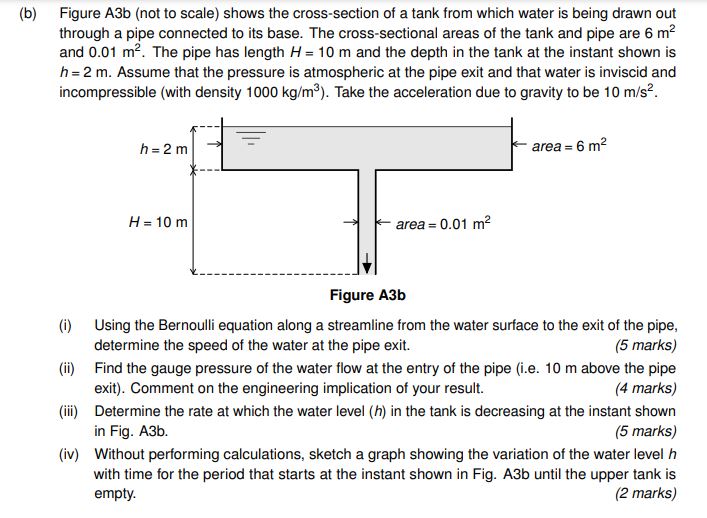
Question: ( b ) Figure A 3 b ( not to scale ) shows the cross - section of a tank from which water is being
b Figure Ab not to scale shows the crosssection of a tank from which water is being drawn out through a pipe connected to its base. The crosssectional areas of the tank and pipe are mathrm~m and mathrm~m The pipe has length Hmathrm~m and the depth in the tank at the instant shown is hmathrm~m Assume that the pressure is atmospheric at the pipe exit and that water is inviscid and incompressible with density mathrm~kgmathrmm Take the acceleration due to gravity to be mathrm~mmathrms
Figure Ab
i Using the Bernoulli equation along a streamline from the water surface to the exit of the pipe, determine the speed of the water at the pipe exit.
marks
ii Find the gauge pressure of the water flow at the entry of the pipe ie m above the pipe exit Comment on the engineering implication of your result.
marks
iii Determine the rate at which the water level h in the tank is decreasing at the instant shown in Fig. Ab
marks
iv Without performing calculations, sketch a graph showing the variation of the water level h with time for the period that starts at the instant shown in Fig. Ab until the upper tank is empty.
marks
Step by Step Solution
There are 3 Steps involved in it
1 Expert Approved Answer
Step: 1 Unlock

Question Has Been Solved by an Expert!
Get step-by-step solutions from verified subject matter experts
Step: 2 Unlock
Step: 3 Unlock
 Study Help