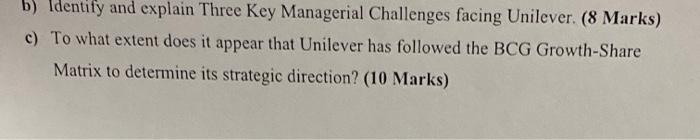
Question: b) Identify and explain Three Key Managerial Challenges facing Unilever. (8 Marks) c) To what extent does it appear that Unilever has followed the BCG
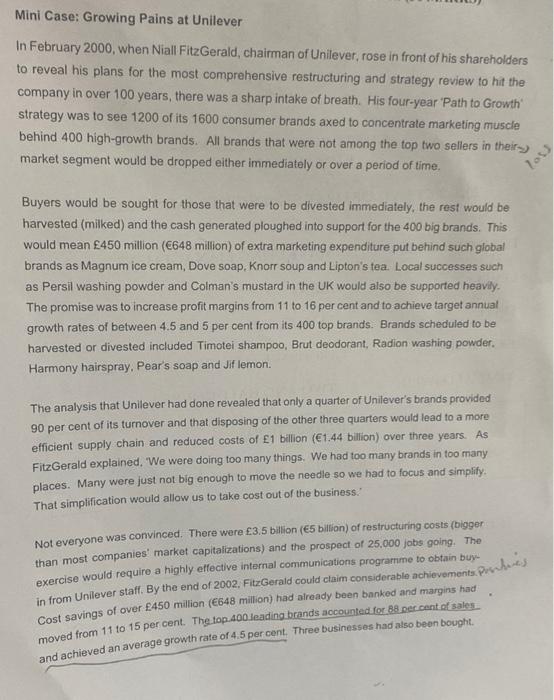
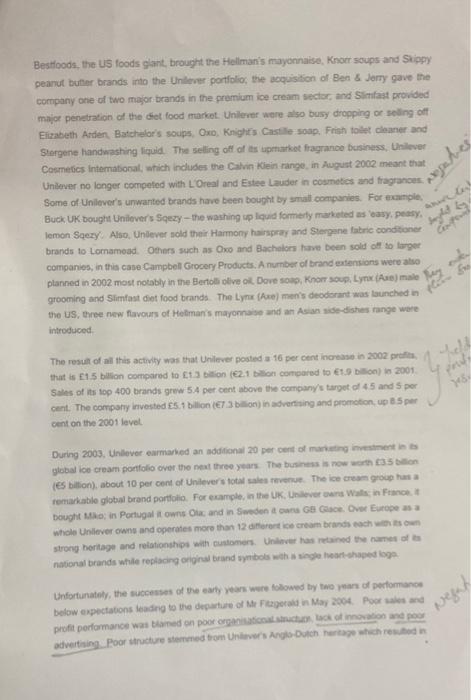
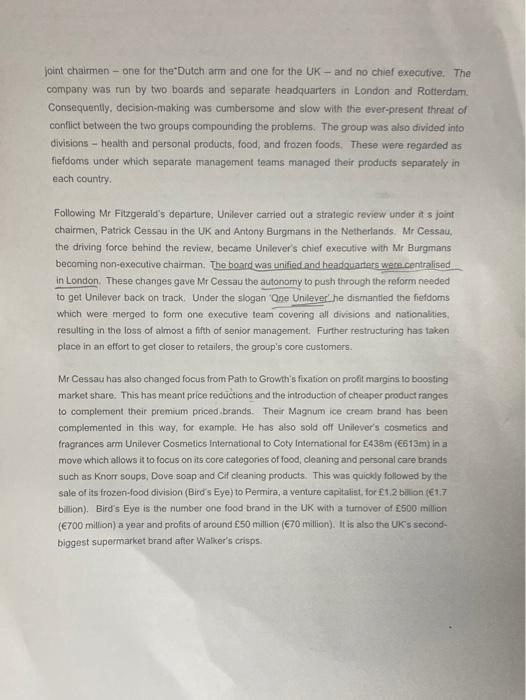
b) Identify and explain Three Key Managerial Challenges facing Unilever. (8 Marks) c) To what extent does it appear that Unilever has followed the BCG Growth-Share Matrix to determine its strategic direction? (10 Marks) Mini Case: Growing Pains at Unilever In February 2000, when Niall FitzGerald, chairman of Unilever, rose in front of his shareholders to reveal his plans for the most comprehensive restructuring and strategy review to hit the company in over 100 years, there was a sharp intake of breath. His four-year 'Path to Growth strategy was to see 1200 of its 1600 consumer brands axed to concentrate marketing muscle behind 400 high-growth brands. All brands that were not among the top two sellers in their market segment would be dropped either immediately or over a period of time. lo Buyers would be sought for those that were to be divested immediately, the rest would be harvested (milked) and the cash generated ploughed into support for the 400 big brands. This would mean 450 million (648 million) of extra marketing expenditure put behind such global brands as Magnum ice cream, Dove soap, Knorr soup and Lipton's tea. Local successes such as Persil washing powder and Colman's mustard in the UK would also be supported heavily The promise was to increase profit margins from 11 to 16 per cent and to achieve target annual growth rates of between 4.5 and 5 per cent from its 400 top brands. Brands scheduled to be harvested or divested included Timotei shampoo, Brut deodorant, Radion washing powder. Harmony hairspray, Pear's soap and Jif lemon. The analysis that Unilever had done revealed that only a quarter of Unilever's brands provided 90 per cent of its turnover and that disposing of the other three quarters would lead to a more efficient supply chain and reduced costs of 1 billion (1.44 billion) over three years. As FitzGerald explained. 'We were doing too many things. We had too many brands in too many places. Many were just not big enough to move the needle so we had to focus and simplify. That simplification would allow us to take cost out of the business. Not everyone was convinced. There were 3.5 billion (E5 billion) of restructuring costs (bigger than most companies' market capitalizations) and the prospect of 25.000 jobs going. The exercise would require a highly effective internal communications programme to obtain buyu in from Unilever staff. By the end of 2002. FitzGerald could claim considerable achievements Cost savings of over 450 million (648 million) had already been banked and margins had moved from 11 to 15 per cent. The top.400.leading brands accounted for 88 percent of sales and achieved an average growth rate of 4.5 per cent. Three businesses had also been bought. Bestloods, the US foods giant brought the Hellman's mayonnaise, Knorr soups and Suppy peanut butter brands into the Unilever portfolio, the acquisition of Ben & Jerry gave the company one of two major brands in the premium ice cream sector and Simt provided major penetration of the diet food market. Unilever were also busy dropping or soling off Elizabeth Arden Batchelor's soups, Oxo Knight's Castle soap. Frish toilet cleaner and Stergene handwashing liquid The selling off of its upmarket fragrance business, Unilever Cosmetics International, which includes the Calvin Klein range, in August 2002 meant that Unilever no longer competed with L'Oreal and Estee Lauder in cosmetics and fragrances Some of Unilever's unwanted brands have been bought by small companies. For example, Buck UK bought Unilever's Spezy--the washing up liquid formerly marketed as easy peasy. lemon Soery Also, Unilever sold their Harmony hairspray and Stergane fabric conditioner brands to Lomamood Others such as Oxo and Bachelors have been sold off to larger companies in this case Campbell Grocery Products. A number of brand extensions were also planned in 2002 most notably in the Bertoli olive oil Dove son, Knort soup, Lynx (Aramal grooming and Simfost diet food brands. The Lynx (x) men's deodorant was launched in the US, three new flavours of Hetman's mayonnaise and an Asian side dishes range were introduced The result of all this activity was that Unilever posted a 16 per cent increase in 2002 pris that is 15 billion compared to t3 bilion (62.1 on compared to 1.9 Dis 2001 Se of its top 400 brands grow 5.4 percent inbove the company's target of 45 and 5 per cent. The company invested 5.1 billion (ET 3 bin advertising and promotion, up 85 per Gent on the 2001 level During 2003, Unilever earmarked an additional 20 per cent of management in globalice cream portfolio over the next three years. The business is now worth 35 les billion), about 10 per cent of Unilever's total sales revenue The ice cream group has a remarkable global brand portfolio For example, in the UK, Us Wallin front bought in Portugal towns and in Sweden uns Ge Over Europea whole Unilever owns and operates more than 12 citronice cream brands each strong heritage and relationships with customers Unlever has and the name of national brands while replacing original brand symbols with a single shaped logo Nega Unfortunately, the successes of the early years were followed by two years of performance below expectations leading to the departure of Mr Fitzgerald in May 2004. Poor sales and profit performance was blamed on poor organisation such action and poor advertising Poor structure stemmed from Univer's Anglo-Dutch ertage which joint chairmen - one for the Dutch arm and one for the UK -- and no chief executive. The company was run by two boards and separate headquarters in London and Rotterdam. Consequently, decision-making was cumbersome and slow with the ever-present threat of conflict between the two groups compounding the problems. The group was also divided into divisions - health and personal products, food, and frozen foods. These were regarded as fiefdoms under which separate management teams managed their products separately in each country Following Mr Fitzgerald's departure, Unilever carried out a strategic review under its joint chairmen, Patrick Cessau the UK and Antony Burgmans in the Netherlands. Mr Cessau, the driving force behind the review, became Unilever's chief executive with Mr Burgmans becoming non-executive chairman. The board was unified and headquarters were centralised in London. These changes gave Mr Cassau the autonomy to push through the reform needed to get Unilever back on track. Under the slogan "One Unilever he dismantled the fiefdoms which were merged to form one executive team covering all divisions and nationalities. resulting in the loss of almost a fifth of senior management. Further restructuring has taken place in an effort to get closer to retailers, the group's core customers. Mr Cessau has also changed focus from Path to Growth's fixation on profit margins to boosting market share. This has meant price reductions and the introduction of cheaper product ranges to complement their premium priced.brands. Their Magnum ice cream brand has been complemented in this way, for example. He has also sold off Unilever's cosmetics and fragrances arm Unilever Cosmetics International to Coty International for 438m (613m) in a move which allows it to focus on its core categories of food cleaning and personal care brands such as Knorr soups, Dove soap and Cif cleaning products. This was quickly followed by the sale of its frozen-food division (Bird's Eye) to Permira, a venture capitalist, for 1.2 billion (1.7 billion). Bird's Eye is the number one food brand in the UK with a turnover of 500 million (E700 million) a year and profits of around 50 million (70 million). It is also the UK's second- biggest supermarket brand after Walker's crisps









 Study Help