







Question: B) memory array D) macrocells 18) RAM memory cells are organized as A) connection blocks data sectors D) column 19) C) density D) capacity 20)
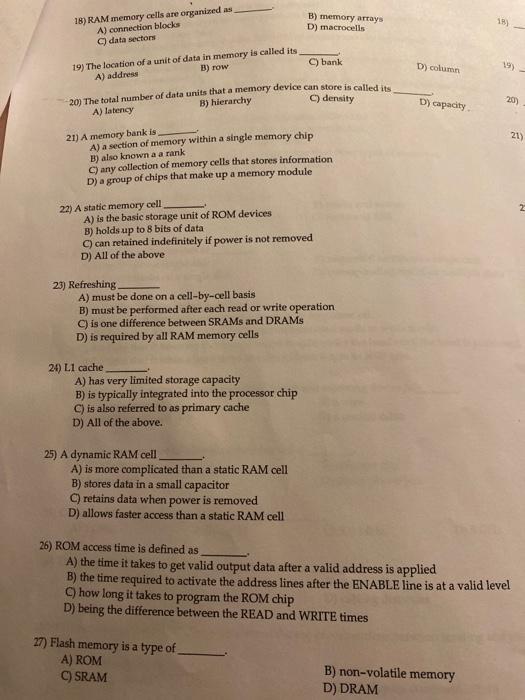
B) memory array D) macrocells 18) RAM memory cells are organized as A) connection blocks data sectors D) column 19) C) density D) capacity 20) 19) The location of a unit of data in memory is called its A) address B) row C) bank 20) The total number of data units that a memory device can store is called its A) latency B) hierarchy 21) A memory bank is A) a section of memory within a single memory chip B) also known a a rank C) any collection of memory cells that stores information D) a group of chips that make up a memory module 21) 2 22) A static memory cell A) is the basic storage unit of ROM devices B) holds up to 8 bits of data can retained indefinitely if power is not removed D) All of the above 23) Refreshing A) must be done on a cell-by-cell basis B) must be performed after each read or write operation C) is one difference between SRAMs and DRAMS D) is required by all RAM memory cells 24) L1 cache A) has very limited storage capacity B) is typically integrated into the processor chip C) is also referred to as primary cache D) All of the above. 25) A dynamic RAM cell A) is more complicated than a static RAM cell B) stores data in a small capacitor retains data when power is removed D) allows faster access than a static RAM cell 26) ROM access time is defined as A) the time it takes to get valid output data after a valid address is applied B) the time required to activate the address lines after the ENABLE line is at a valid level C) how long it takes to program the ROM chip D) being the difference between the READ and WRITE times 27) Flash memory is a type of A) ROM C) SRAM B) non-volatile memory D) DRAM
Step by Step Solution
There are 3 Steps involved in it

Get step-by-step solutions from verified subject matter experts
 Study Help