







Question: B. Starting with F(x) = ], 312(cos(13) + 2)dt, use the substitution u(t) = 13 to rewrite the definite integral. You should get a new
![B. Starting with F(x) = ], 312(cos(13) + 2)dt, use the](https://s3.amazonaws.com/si.experts.images/answers/2024/06/667f8ced2b734_181667f8ced27319.jpg)
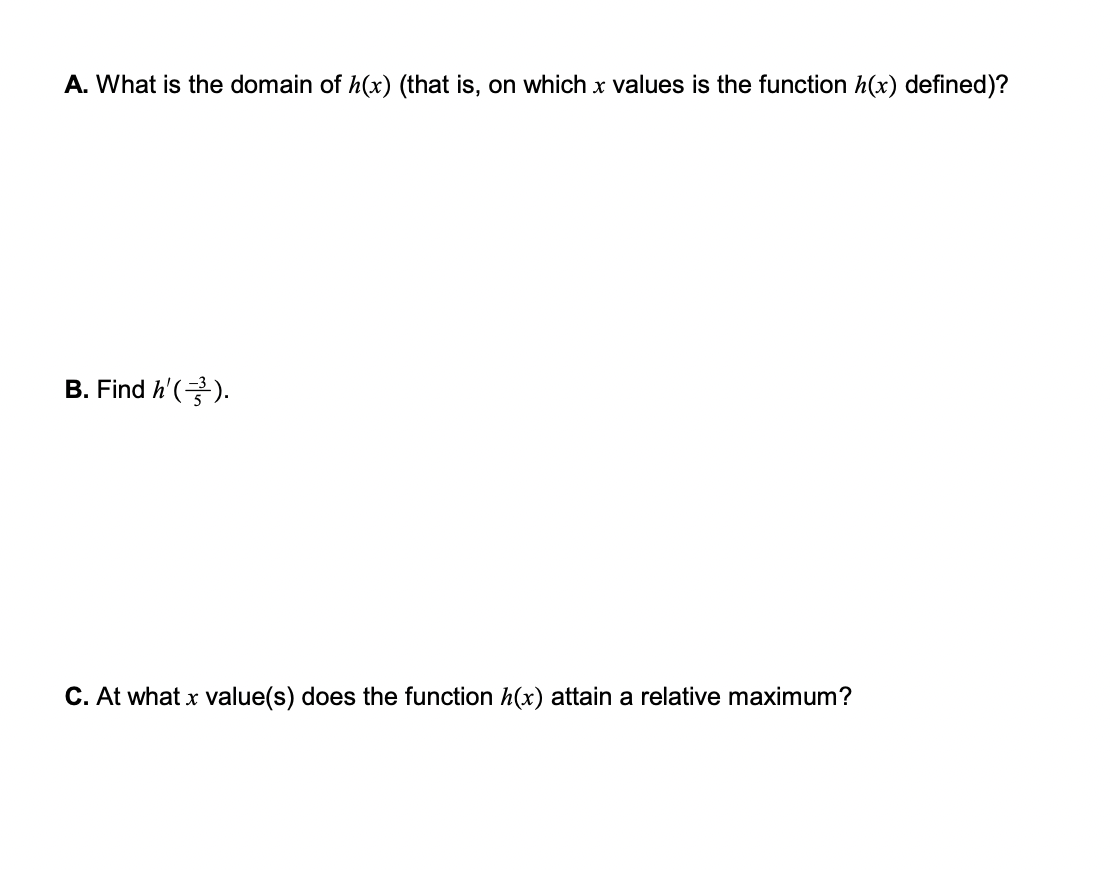
B. Starting with F(x) = ], 312(cos(13) + 2)dt, use the substitution u(t) = 13 to rewrite the definite integral. You should get a new (equivalent) expression for F(x), which consists of this new definite integral. C. Using your new expression for F(x) from part B and Leibniz's Rule, find F' (x). 4. The function f(t) has domain [-2,3] on which it is continuous. A graph of y = f(t) is given below: -2 y = f(t) Define a new function h(x) by h(x) = ]_,f(t)dt.A. What is the domain of h(x) (that is, on which x values is the function h(x) defined)? B. Find h'(). C. At what x value(s) does the function h(x) attain a relative maximum
Step by Step Solution
There are 3 Steps involved in it

Get step-by-step solutions from verified subject matter experts
 Study Help